Doug Wilson, localized into American English

So my day job consists of managing a magazine about translation and cultural differences, including editing a host of articles written by people whose first language is not English. In these instances, it is very helpful to know how language works — the way French deals with certain idiomatic expressions that would not make sense translated literally, for example.

Over my years of editing, I also got pretty good at reading between the lines of a certain kind of person who was allergic to being wrong or to admitting to wrongdoing in writing — namely, lawyers. I edited my ex-husband’s legal briefs and memos, and I also dealt with the way he argued with me. His claim was, typically, that nothing existed unless it was written down. Because of this, he would insinuate things in writing but not state them explicitly — because that would get him in trouble.

My ex-husband received his education in debate from Doug Wilson, personally. And I’m strongly reminded of his style of discourse when I look over the things Doug has been writing. Although, credit where credit is due — my ex-husband, unlike Doug, would occasionally break down and admit he was wrong about something.

Doug’s letters to Natalie’s dad and to an investigating officer in the case of Natalie’s sexual abuse by Jamin Wight do just that: insinuate the opposite of what they’re explicitly stating. For example, in his letter to the investigating officer, he notes that Jamin has committed a crime, but he also claims that Jamin “is not a sexual predator” and, moreover, the only wrongdoing Doug mentions explicitly (aside from Jamin not living up to his duties as seminary student) is what Doug claims the parents did. In his letter to Natalie’s dad, he frames “protection” as the “protection” of not taking the case to trial — without ever explicitly saying so. And if you ask any number of the people who have interacted with Doug over matters of church concern, and subsequently left, the letters Doug wrote them were similar: unspecific, vaguely threatening and full of double-speak. There is a cloud of witnesses on this issue, and Doug’s still insisting they’ve all got it wrong, that they’re persecuting him with a pack of lies.

The thing is, I bet even his staunchest supporters would agree with me if they could shift their assumptions even a little bit. I encourage you who are, go back and re-read Doug’s communications imagining that Doug is someone else, from somewhere else other than your own culture — a Catholic priest or a Muslim cleric, for example.

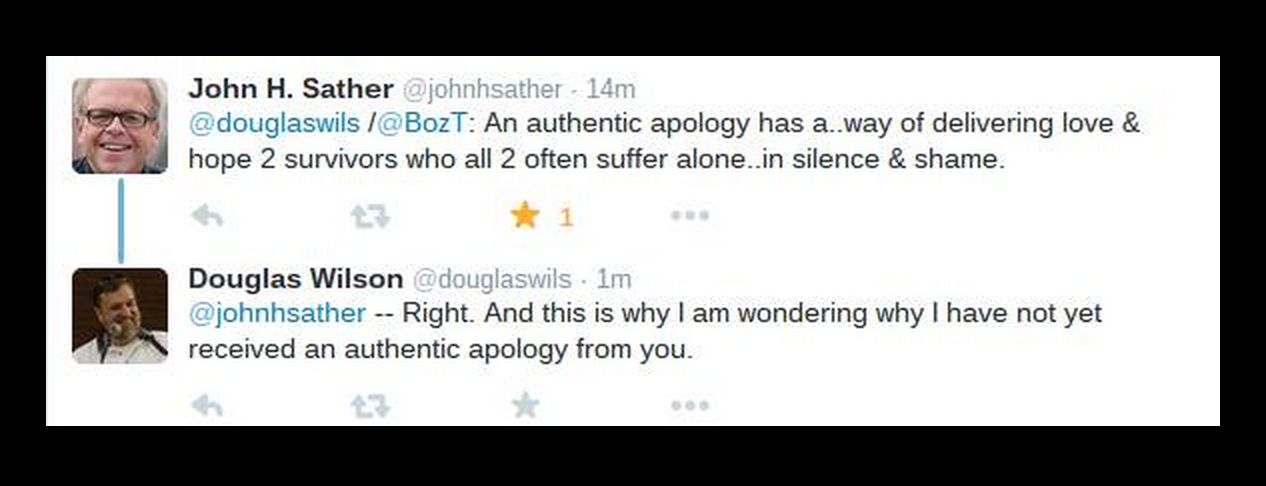
However, Doug has been getting sloppy lately with his discourse and is actually going on record with things that are easily provable as false. What Doug has asserted in writing recently: that “it [the Jamin Wight/Natalie case] was a foolish parent-approved relationship, which led to statutory rape, as was shown in court.” Doug Wilson tweet

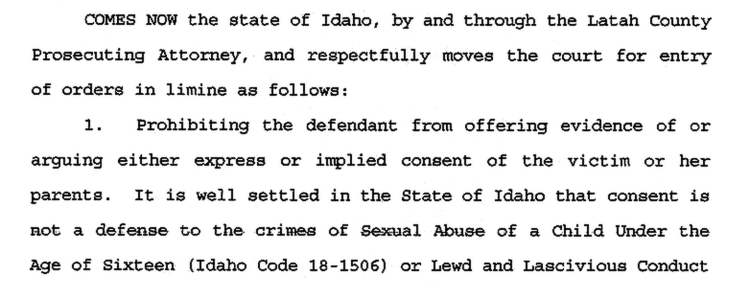
This is actually a lie, and here’s the proof, in writing. The court case did not show this; in fact, the court records stated that it was legally impossible to argue “consent” (by the victims or her parents) in this case given the age of the victim, and the “consent” of the parents never came into the court case either way — other than in what Doug himself wrote, and this notation by the court. So I find it ironic that Doug started this particular twitter conversation with a quote about truth. Here’s a link to the actual court documents, and if you are more up on courtspeak than Wilson appears to be, you’ll notice that the case ends in a plea deal where Wight pleads guilty — the case never even went to trial, so “the court,” by definition, never “showed” anything. Which Doug should know, since he sat in an adjacent room during the moderation.Screen Shot 2015-09-22 at 6.43.38 PM
Moreover, just because parents approve a courtship, that doesn’t mean courtship “leads” to statutory rape. Or is Doug actually arguing that it does? Is Doug actually arguing that two parents allowing one of his seminary students to be interested in someone — hold her hand, smile at her — “leads” to the kinds of grotesque things that Natalie describes on her blog, the kinds of things so vile that I don’t even want to think about them? If so, Doug should burn all the stuff on courtship he’s ever written. Because he can’t have it both ways. He can’t encourage parents to board his seminary students and college students, and encourage early marriage in his congregation, and encourage chaste getting to know one another under the eye of the parents, and then claim the parents were negligent because they followed his advice.

And for all of Doug’s recent private assertions to Natalie that she was so tall and mature and pretty at age 14 (you know, the really important things when looking at a sex abuse case), Natalie herself has said that her sex education consisted of her reading the dictionary at age 13. The rest of it, she said, she found out six months later when Jamin started abusing her. And this lack of sex education for females is entirely consistent with what the CREC teaches.

I’m not sure what tenuous “proof” Doug is holding on to in order to claim that there was a “secret courtship.” I don’t think he actually has any, other than his own faulty memory of something Natalie’s parents told him ten years ago, and which Jamin Wight spun to his own advantage. But I do know that when I shared his letter to the officer with Natalie (who had never seen it before), she was genuinely confused and horrified, as no such courtship had existed. Her reaction was not the reaction of someone who’d been holding back knowledge of some “secret courtship,” and as she pointed out, she would be the one to know, not Doug Wilson. Her family would be the ones to know, not Doug Wilson. You know, the family that nearly all left Christ Church after Natalie was treated so badly by the church in the wake of her abuse.

Doug has been using the “proof” he claimed he had as a threat to shut Natalie up, and actually wrote her a letter in which he the first thing he asks is “Did your mom hurt you or wrong you in some way that makes you want to get back at her like this? Is there something we don’t know? Are you aware that my central reason for not talking publicly about all this has been to protect your mom from accusations of parental negligence?” Translation: if you don’t stop talking about this, I’m going to have to try to vilify your mother publicly, even though, legally speaking, she had nothing to do with the case. So stop talking!

It’s important to note that, up until this point in time, Doug has been fighting tooth and nail to explain away why he felt the need to severely minimize Jamin’s crimes. And it’s relevant that Jamin, like Natalie has been telling anyone who would listen for the past ten years, was a violent, manipulative person, who, according to public court records, went on to throttle his now-ex-wife while she was holding their child.

But to Doug, everything Natalie is saying about Jamin is still untrue, because Natalie was tall at age 14, and because Doug has convinced himself that Natalie’s parents let Jamin show her affection. Doug wrote to Natalie a few days ago and told her, “what [Jamin] had done was very different from subsequent reconstructions that [you have] been periodically posting.” No hint of what, exactly, Natalie was supposedly lying about, except the “consent” thing — and Doug has claimed to Natalie repeatedly, that at least in a certain sense, she had consented to the “relationship” with Jamin.

Another thing Doug shared with Natalie a few days ago: “Though Jamin has been in possession of this entire set of facts through various Internet dust-ups (demonstrable facts which enabled him to show that his crimes did not include pedophilia), he has shown more respect for the feelings of others than have all the so-called ‘victim advocates’ in all our comment threads put together.” Translation: Jamin might have been a rapist and a wife-abuser, but at least he kept his mouth shut when I told him to, and that’s what really matters.

Now, Doug has recently indicated privately to Natalie that he was sorry about one thing — not finding a way around Natalie’s Dad to meet with her during the aftermath of her abuse (translation: it’s your Dad’s fault that you didn’t get the care from the church that you needed). But, in fact, he did meet with her then against her father’s wishes, and it was not an experience that resulted in anything but her feeling shamed and blamed for the abuse. Additionally, she was prodded for information about her father, as were other members of her family. Someone else recorded the conversation he had with Doug about this very thing:

Me: . . . did you meet with this girl alone in a room?

Wilson: Yes, for 15 minutes.

Me: So [Natalie’s father] gave you permission to meet with his little girl?

Wilson: Well, ah, no.

Me: Oh, I see.

Wilson: He did give me permission to counsel his family.

Me: Did he give you permission to interrogate his little girl?

Wilson: I did not interrogate; I met with her only to offer her encouragement during this hard time.

Me: Did you ask her if her father had made reference to Christ Church [Wilson’s congregation] as a “cult”?

Wilson: Yes, I did.

So there you have it — in Wilson’s accounts he gives of his actions versus what history actually shows, you have more posing, more wrangling, and no actual acknowledgement of cause and effect.

So what would the “internet mob,” as Doug is so charitably calling the people who want to see reform in the way the CREC handles abuse, like Doug to do in this instance?

First: we’d like to see him publicly retract his false statements that e.g. “it [the Jamin Wight/Natalie case] was a foolish parent-approved relationship, which led to statutory rape, as was shown in court.” And we mean actually retract — not pretend like those words mean something other than what they so clearly mean. Or that we all just misunderstand him.

Second, we’d like to see him demand that abusers pay restitution to their victims — all their victims, not just the ones they plea-bargain out for — in the form of, at the bare minimum, an acknowledgement that they abused the victims and that this will have lasting psychological consequences that will probably need professional psychological help. The more public the abuse, the more publicly it got hastened away into the shadows, the more public the restitution should be. In this case, Wilson himself is one of the abusers, since he used his power to silence the victim and insinuate, both privately and publicly, that she was lying, that her parents were to blame for her abuse, and that publicly calling for change within his denomination was an act of treason or war. Because Wilson said all this publicly, he should make his restitution public. He should make his retractions public.

But I would probably have a heart attack if Doug Wilson did either of these things. What we will likely see, instead, is what we’ve seen all along: more of the carefully-worded “my bad behavior was someone else’s fault,” more revising of clear historical statements in the vein of “see, when I said that Jamin was not a sexual predator, I actually meant that he was sexual predator — and it’s your fault if you couldn’t tell what I really meant,” or “I sneezed in Natalie’s direction once, and she didn’t take this as a sincere apology, so what are you going to do?”

50 Shades More Redundant

Doug Wilson’s recent post reminds me of something he wrote back in 2013. So much so, that I pulled up a draft of what I was writing in response back then, and it basically matched word for word. I figure that if Doug can recycle his arguments ad nauseum, at least it gives me a chance to make good on stuff I didn’t publish two years ago.

His current post is about how non-Christian women really are mostly on the spectrum of whores and dykes, so it’s totally legit to “generalize” them as such because — wait for it — 50 Shades of Grey sold a lot of copies. The assumption here (quick lesson, in case Doug’s fans aren’t up on logic, but assumptions aren’t real proof) is that a. all these copies were sold to non-Christians; b. all the readers were women; and c. all the readers approved of the book. And when I say “all” I mean “all” in the way that Wilson appears to use it, which is “generally speaking, because I’m not going to bother being clear about this, since it’s more fun pretending I was clear in the first place and then mocking everyone who called me out on my BS.”

The post a few years ago similarly challenged us to consider the sexual double standard set forth by liberals, and was similarly used to sidestep the issue of his tendency to blame the victim in abuse scenarios. It appears from reading this post that Wilson sincerely believes feminists are staunch fans of 50 Shades of Grey and Lil’ Wayne, which is apparently hypocritical of them because they don’t like it when men tell women what to do.

So I’m wondering, based on these and many other posts like it: Does Wilson know any real feminists or real non-Christians, or is he still arguing based on some two-dimensional scarecrow he’s made up in his head? He seems very keen on letting us know how much people misunderstand his arguments, but he doesn’t waste his precious time actually trying to figure out the arguments of anyone who thinks he’s wrong.

In the post from two years ago, Doug urges us to compare 100 women who like him and follow his teachings and 100 women who don’t, in what he seems to believe is a good limitus test of happiness and safety: whether the women have been physically abused, been called “bitch” by a boyfriend or husband, or have read 50 Shades of Grey. He obviously believes the 100 women who follow his teachings would get better grades on this test.

So, Ok, I’m accepting the challenge. I know a fair amount of women who do like Wilson and a fair amount who don’t. Probably over 100 of each. I also know a fair amount who have abandoned his teachings (and teachings like them) precisely because they were abused in some way under those teachings. I’m not sure which category I’m supposed to put them in. Presumably, they’d go in the “don’t like Wilson” camp, although that’s obviously unfair; they don’t like Wilson because his theology enabled their abusers.

But still, for the sake of argument, let’s leave them out of it. I think we can safely say that the women who follow Wilson’s teachings won’t be reading 50 Shades of Grey, because according to Wilson, that’s a sign there’s something seriously wrong with you. To hear Wilson tell it, reading that book means you’re basically apostate. So, yes, Wilson, if they agree with you, they clearly won’t be reading that book. I believe this logical fallacy is called “circular reasoning,” if you care to keep track. Although, come to think of it, most of the Facebook posts I’ve seen mentioning 50 Shades over the years were made by people in Wilson’s camp — in the negative, obviously. I’m sure they read it twice just to make sure they disapproved.

However, of all the feminists I’ve discussed 50 Shades of Grey with, not a single one of them, male or female, was a fan. They’d read it, or at least started to, because they were curious what all the fuss was about. Because they don’t believe buying a book makes you apostate or anything. They said the book was degrading and insulting to women, that the female character was an idiot, that it was absurd, poorly written, and not erotic. I confess: I read it. I was in a hostel in London and it had been left behind by someone, and I had an evening to kill that I didn’t want to spend trying to get the best of the horrendous internet connection. I was not impressed. The book was mildly amusing, in the same way that horrible things that have somehow become popular are — Doug Wilson has jump-started his notoriety on this exact principle. I’m guessing the book became popular in part because it’s so easy to make fun of; everyone loves to hate it. And that’s kind of our cultural ethos right now. Not that Doug would know anything about that.

So on to the second part of the test: being called a “bitch” by your boyfriend or husband. Here I draw a blank, because this is not something I’ve ever asked anyone else or that anyone else (again, outside of the abused women formerly from Wilson’s circle) has ever volunteered. I have insider knowledge of myself and that’s it. However, if I consider my ex-husband, who was going to counseling with Wilson at the time of our divorce, compared to every other boyfriend I’ve ever had (none of whom were big Wilson fans) then sorry, Doug, you lose this one. Your camp is the only one that ever called me a bitch. Your camp is the only one who’s ever called me a lot of things, come to think of it.

The third test, that of physical abuse, is of course the most serious. I’m not sure what Wilson considers physical abuse, but I do know a few things that he thinks aren’t physical abuse, or at least weren’t abusive enough to merit much in the way of church correction. So I don’t think I know anyone who Wilson considers to have been actually physically abused, in his camp or out of it (as far as I know, he’s never stated publicly that anyone was). I do know that every single woman I know who I would say has been abused, however, was abused at the hands of a so-called Christian man who believed in traditional gender roles. More, the more dependent my friends have been on their boyfriends or husbands, and the more patriarchal their boyfriends, husbands, and broader community were, the more likely it was that they stayed in a bad situation.

That’s what feminists are trying to prevent, actually: the entrapment of the weak by the strong. In pop culture, feminists write parodies of Robin Thicke, beg Miley Cyrus to get a clue. In real life, they live, and they want other women to have the same opportunities. Because as much as feminists like community and supporting one another, in the end, they know those things can get pulled out from under you. So you’d better know how to survive on your own if you need to.

When I think of feminists, I think of my group of female friends in Sandpoint — all of them beautiful, in the way that the summer forests and the mountains of that region are beautiful — warm, in full bloom, adorned by the natural slant of the sunlight, strong, tireless, shaped by laughter and the glory of capability. We are designers, scientists, mothers, triathaletes, homeowners. We run businesses and clear trash from cliffs; we go rock climbing and skiing together; we trade clothes regularly because we are frugal and because we see where someone else would wear a thing with better grace. We are all close with our families, but we can all take care of ourselves solo. We are afraid of neither the future or the past. We do not suffer fools. We love deeply and selectively, because we, too, want happily ever after. We believe in sacrifice, but we also believe in standing up for ourselves. We believe we are human beings before we are women. We have differing opinions, strengths, and talents. We vote. We get paid at work. We love our work. Our work makes the world a better place. And this, Doug Wilson, is how you actually praise a group of people. You don’t praise a group of people by saying “they’re better than some really hideous people I could mention.” You also don’t claim that you’re being nice because you’re only nice to the people in your camp. Even the gentiles do as much.

Feminists want the world to be a safe and fair place for everyone, regardless of their religious beliefs, gender, level of attractiveness, or marital status. They don’t like patriarchy because it demands that women put themselves in a vulnerable position, suspending their own needs and safety in the hope that the man they’re under can provide for everything. And, of course, sometimes he can, and sometimes he’s wonderful. But certainly not always. Mind you, feminists are not adverse to being stay-at-home moms. They just don’t want to be required to be stay-at-home moms in order to be considered “real” women.

They just don’t want a woman to be required to submit against her better judgement. Because there lies the road to the kind of madness that Doug ends up defending.

Why men who submit to authority are prettier

Doug Wilson’s distracting us from the recent sex abuse hubbub by dishing up his usual insults about the kinds of females who displease him. Specifically, he gives us the supposed full picture of non-Christian females by stating “Unbelieving women either compete for the attention of men through outlandish messages that communicate some variation of ‘easy lay,’ or in the grip of resentment they give up the endeavor entirely, which is how we get lumberjack dykes. The former is an avid reader of Cosmopolitan and thinks she knows 15K ways to please a man in bed. The latter is just plain surly about the fact that there even are any men.”

Now, I’m pretty sure that, regardless of my actual beliefs, Doug wouldn’t count me as a Christian, since my doctrine is about as far from his as one could get. So which one am I — the shameless, Cosmo-obsessed hussy falling out of her clothing because she’s obsessed with getting men to look at her, or the resentful, man-hating, maybe-even “lumberjack dyke”?

Katie BotkinHere’s a helpful photo in case Doug’s having a hard time deciding which of these categories I belong in. In it, I’m wearing a dress my grandmother designed in the 1940s. Hussy, dyke; hussy, dyke. You know, I can’t really decide. Am I inviting the male gaze too much or too little? Because for the non-Christian/non-CREC woman, those are clearly the only options.

Doug’s pulled this distraction before, numerous times, commenting on e.g. “clueless women … who are themselves pushy broads, twinkies in tight tops, or waifs with manga eyes.” This works as a distraction because he then makes a big show of correcting the people who inevitably draw the conclusion that he’s being pretty insulting to women. Because, you see, he’s not insulting all women. He’s just insulting some women. He pats himself on the back for thus schooling the masses in logic.

Ahem. Ever heard of the straw man fallacy, Doug? Where you disingenuously act like your intellectual opponents are arguing something that’s easy to refute, then blow them aside like so much chaff? See, it’s not necessary to claim that you’re insulting all women in order to say you’re insulting women. Or are you linguistically disingenuous as well? “You’re insulting women” is ambiguous precisely because it doesn’t specify how many women you’re hurting. “You’re insulting all of womankind” would be something else.

Let’s put this another way. Let’s claim that men who spend all their time deflecting accurate criticisms by trolling the internet hordes with shots about “small-breasted biddies” are themselves bulbous, unattractive effetes whose physical masculinity is obviously so tenuous that they need to assert themselves by regularly throwing verbal tantrums like two-year-olds obsessed with the idea that not enough people think they’re in charge. Actually masculine men don’t need to spend all their time convincing people that they’re masculine. Actually witty men don’t need to spend all their time convincing people they’re witty. Men who actually show honor to women — all women, not just the perfectly-dressed, perfectly-submissive ones — don’t need to spend time protesting that they’re nice to all the women who deserve it.

I’ve said all this, but note that I’m not necessarily insulting Doug Wilson with those statements. In fact, I’ll specifically say I’m not. See how Doug’s logic works?

Now, as it happens, I actually believe that kind men — men who are kind to their own bodies and to the people around them — are far more attractive, both physically and emotionally, than men who insult [some] women for a living. And this, to cop a phrase, is “an erotic necessity.” It’s sexy when a man is confident enough that he lifts up everyone instead of maligning some. It’s sexy when men take care of themselves physically, and usually this translates to an ability to take care of women physically (wink, wink, Doug. What am I implying with this statement? Rest assured, it’s the opposite of whatever you assume it is).

Also sexy: consistency, and humility. And that goes double for any man who talks day and night about submission, patriarchy and trusting the judgment of the elders.

So for those of you who are not aware, let me take you down memory lane, back to the birth of Christ Church. Trust me, it’s relevant.

Christ Church, Moscow, was originally planted as a mission church of the Evangelical Free Church of Pullman in 1975. By the early 1990s, the church, then called Community Evangelical Fellowship (CEF), had grown to about 80 families. It was led by four elders: Bob Callihan, Fred Kohl, Terry Morin, and Doug Wilson. As this archived website states, “although the origin of CEF was in the Evangelical Free Church, the doctrinal character of Doug Wilson’s pulpit and teaching ministry began to take on a Reformed orientation, first embracing a postmillennial eschatology in the late 1980s, and moving toward a Calvinistic soteriology in 1990 or thereabout.” This was a matter of doctrinal concern to the other elders, and they, all PhDs and professors at UI, served Wilson notice that the church constitution required them to remove him from the office of elder. In a responsive letter to these other elders, Doug wrote “If you require me to cease teaching, I will submit to that. If you want me to step down as an elder, I will submit to that. In no way will I fight, or maneuver to resist you. If anyone else in the church were distressed over what I was being asked to do, I would use whatever influence I had to keep it from being a problem.”

The elders responded in turn by asking Doug to resign from the eldership, unless he could confirm that he was in line with the church’s statement of faith. They also informed the congregation of their decision.

So did Doug step down? No, he didn’t. Instead, he drafted a letter to revise the events that had taken place, listing the elders’ names at the bottom. The elders refused to sign it. Doug did not leave the church, which forced two of the elders to resign instead.

Of note here: Doug’s financial shenanigans had been an issue in this church as well — he’d borrowed money from the church to pay his tax debts, something the elders were not happy about. In an elders’ meeting, they instructed him on how to pay the debt back, and to stop self-allocating church money. Doug complicated the issue by drafting a set of fake minutes from this elder’s meeting in an attempt to show a different story, which was subsequently posted on the Christ Church website years later when all this came to light. When the authenticity of this document was pointed out as false (along with the letter that the elders refused to sign, which had also been posted as “proof” that Doug had done the right thing), Christ Church issued a non-apology apology that included the assertion that the church should have just paid Doug’s taxes because they hadn’t taken out enough from his paycheck every month (weird, I don’t expect someone else, least of all a nonprofit run on donations, to pay my taxes if I owe tax money at the end of the year — it’s called being financially responsible) and gave a bunch of excuses as to why Doug hadn’t resigned like he said he would do back in 1993.

Are we seeing a pattern here yet? Doug talks straight but plays crooked, and he’s always blaming someone else for this, even in matters of obvious personal responsibility such as paying his taxes.

Crooked men are rarely beautiful at his age, since a lifetime of self-justification and making enemies of countless former friends tends to cook you from the inside out.

I’m not saying this, of course. I’m just saying this.

The CREC’s Cult of Silence

I don’t know everything about these cases in the CREC, that’s what people say. I don’t know what the elders know, and I’m just stirring the pot needlessly. So I should just stop talking about it.

Here’s the truth: I’ve known far more about these sexual abuse cases than what I’ve published or commented on, and with Natalie deciding today that she was comfortable sharing a letter Doug Wilson wrote back in August of 2005, I can now discuss it publicly. Natalie’s story behind the letter Doug wrote is laid out here. In this letter to an officer who was involved in collecting evidence for the court case, Doug notes that “I do not believe this situation in any way paints Jamin as a sexual predator,” claiming that he was privy to “confessions” from the family that proves Jamin Wight is not a sexual predator — namely, that the family knew there was a romantic relationship between 24-year-old Jamin and 14-year-old Natalie. Knowing how much pain the family has already gone through I’m not getting all that far into the details, but it is relevant to point out that this particular vein of victim-blaming set the family at odds with one another (such things plant the seed of doubt and paranoia — maybe someone else made the confession and now is denying it?) and helped to drive them apart. Suffice it to say that as far as I have been able to figure, no such confession was ever made. Certainly what Doug claims to the court is true is not in fact true — and if it was true, legally speaking, it should have made zero difference. 14-year-olds can’t legally consent to sexual relationships with 24-year-olds, even if, for the sake of argument, the 14-year-old’s family is shoving the two together aggressively. But regardless of the fact that this assertion should have made zero legal difference, it seems to have had an impact on Jamin Wight’s sentencing.

So why would Doug assert such a thing, under privilege of his role as a confessor — that a big chunk of the blame of this statutory rape case lay with the family? Did Jamin convince him this was true? Does Doug want the parents and the victim to be at fault rather than (only) the perpetrator? Did Doug have some other reason to assert all this to the court? Again, I don’t know, but I can say: follow the money trail of the break up of this particular family and observe how Doug ties in.

In any case, I’m happy that these things are finally being brought into the light of day.

I first encountered Doug Wilson 15 years ago, as a 19-year-old several months out of homeschooling. I was attending an event with my new housemates, whom I’d picked to live with because they were all good Christian girls like me. I spotted him across the room, surrounded by a crowd of starry-eyed students who obviously had dreams of some kind of Christian Oxford and who laughed at all his jokes. I hung back and watched. By all accounts I wanted to attend a Christian Oxford myself, having longed for the real thing since I was six years old. By all accounts, I should have been right there with them, starry-eyed. But I wasn’t. They were laughing too hard, and he wasn’t all that funny, and it was setting off quiet alarm bells in my head. Why, I wondered vaguely, did he feel the need to surround himself with such a rapt, inexperienced audience?

Over the last 15 years I’ve attended CREC Bible studies, made CREC friends, lived with them, worked with them. I had to pay attention because I reported on the Southern Slavery As it Was controversy, and I wanted to be accurate. I married someone who was part of the NSA zoning complaint, and things got weirder from there. Afterwards, even more than usual, people felt comfortable talking about the things they’d dealt with growing up in the CREC, or marrying into it — and not just the stories everyone knew. They had very few people to talk about this stuff with: their friends currently in the CREC didn’t want to hear it, interpreted their pain as “sin.” The people who had never been abused in the name of religion were puzzled by it. Their eyes would glaze over. Why do you still care about this stuff, they’d ask. Why can’t you just move on?

Why can’t they move on? I think for some, it’s a grieving process. Their parents, their spouses, their loved ones hurt them repeatedly and called it goodness — spanked them bloody because “spare the rod, spoil the child.” Raped them bloody because “render to the husband due benevolence.” This is more traumatic than dealing with death, in some ways. It requires re-evaluating your belief system, your belief in your parents, your loved ones. Your belief in your pastors or your elders. Your belief in the sacredness of your texts.

If the gospel is a cudgel used to beat down the least of these, the gospel should be overthrown. If the gospel lifts up the least of these, before and above the strongest of these, the gospel should be embraced.

Where Christ Church, or any church, uses the gospel as a cudgel, it should be called out. In the past, elders who disagreed with Christ Church on how to treat the poor and the hurting were shuffled off into oblivion. And now Christ Church is attempting to do the same thing with its congregants.

The elders of Christ Church far overstep the bounds of sane intervention in many, many cases I’ve seen or heard of them getting involved in, and they do not want anyone talking about their failures in the process — to the point that many do not want to publicly speak out against them. Doug Wilson writes ominously on his blog about how people “’like’ articles and posts they shouldn’t, and don’t seem to be aware that what they are doing is quite visible and consequential” — and, in fact, a number of people in his congregation or on the fringes of it have liked things calling the pastors out, only to get reprimanded for this. When your elders and pastors monitor your social media for likes or dislikes of their regime and decision-making, this should be raising alarm bells like crazy.

The expectation that people stay silent on these issues doesn’t stop with monitoring social media. One anonymous person detailed that her now-ex somehow recorded her phone conversations (likely for reasons related to the break up of their relationship) and gave them to the Christ Church elders who were counseling her — something I independently verified. By her own admission, she hadn’t acted well all the time, but let me just say, the temptation to act out against people who are spying on you in the name of “keeping you from gossip and slander” can be pretty strong even in the best of times. And frankly, it doesn’t matter what this person was saying about the Christ Church elders or anything else: it doesn’t give them the right, legally or ethically, to listen in to private conversations she had.

My friend says, “I spent years running from Jesus, and they were sucky years. But a church here in Moscow Idaho loved me and took me as their own. They didn’t care if I went to church high or dressed like a bum — they genuinely cared. For some reason, I kept hearing through someone who went to Christ Church that I needed to apologize to one of the elders if I truly had been saved. Long story short, my pastor encouraged me to write an email and put this chapter behind me.”

This is what she wrote: Hi there [name redacted],

I’m sure you’ve heard through the grapevine that I was saved some months ago — I’m doing really well and faithfully attending [specific church], as well as meeting with my pastor on a regular basis and I’m very thankful for their support through the last five or six months! It’s been a roller coaster of emotions and different things getting “cleaned up” as you can imagine. I did want to fix things with you, and to be honest I know it will sound like I’m trying to avoid apologizing specifically but I’m not. I have forgotten a lot of things that I probably should apologize for, it’s just been a long time and I’ve been through ten thousand more things since then. I do know you spent a lot of time with [redacted person’s name] and I, and I know it was probably miserable in most ways due to my behavior. I was not a believer, I didn’t trust anyone but myself and my own desires and I know I slandered you, the church, your help — I lied, I was a drunken mess and I would like to ask your forgiveness for these things. As well as anything I’ve done that I can’t remember! 🙂 I’m very excited to move on with my life with a clean slate and be a part of [church’s name] ministry — I hope you and your family are well!

The elder’s response: Wow. That’s great news! I’d love to talk with you. How about Monday at 1:30?

Her response: Hi there

Well what is the reason to meet? I just want to put this chapter behind me and move on and to be honest a meeting with you scares me so I’m not inclined to do that.

The elder’s response: Hi [redacted name],

A couple of things spring to mind: First, I suppose I thought the reason you wrote was to repair our relationship. The Bible tells me that if a person comes to me and says they repent from the sin they have committed against me, I’m supposed to forgive them (Lk. 17:3-4). I’m happy to do that with you. However, I don’t consider an email full of vague generalizations, “coming to me and asking for forgiveness.” It looks a lot like just the same old lying, sinning, controlling, and conniving [redacted name], doing what she’s always done.  

Second, I was looking forward to hearing how you “got saved.” I think that would be a wonderful thing. I was all for it and very encouraged to hear that things have changed for you. Your response to my invitation rocked me a bit. “What is the reason to meet?” Well, to let me rejoice with your new life, to repair the ruins of our relationship, to encourage me that God is gracious and works in the lives of people who don’t deserve it.

This little exchange has done one thing for me. It inspires me to write something on what it means to “get saved.” What you got was not saved if I scare you. There was nothing scary about me when you were meeting with me before. Now that you’re supposedly on my side, you’re afraid of me? Give me a break. Coming to Christ means dying to yourself (Mk. 10:21). This means that nothing in your life matters more than receiving the blessing of God in repairing the relationships you’ve destroyed by sinning against folks. You’ve not done this, therefore, you are not saved!

Just so you know, I’d love to have this chapter of your life behind me as well. But this is not how it happens.

So, this Christ Church elder is claiming that in order to be a Christian, you have to meet with him and apologize for a list of specific sins, even if you find him potentially terrifying thanks to all those conversations he was listening in on. In fact, if you’re scared of him, you’re “not saved.” If you don’t want to meet with him, you’re “not saved.” That sounds totally like the gospel. Just kidding! It sounds like threatening someone with hellfire if they resist your control-freak behavior.

Fortunately, this person’s current pastor stepped in and wrote this elder that “there is no need to restore the relationship with you specifically in order for her to repent, forgive, and restore her to good standing within the congregation, which is the goal of all this.”

He goes on to say “fear does not call someone’s salvation into question. That is simply silly. Whether or not you see that you are intimidating to her is of no consequence. Nor is whether or not you meant to be. The truth is, she is scared of you. And I will testify first hand that this is not an attempt to run from responsibility. She has owned as much as she knows how to own. But you scare her. I would not be a good pastor to let her run into what she and I both deem as ‘harm’s way.’”

But things don’t stop there. Shortly after I read through this exchange for the first time, a strangely familiar-sounding letter popped up on the CREC Center For Biblical Counseling’s webpage, embedded in a “fictional” story about a really bad sinner who needed to get forgiveness from this great guy he’d wronged.

Mike LawyerSo, let’s recap: the CREC’s tactics for “Biblical Counseling” include shady information-gathering to keep tabs on “gossip,” threatening your former counselees’ salvation if they don’t agree to meet with you, and publishing their letters with a few slight changes if they piss you off.

With that in mind, I don’t feel bad at all publishing these particular letters and asking people: is this how you want your counselors and elders acting? And at what point will you break your silence about these and other injustices, even where the people the pastors and elders are mistreating are “sinners”?

The CREC and sex

Sex figures prominently into many of the narratives where the CREC has spectacularly failed.

And I don’t think the CREC will fix this problem until it fixes its perceptions of sex. So the denomination as a whole and the individuals within it need to re-examine several crucial sexual issues, and go from there.

First, the CREC needs to publicly recognize that being sexually abused is not in any way, shape or form a sin. The responsibility of sexual abuse lies on one person, and on one person alone: the person doing the abusing. It doesn’t lie on the victim’s family, it doesn’t lie on the victims. So what if in theory, in some alternate universe, the victim or the victim’s family could have stopped the abuse before it happened? That doesn’t mean it’s their fault that they didn’t predict the future sufficiently to do so. Being naïve is not a sin. Being small enough to overpower, either emotionally or physically, is not a sin.

Second, the CREC needs to publicly recognize that the fix for sexual abuse is not marriage. That just pawns an abusive (or, at best, highly likely to be abusive) person off on someone else. Is it possible for someone to deal with their abusive nature sufficiently that they stop being abusive? Yes, it is possible. But it’s not that likely. As Eric Holmberg says, “it is a miracle akin to the raising of the dead.” And verbally “repenting” is about as indicative of real change as putting on a new church suit. We’ve seen this in the Wight case, and we’re in the process (if you’re following the court developments, which are sobering) of seeing this in the Sitler case as well.

Third, the CREC needs to recognize that there is no shame in having been a victim of sexual abuse. There is no shame in saying “I was abused.” Indeed, many who are standing up to say this now are joyful people who have become stronger for the adversity they faced, although they left the church because the church was no help to them. They say “I was abused” not to revel in self-pity, but to demand that cultures enabling abuse change. They do not want to see this happen to other people.

R.L. Stollar has a good post up where he refers to Madeleine L’Engle’s phenomenon of “naming” in the face of annihilation. And this is very pertinent to victims of abuse, who may begin questioning their identity, their power, their sanity, especially when they’re told over and over “no, your wound has already healed, and you bringing it up means that you’re bitter, that you’re sinning.” Trust me, if wounds have healed, the ones who have been wounded won’t be showing you a bleeding cut. An apology, like the one Peter Leithart so poignantly offered, goes a long, long way to “naming” the victims of abuse, goes a long way towards saving them from annihilation and the X-ing out of their essential selves, or at least where you and the church are concerned. It tells them: you were right. Within our church, your voice should have mattered more. The voice of your destroyer should not have been the one we listened to. That was wrong of us. You were hurt, but you still matter. You were plunged into a world of shame, but now I want to publicly call you what you are: blessed, whole, sane. You were correct that something terrible was done to you.Douglas Wilson twitter

Doug Wilson’s staunch refusal to understand this is puzzling, frankly. Especially when he couples it with mockery of anyone who tries to call him out on it — a recent blog post asserts “David gave occasion for the enemies of God to blaspheme, but he also knew that the reason they wanted to blaspheme so much was because of his righteousness.” This is just bizarre, given that many of the people calling for Doug Wilson’s repentance are very clearly kind people who are not Doug’s enemies and would even agree with him on most points about “righteousness.” Not to mention, his enemies notwithstanding, David publicly repented. The Pslams are full of David’s repentance, not David yelling “Shuddup, you guys, it’s none of your beeswax that I used my political power to do bad things!” Or maybe I’m missing that passage where he says, “all night long I water my couch with contrite weeping because my righteousness makes my enemies attack me.”

This is all the more true when it is glaringly obvious that Doug Wilson made a host of mistakes in both the Sitler and the Wight situations. The most serious of which, at least from all the proof that I’ve seen, is that he actively encouraged the Greenfields not to take the abuse case to trial, and threatened to withhold communion if they did. I understand why Doug Wilson wouldn’t be keen to apologize for this, since Christian attorneys have called it potential obstruction of justice. But all the more reason for him to be humble and transparent, if he’s a leader worth his salt.

Douglas Wilson abuse

Fourth, the CREC needs a broader idea of gender roles. Now, there are many happy marriages within the CREC, but in my observation, these happen where both parties came into the marriage as more or less understanding, developed, compassionate people — meaning nobody is taking the CREC’s teachings on headship and submission all that far. But this is a serious potential issue where men are tempted to be domineering jerks, and women are tempted to be mousy individuals afraid to express their opinions about anything. And you know, I’m willing to accept that certain CREC pastors don’t even intend for their teachings to come across as black-and-white as they do. However, they need to realize how they are coming across, at least for some individuals, and that in fact these types of individuals will be attracted to churches and organizations that give them a free pass on domineering, control-freak behavior. One woman writes about being engaged to a man who went on to become a CREC deacon, and this man was so obsessed with headship that he was furious when she publicly suggested changing the kind of toilet paper they used.

As another friend of mine stated, “one of my great regrets in life is how I treated my wife when we were first married. Marriage is incredibly difficult, and we had several complicating issues that made it harder than usual, but I fell back on being an angry, controlling, dictatorial spouse.

“As a male, I reverted to the version of theology that gave me the illusion of control in a situation that made me feel powerless. It was comforting to think that there were elders that I could call on to fix my wife, and deal with the problems that I couldn’t.

“It took several years and lots of horrible things happening to us for me to understand how badly I’d behaved. We had a string of really awful Christian counselors who usually made things worse. It really wasn’t until I’d been run over roughshod by my own elders and by our Greyfriar pastor that I started to understand what I’d done to my wife.

“It isn’t the CREC’s fault that I was the way that I was, and it wasn’t the fault of the church that I attended, it was my fault. When I was struggling, though, the advice that I received came from a theology that, at its core, holds women as inferior to men in any arena that matters, and that validated any natural machoistic arrogance that I had.”

Fifth, the CREC needs a broader understanding of sexuality itself. Sexuality isn’t just about men-dominate, women-submit. There is a kernel of truth to this, and that is that sexuality between men and women is polar, that the ebb and flow of it is equal, but not equally expressed; men and women “fall asleep briefly in moments of quiet, tight-pressed together, and wake again, begin again, asymmetric equals in the slanting light of afternoon.” This polarity is about being “spirit, elemental, dissolving into the pull of another soul.” But within this polarity, feminine sexuality is as strong as, if not stronger than, masculine sexuality. Even near-lifetime-bachelor C.S. Lewis writes that “The beauty of the female is the root of joy to the female as well as to the male, and it is no accident that the goddess of Love is older and stronger than the god.” And, frankly, this is far more expansive and broad than anything I’ve ever heard of coming out of the CREC leadership about sex. Now, it is true that there are people within the CREC who are into celebrating female sexuality instead of dictating it, but these are typically the kinds of people who are borderline rebels within the community; the kind who, despite official teachings to the contrary, wear nose rings and believe that depression is a real thing (not just a sin).

What should the upshot of all this be? One suggestion by my friend was, “I want the CREC and Moscow in particular to radically alter how they teach about gender relations, I want them to radically alter what they teach about authority and its administration, and I want Doug Wilson to step down — as a symbol that the era of serrated misogyny is over so that others will have a better chance of doing the right thing in their lives in the future.” Should Doug actually step down? It’s kind of a moot point, because we all know he never would.

A slice of my own story

Over the past decade, there has been a pattern of dealing with abusive people in the CREC and affiliated churches, and the pattern hasn’t been good. The pattern, in fact, has allowed abusive people to flourish and re-offend. I am not the first to have commented on this, and I will not be the last. And this is the thing: if it’s one instance, or two, or even three, and it gets resolved, then maybe you should drop it and let bygones be bygones. But if it happens over and over, and nobody admits there’s anything wrong with it, that’s serious. And you should not drop it. You should air it out until something changes.

Doug Wilson says that he does what he does to protect his congregation, but he’s shown very little public concern for the victims of many abusers in his care. And there have been cases where people within his congregation were being indirectly threatened, and he didn’t stop it or even alert the people that they were being threatened.

This is a serious allegation, and I am aware that what I am writing here could potentially even land me in a libel suit. Which is why I’ve ensured that every word that I write here is concretely provable as true, using clean primary documents and data that I have immediate access to. Because truth is a defense in libel suits, but you need to be able to prove it’s true to definitely win the case.

Specifically, I’m talking about something that happened in the course of my divorce. After I filed, my ex-husband was going down to Moscow to meet with Doug Wilson, as well as other pastors in the area, ostensibly to get church counsel. In reality, he had his own agenda, but this story is not really about him, so I’m going to leave out the vast majority of the details where he is concerned.

Just as some background, however, my ex was not someone that Doug had previously been a big fan of. In fact, I remember attending a CREC Bible study on campus years prior, and listening in on students’ imprecatory prayers asking for his destruction. Doug’s dislike of him was well-known. Doug himself spoke derisively about him on his blog after the NSA zoning complaint was first filed, and privately accused him of “participating in a conspiracy to make the Sitler issue a public scandal,” among other things.

Before we were married, my ex had a change of heart about all this (coinciding with his interest in women in the Christ Church community) and asked for Doug’s forgiveness for “wrong motives” with the NSA zoning complaint. Doug wanted my ex to prove his repentance by publicly confessing he was wrong, via a letter to the Moscow-Pullman Daily News (which Doug was assuming they would print). My ex actually started drafting such a letter, and was even sharing the drafts with members of the Christ Church community to see if what he was writing was sufficient to prove his repentance, but he moved on to other things before the thing was completed.

When my ex once again started meeting with Doug during our divorce, Doug asked the same thing of him: he wanted that letter sent to the Moscow-Pullman Daily News. Because that would prove he was repentant and acting in accordance with morality.

In the meantime, one thing my ex did was access a hacked email account (someone else did the actual, physical hacking; my ex was not a hacker) and get an email my sister had written to another woman. My sister goes to a CREC church and so did the recipient of the email. My ex complied an extensive Excel file and passed it around to the pastors for their perusal, and among the many documents and photos there was this email (helpfully highlighted and commentated on), which had very obviously been obtained without my sister’s permission.

Honestly, I can get why the pastors of these churches wouldn’t go out of their way to protect me, personally, in this circumstance. But these other women were innocent bystanders having their emails stolen. And they were in these pastors’ congregations.

So why didn’t the pastors do anything about it? At the very least, why didn’t they alert these women that their emails were being stolen? Was this not “need to know” enough? Do these pastors think that hacking is just not that big of a deal? Do they maybe even think it’s justified if they’re worried about “gossip”?

I want to stress, there was a lot more going on that this one email being taken. My sister was having more than that done to her, unbeknownst to her. I don’t know if the pastors knew about the rest of it, but if they had any wherewithal whatsoever, they should have been asking the kinds of questions that I eventually started asking. And they should have done more — anything, really — to protect the innocent.

I personally did not know most of this at the time. I knew something weird was going on, or lots of weird things were. But every time I tried to bring it up, they (the coterie of pastors, not Doug Wilson specifically) said I was being “bitter” and uncooperative. And, you know, I was being uncooperative, in that I was not about to admit to the sins my ex was accusing me of and then drop the subject. Additionally, and this is important: none of them were my pastors. I was not going to their churches. I had never been a member of any of their churches, didn’t even live in their town. I’d gone to Doug’s church a grand total of one time, years before.

But back to the hacking. Once I found out that my ex had involved my little sister, I was furious in ways that I was not when it was just my sanity on the line. She had just announced that she was pregnant, and I honestly thought that if my ex went after her like he was threatening to, she might get so stressed out that she would miscarry. So I found a way to stop him. Where the pastors did not curtail his behavior, I found a way.

Sometimes I look at my oldest niece, who is beautiful and smart and now going to Logos kindergarten, and I remember all of this. And I remember begging for answers from her pastors and getting nothing. Almost the worst part of it was, my ex was telling me that everything he was doing was under approval of the pastors as part of some sort of bizarre, church-approved Matthew 18 process. I wasn’t sure that this was true, but when I asked them about it, I got literally no response (in Doug and Toby’s cases) and a roll of the eyes and a wave of the hand (in the case of the other two pastors). And a re-doubling down on how that was totally not the issue, the issue was my sins.

This is part of the email I sent four people about it, including Doug Wilson and Toby Sumpter, on December 22, 2009:

“Forgive the awkwardness, and please see into what I am really asking of you: if this should be how women are treated in the course of being Matthew-18ned…

[redacted because the point here is not what my ex-husband did to me, or even what I did to him]

And you may say: I had nothing to do with any of this; any mistakes, any lies, any blackmail or criminal activity, was done by another man, by other men. Perhaps this is true. I do not know. I only know that Scott told me many times that ‘the pastors’ ‘approved’ this behavior. I have been told repeatedly that all of this is totally biblical and right and rubber-stamped.

And this is the question I have been trying to ask myself. This is also the question that has not been answered by anyone. Was this behavior approved as a routine Matthew 18 exercise? And if so, why? Can you point me to scripture that would support it?

It is my understanding that Matthew 18, the verb, should not give you nightmares. It shouldn’t wake you in a cold sweat weeks and months after, when the snow falls off the roof, when someone yells on the street, when the furnace comes on…”

After this email, I went to Moscow meet with one of the pastors and a CREC elder. I didn’t get any answers then either. I never have.

So, the question still remains: should hacking or other shady information-gathering be part of the Matthew 18 process in CREC churches, and what should CREC churches do if they discover their congregants’ emails are being hacked using Matthew 18 or “church discipline” or “prevention of gossip” as an excuse?

The Wittenburg door

11855393_10100693562552284_539379594_nDear members of Christ Church, Trinity and the CREC at large,

I know and love many of you. It’s important that you know that I don’t hate Doug Wilson, that I bear him no ill-will, and that, if I am proven wrong about him, I will issue a public apology or factual correction. From the many letters of communication I’ve seen between Wilson, his elders, and various people they have deemed to be under church discipline or potentially warranting it, the CREC is stringent in wanting specific confession of specific sins to the specific audience they deem to be in need of it. Because my blog is public, and because I’m making public statements about him, and because I hold myself to journalistic/factual integrity, I’m demanding something similar from myself. And this is pretty normal: the magazine that I run will print corrections and re-vamps digital copies if we inadvertently make a factual error; if we were to back the wrong candidate, so to speak (the magazine does not address politics, but you get my drift) we would make public note of this.

But I want Doug Wilson to hold himself to the same standard.

And this is where he has spectacularly, and very publicly, failed.

Even if you think that Wilson is in the right in the Sitler/Wight situations, despite more and more people within the church coming forward to voice their concerns to the contrary, do you think that Wilson has never made a pastoral error in the public sphere? That all the name-calling on his blog, all the factual statements he’s made, everything — it’s all above reproach? That Wilson has never done a single thing in the entire course of his ministry that should require him to have said “you know, I was wrong about this, and I’m sorry”?

I’ve scoured his blog, his books, personal letters from him and his elders, and I’ve never seen him apologize or admit fault for a single specific thing (other than some general “this was badly worded” or some other waffling non-apology). I’ve asked others to do the same. If, in fact, anyone can point me to a place where Wilson made public apology over something in the past, I’ll be happy to amend this post.

So, given all of this: is Wilson the kind of demigod who actually never does anything wrong, or is he the kind of demigod who deflects his wrongdoing, bad decisions and poor pastoral choices onto other people and other situations?

And what does Wilson call people who do this 100% of the time? He calls them unrepentant. If they continue to be unrepentant, he tells them they’re barred from taking communion. He tells them they’re “bitter.” That their anger and blame-shifting are preventing them from true repentance.

So, because Wilson has placed himself in a position of authority where you answer to no one because he is at the forefront and pinnacle of a denomination that he made up, and he kicks out or sidelines anyone who seriously questions him, Matt 18 has to come from those outside the denomination and from, at least in non-technical ways, below Wilson in hierarchy.

The difference is, I don’t pretend to know what Wilson’s specific sins are. I will say that to all appearances, Wilson is exhibiting pride and arrogance. That according to the laws of Idaho, he potentially committed witness tampering, if he in fact encouraged Gary Greenfield not to allow Natalie’s case to go to trail and held up suspension of the Lord’s Supper as one of his methods of persuasion. That in cases of sexual assault, he seems to have soundly violated the tenants of Isaiah 42:3, (“a bruised reed He will not break and a dimly burning wick he will not extinguish; He will faithfully bring forth justice”); Malachi 2:7-8 (“For the lips of a priest should preserve knowledge, and men should seek information from his mouth; for he is the messenger of the Lord of hosts. But as for you, you have turned aside from the way; you have caused many to stumble by the instruction; you have corrupted the covenant of Levi”); and Psalm 82 (“How long will you judge unjustly and show partiality to the wicked? Vindicate the weak and fatherless; do justice to the afflicted and destitute. Rescue the weak and needy; deliver them out of the hand of the wicked”).

But this is “to all appearances.” What exactly Wilson has done wrong is something he, at least in my opinion, should figure out for himself.

And rest assured that there are many in your midst (or just outside it) who are questioning Wilson. People have been contacting me to tell me that “the emperor has no clothes” and to say things like “there are still many good and godly people [in the CREC], including many of those who now blindly defend Doug and Toby and think they are taking a stand for the Bible and grace of God. May the Lord have mercy on them.”

The letter on Christ Church stationery

In my last post, I discussed the fact that Doug Wilson was claiming that his refusal to talk about the Jamin Wight and Steven Silter scandals was because he was bound by confidentiality and also by his need to “protect” “the sheep” from “wolves” who had come forward to “tell the story.” If you need a reference to what Wilson actually wrote, here’s a screencap (click to enlarge).Screen Shot 2015-09-10 at 11.41.42 AM

But here’s the thing: by refusing to answer any questions about these cases and by refusing to apologize for his own actions, Wilson isn’t protecting “the sheep,” he’s protecting himself. And I’ll prove it. Wilson’s huge on proof and not accusing anyone without basis (well, at least if it’s him we’re talking about). So here’s the proof on a silver platter.

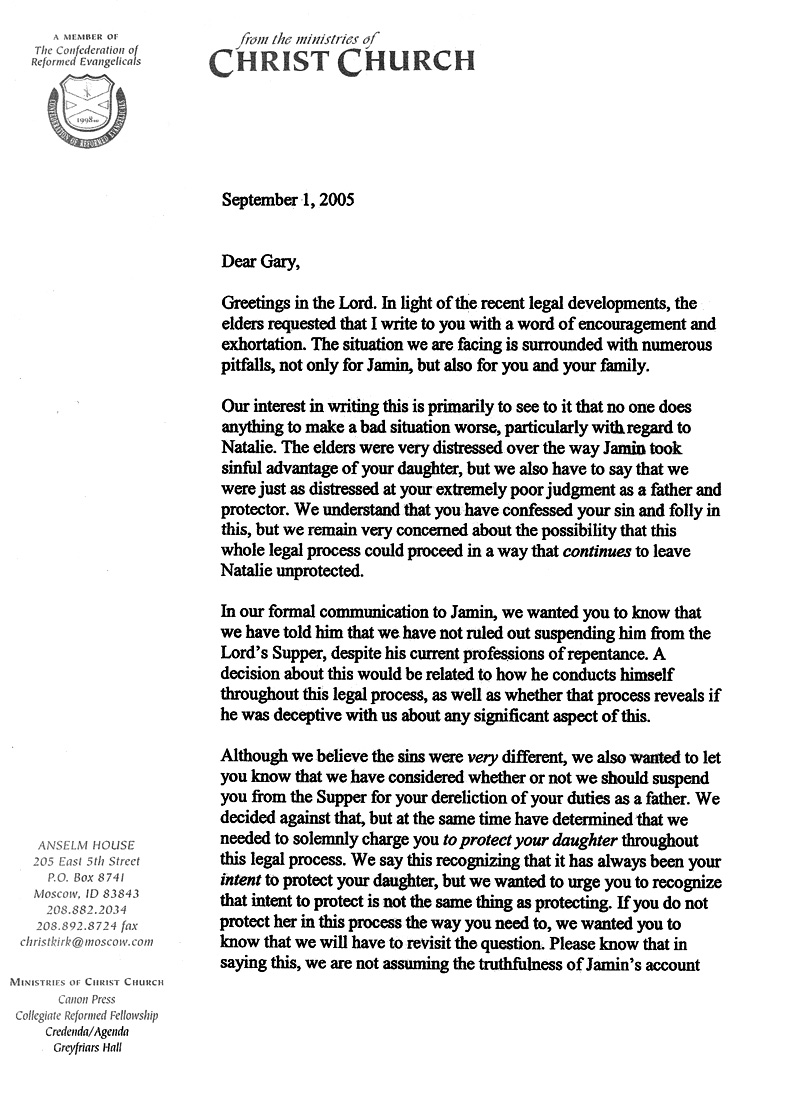
Just over ten years ago, Wilson wrote a letter to Gary, the father of Jamin Wight’s abuse victim. Keep in mind: Gary had just found out that one of the Greyfriars seminary students, who had been boarding with them as was very common within the Christ Church community, had sexually abused Gary’s daughter. Wilson tells Gary in this letter that “The elders were very distressed over the way Jamin took sinful advantage of your daughter, but we also have to say that we were just as distressed at your extremely poor judgment as a father and protector.” That’s right. In Wilson’s view, having a daughter who was sexually abused by a seminary student is as much of a problem as doing the actual abusing. Imagine, if you will, being the parent in this situation and having this be the response from your pastor. And now, if you go to Christ Church or any of the other churches backing Wilson in this, recognize that you very well could be if history ever repeats itself. It could be you, unjustly blaming yourself at the behest of your spiritual leaders for not, somehow, preventing your little girl from being sexually abused.

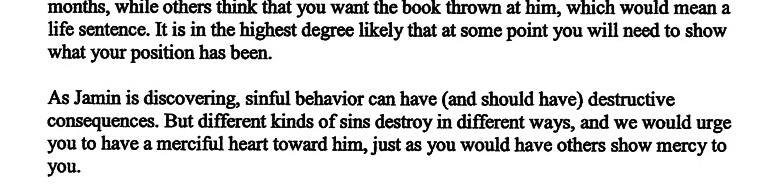
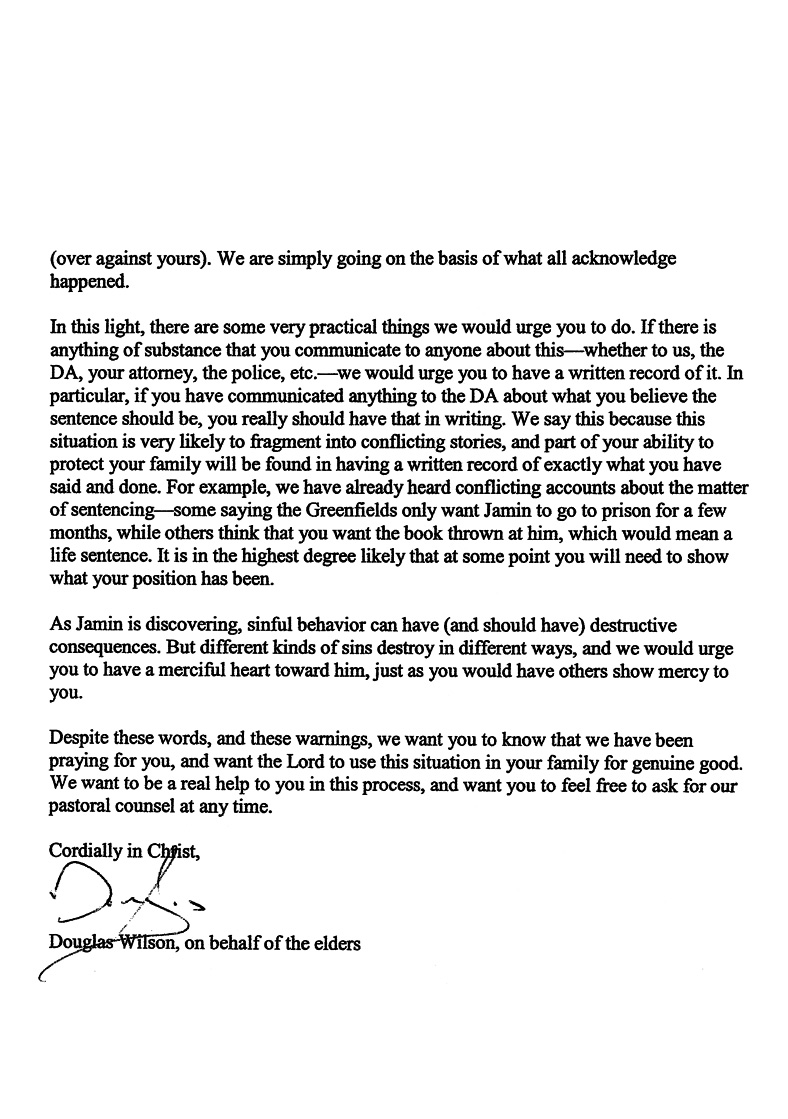
But it doesn’t stop there. Wilson has a lot to say in this letter about the legal process around Jamin’s sentencing. Most of it is convoluted and unclear, referring to “protecting” Gary’s daughter “in the way that you need to,” stating that if Gary doesn’t, he’ll (probably) be refused communion. What exactly is the way Gary needs to protect his daughter? That’s not spelled out, although it is likely that Wilson is referring to “protecting” her from testifying in open court, given that he pressured her parents not to take things to trial. Wilson most certainly does not mean that Gary should request the maximum sentence for Jamin’s crimes. In the matter of requesting anything from the DA, Wilson and his elders “urge you [Gary] to have a merciful heart towards him [Jamin], just as would have others show mercy to you.”

Moreover, Wilson wants a record of what Gary asks the DA for. A written record. Because this is somehow part of “protecting” Gary’s family. It couldn’t possibly be because Wilson wanted to maintain control over a situation involving one of his seminary students.

Gary1Gary2

If you want to read the full letter, here it is in JPG format (again, click to enlarge).

Now, Gary did not play along with this scenario, and told Wilson that he would not. He was subsequently refused communion at Christ Church — the official story was that he wasn’t doing right by his family. His daughter (yes, the one who was abused by Jamin) completely rejects all of these accusations against her father, and describes him as having “the kindest, gentlest heart.” She stresses that she in no way blames him for what happened to her.

So, Doug Wilson: I’ve posted a letter written by you to one person, Gary, who gave me permission to post it. I’ve also obtained permission from his daughter, since the letter is about her and the abuse done to her. So you can’t claim that you’re protecting people’s confidentiality any more.

Are you going to issue a public apology for the way you treated Gary and his daughter, and for the way you’ve publicly misrepresented this situation to people over the years? Because you should know (as I’m sure you do know) that your actions contributed to Jamin marrying and starting a family within your community. I would think that, additionally, you owe an apology to Jamin’s ex-wife for wrangling for “mercy” on Jamin vis a vis his sentencing, as, had he been given a life sentence, she never would have been abused at his hands.

All of this raises some questions around motive. Why would Wilson hold Gary accountable for Jamin’s crimes? And ask that Gary be merciful in Jamin’s court proceedings? I don’t know, but I’m guessing it had something to do with image control. It looks pretty bad if your seminary student is convicted as a child rapist.

I can’t actually speak to Wilson’s motives, either here or in the Steven Sitler case. But I do know that Silter’s dad was comparatively wealthy, at least at the point when the Sitler scandal was going down, and is a CREC deacon. And I also know that church members are allowed, by law, to look at the financial records of their churches. I’m not a member of any CREC church, but it would be really nice if members did a little digging into financial donations from these time periods. I have no way of knowing if this hunch is accurate, other than the fact that in many cases, following the money trail can lead you to the truth.

Wilson on pedophiles and spotting the wolves

Doug Wilson is totally sticking by his decision to preside over the marriage of a pedophile who had made no secret of the fact that he wanted children. Wilson states that “when Boz Tchividjian is barely introduced to the subject, and then pops off with this, ‘Wilson’s unwillingness to acknowledge his ignorance about child offenders makes Christ Church an unsafe place,’ one doesn’t know where one should look exactly. Boz doesn’t have an earthly about what I know or don’t know, counseled or did not counsel, said or did not say, and this means that he wants to protect your church from such offenders using his amazing gifts of clairvoyance.”

But Wilson’s ignorance is obvious even in this statement. What Tchividjian and those like him are worried about is precisely that Wilson, in his own words, thinks that “[t]he wedding between Steven and Katie was a lawful wedding. There were no biblical grounds to prohibit it. When there are grounds to refuse, a minister should refuse. I would refuse to do a wedding if one of the parties was unlawfully divorced, for example.” In Wilson’s eyes, the fact that a convicted, repeat pedophile is getting married at least in part to produce offspring is not a “biblical reason” to object to the wedding. But, you know, performing the marriage of a divorcee who ran out on her husband because he was emotionally abusive: totes not biblical, and not something he would do.

People’s objection to this, no matter what Wilson may think, has nothing to do with Wilson himself. Just to test this theory, I commented to someone who had never heard of Wilson or this situation, “there’s this pastor who performed the wedding of a convicted pedophile who had said he wanted kids.” That’s literally all it took for the person to be outraged. “And he knew he was a pedophile?”

Put this in a different context: a Catholic priest who’s been caught molesting children red-handed. After multiple instances, he goes to jail for 20 months and claims he’s cured, because he’s “repented.” He can’t be a priest anymore, so he’s going to get married and have kids. Never mind that the state won’t let him hang out with any kids without a watching chaperone. Never mind that he’s struggled with sexual attraction to minors his whole life. Never mind that it took some serious pressure to get him to admit that raping kids was wrong. Never mind that he reoffended after admitting this.

Does facilitating his marriage to a sheltered Catholic girl, and therefore giving implicit endorsement of his clearly-stated desire to have kids in the marriage, seem like a good idea? Does it seem like the right thing to do? For the Catholic girl or for the future kids?

Wilson’s ignorance also lies in the fact that he claims getting married “helps against immorality” in the context of pedophilia. Pedophiles are sexually attracted to minors, by definition. Although they may be able to have sex with adults, having sex with people above the age of 18 does not cure them of this attraction. At least some pedophiles recognize that this attraction is abhorrent, and do not act on these urges. But, like recovering alcoholics, they have to stay away from temptation as much as possible. If Steven Sitler had stayed away from temptation, he would not now be facing the breaking up of his family over him being “sexually stimulated” by his infant son. If Wilson had recognized that 1 Cor. 7:2 isn’t just something you slap on a situation in the hope that it might cure pedophilia, the family might not be on the verge of breaking up either.

Here we come to another problem, by the way: Wilson, by his own assertion, wasn’t even convinced marriage would cure Sitler of pedophilia. But that didn’t stop him from performing the marriage either.

But none of this is even the biggest problem with Wilson’s most recent blog post. The biggest problem lies in this passage:

“Relationship meltdowns can be very messy, and sin can leave a big smoking crater, and the same thing is true when a family blows apart. If I were in the middle of one such situation, and one participant in it comes out years later to ‘tell the story,’ I am not in a position to set the record straight if the cost of defending myself is to volunteer information about other people involved in the meltdown. A shepherd doesn’t use the sheep to shield himself from wolves. It is supposed to go the other way…

“I am not giving hints about any particulars. But I do say that in both the Steven Sitler situation and the Jamin Wight situation, the principle outlined above is extremely relevant.”

Translation: the injured people who are “telling the story” (notice the scare quotes) about Steven Sitler and Jamin Wight are the ones labeled “wolves.” Let that sink in. Read the passage it in its original context if you doubt the translation.

And if you still don’t believe this translation, check out this screen capture of Wilson accusing someone (?) of lying about something (?) in the Jamin Wight case. Wight was a “skunk,” but… somebody’s still lying.

Doug Wilson tweet

Let’s be clear: Jamin Wight was convicted of having sex with a then-14-year-old/15-year-old. Years later, long after he had been reinstated as a repentant member of Christ Church/Trinity society, he was found to have strangled his then- (now ex-) wife. These are matters of public record. And yet Wilson has the gall to assert that the Jamin Wight case, “telling the story” after the fact isn’t legitimate, and he’s certainly not going to answer any questions about it. Because “protecting the sheep.”

Here’s one question that Wilson can answer that absolutely does not conflict with pastoral counseling confidentiality: Doug Wilson, did you, in fact, tell the victim of Wight’s sexual abuse that she needed to repent of her “sexual sin” with Wight? She has publicly stated that you did. Furthermore, she has said that after she left your church (still a teenager at this point, and hurt on multiple levels), you told her she could not partake in communion until she came in and explained herself to you/your elders. Unsurprisingly, none of this inspired her to return to your church.

This is a yes or no question that does not involve anyone but her and you. Yes, you did tell her she needed to repent from being statutorily raped by a serial abuser, or no, you didn’t tell her this.

And, while we’re at it, was this wrong or right of you?

I know that there are people in the Christ Church/Trinity community who, particularly in retrospect, are horrified by how the Jamin Wight case went down, and who do see their past involvement as implying “support” of Wight. It saddens me that they have been silent, and I can only assume it’s because of Wilson’s shady rhetorical tactics and backhanded control moves (e.g. if you “tell the story” you’re a wolf, and the sheep must be protected from you by the pastorly knight in shining armor).

Church communities where victims are told to repent and stay silent, and where abusers are allowed to flourish in the name of Christian forgiveness, are not safe places. At least not when the leaders are justifying their behavior and refusing to apologize/admit fault for the way things were handled. Because I know and love a lot of kids in the Christ Church/Trinity community, this is deeply personal for me. History repeats itself, and this pattern will repeat itself if nothing is done to change it.

Doug Wilson on marriage

Doug Wilson, and his fans, are pretty busy telling everyone that the courts allowed Steven Sitler to get married, so Wilson himself is blameless if said marriage produces abuse or “sexual stimulation” involving an infant, even though Wilson officiated the wedding of this couple, both of whom attended his church. Presumably, Sitler was also under Wilson’s counseling during this time, as he had been prior to this.

The recording of a court hearing 10 days before Silter’s wedding doesn’t totally match up with this line of reasoning, though. The recording indicates that there was “concern” from the Department of Corrections about the marriage (31 minute mark). Sitler’s parole officer states that “we discussed that children and family were core and central to his [Sitler’s] religion,” and that once Sitler’s fiancée/wife was finished with college, “they were going to start trying to have a family at that point.” The concern about children was “because Mr. Sitler has been diagnosed as a pedophile.” As such, “he wouldn’t be allowed to have unrestricted access to his children. He wouldn’t be allowed to live with his children.” Thus — no brainer — the Idaho Department of Corrections did not support the marriage.

The judge ultimately “approved” the wedding. However, the courts don’t have a ton of power to prevent of-age couples getting married. Felons get married, all kids of people get married; nobody even blinks. There’s not much precedent for blocking the weddings of pedophiles, to the point that I have been unable to find a single instance of this happening. The most courts can do is intervene once a pedophile has kids and is discovered (no surprise) being “sexually stimulated” by them. This doesn’t stop experts from advising women not to marry sex offenders, whatever the sex offenders claim actually happened.

So the courts really didn’t decide much in Sitler’s particular case. However, according to Doug Wilson, churches should be at the forefront of “reforming marriage,” and Wilson not only should have known that Silter’s religious beliefs included children as part of marriage, but Wilson should have realized he was actively encouraging this. Wilson explicitly defines marriage around “openness” to children. Wilson states here that “capacity for procreation is essential to marriage. It is not essential for a marriage to occur or to exist, but openness to children is an essential part of the definition of marriage.”

Doug Wilson either 1. did not bother to ask if Sitler planned to have kids or 2. decided it was fine that Sitler wanted kids, or at least fine enough that Wilson was cool performing the actual marriage ceremony. Either option shows a complete and utter disregard for Sitler’s future children, who, best-case scenario, would never be allowed to give their dad a hug without a chaperone eying his crotch. And I can’t imagine encouraging (implicitly or explicitly) a woman to marry into this situation either. Wilson claims that the gospel orders him to forgive people if those people are “repentant” — but forgiveness doesn’t mean you agree to marry the dude to a sheltered 23-year-old who said yes to a second-date proposal, and you agree that convicted pedophiles should have access to the ovaries of fertile women. Also, let’s get real: no truly repentant pedophile who’s just molested a string of children wants to have kids himself. While we’re on the subject: Wilson has a terrible track record deciding who’s repentant and who’s faking (Jamin Wight, anyone?)

Wilson is not being inconsistent, however, because he routinely encourages marriages that might give sane people pause. Why? Because, in Wilson’s view, marriage encourages sanctification. He learned this from his father, the same man who encouraged my ex-husband to find someone to marry essentially the moment my ex became “a Christian,” never mind the fact that my ex was busy running around breaking all the rules of Christian courtship with multiple women. Fast forward to a month past our divorce, after some seriously weird crap had gone down: Doug Wilson was telling my ex that he would officiate his wedding to a Christ Church woman. And, well, Wilson was sure the reason our marriage hadn’t gone well was because my ex wasn’t a good enough leader (I have this on record). Never mind all that other weird stuff, which, yes, Wilson was fully aware of. Gender roles: the answer to all of life’s persistent questions!

If I had to summarize all of the talks I’ve heard Wilson give, all of the books on the subject he’s written, and all of the private emails I’ve perused, I’d say Wilson believes that marriage cures sexual sin. As well as many other types of sin. Wilson will defend this position come hell or high water, using Bible verses, veiled accusations (I see what you post on Facebook! You’re doing it because you’re bitter!), and the kind of humor that allows him to get a kick out of people worried about child molestation. But he will never, never apologize for putting children at risk. That just doesn’t jive with his image.