More on climbing

As I sank exhausted each night into the thin padding of the chilly space on the right side of the tent, I had just enough time before crashing into cough-broken slumber to ask myself if I was really enjoying this. And then I woke with the sun, savored the luxury of a cup of hot water boiled over propane, and maybe a few lines of Umberto Eco, packed up and toted my red backpack, filled with rope, equipment, food, water, an assortment of extra clothing, extra shoes, and so on, wherever we were going that day. The straps cut into my shoulders and I bent to shift the weight onto my hips, one foot in front of the next, feeling the strain in my knees. I will never be a Sherpa, I kept saying to myself. After a mile, two miles, or the entire morning, I would shed my pack and run as if weightless up the steps of Smith Rocks, the sweat cooling me in the wind. And then, if I was not too tired, I could hold onto small holds, crimping with the tips of my fingers, the very diminutiveness that had cursed me under the weight of the pack a boon.

The week-long climbing trip led me to decide one thing: I am probably going to primarily be a sport climber. I like the difficulty of sport more than I like the difficulty of trad. Trad is about exploration and reliance on what you yourself can place in the rock; the dangers of trad climbing are magnified by the conditions in which it often occurs. Sport climbing, on the other hand, is more about gymnastic ability and personal improvement. Often, it’s more social than trad; more approachable; more prone to lend itself to a laid-back afternoon at the crags with a motley crew of friends. At its most serious, though, it still appeals to me. I like the idea of lightness, the idea of flexibility and strength and balance, the idea of being so aware of your body and of the rock that one inch, one millimeter, makes the difference between sticking it and falling; I like the idea of being able to clip in quickly to what is safe. I like the idea of knowing the difference between rational and irrational fear; of knowing what I can do when mental and physical pain smooth out into a fluid dance with the ancient.

And I also like the idea of going home after doing that to a hot shower and my own sweet bed.

Celestial bodies

C.S. Lewis once remarked that when men are on the prowl and claim they “want a woman,” they actually do not want a woman at all. What they really want is the thing for which a woman is the appropriate appendage: “One does not keep the carton after one has smoked the cigarettes.” I was reminded of this in a recent discussion in which one man defined “being a guy” (as in “oh, he’s just being a guy”) as “only seeing body parts.”

He was congratulating himself because he wasn’t that type of guy. He liked girls for “the right reasons.” He liked their minds. He liked their souls.

But I think on some level this is mistaken. Even soldiers on shore leave for a mere five minutes of fun want more than just body parts… they want a real, live woman, and preferably one they’re not going to hate afterward. On some level, I think even rapists want to possess a woman mind, body, and soul. What on earth would be the point of dominating a cardboard cutout, even a really attractive one?

However, most guys still want to differentiate their attraction to their girlfriends or their next-door neighbors as somehow deeper than the average frat boy’s. And I’m guessing it is. If nothing else, it’s more longsuffering and more supportive. Instead of liking a woman because she has a mind, body, and soul, they like her for having this particular mind, body, and soul. And the drawbacks that come with the package, well, those are things you’ve just got to deal with. And you do deal with them. Because you’re not “just a guy.” You’re one man in love with one woman.

The tricky thing here is that girls want to be wanted for their mind/body/soul, and they keep getting told that assholes only care about their bodies. If a guy tells them he’s into all three, he’s got a good chance of scoring with them.* Naturally, as long as he does it right and as long as they’re attracted to him on some level. Of course, they really have no idea if he’s telling the truth, and they’re less focused on his mind/body/soul because they’re so intent on analyzing how sincere he is about theirs. If he moves too quickly, he’s probably “just being a guy” and “only seeing body parts.” But if he waits until the third date, and knows how to have a conversation with them, then maybe he’s actually The One!

So the nice guy who likes women for the “right reasons” is left asking why women make so many stupid decisions when it comes to men, not realizing that he may actually be part of the problem.

Here are some sample analyses, if we follow the logic of the nice guy:

Premise 1: only men who focus on my body are assholes
Premise 2: John doesn’t focus on my body
Conclusion: John isn’t an asshole

Premise 1: only men who focus on my body are assholes
Premise 2: I keep catching Will staring at my legs when I wear a short skirt
Conclusion: Will is an asshole

John may be an embezzling psychopath, but he doesn’t creep me out by noticing how amazing my thighs look, unlike that weirdo Will.

Result: ditch Will, date John.

*Nice guy response: “he never means it, you know.”
Me: “And hence, you don’t.”
Nice guy: “I’m not typical.”
Me: “Neither are they.”

On names and naming

A few years ago, I took a class in Philosophy of Language that dealt, in part, with names. It did not cover the deeper meaning of names, unfortunately, just the highly theoretical practice of trying to discover how a name meant anything (e.g. what does a name really refer to, according to Russell, Frege, and all those guys).

In fiction of any kind, names may define characters, or speak to some essence the writer wishes to get across. For example, Jean Valjean, the hunted but selfless convict from Les Miserables, has a name referring to the power of God’s grace — which is very fitting for a man whose soul was “bought” by a priest he stole from.

I have long been intrigued by the practice of naming characters according to their essence, and at 14, wrote a short novel featuring, among others, a suave Mala (= bad) and a reptilian Rana (= frog). Since then, I’ve written multiple stories with nameless characters, in an attempt to speak to the universal. One short story revolved around Caleb (= dog) and the opening to the Iliad… a finer reference than calling a creepy guy a frog, and the plot (though it mirrored the reference) in no way depended on the reader “getting it.”

The problem with naming characters according to some greater archetype is that the characters may then disintegrate into mere copies. So it’s best to do this subtly, as an added bonus for the easily-bored consumer. In Inception, for example (soon up for a host of Oscars, including Best Picture), the only really obvious name reference is Ariadne. Possibly Mal, as well, but the pronunciation in the movie sounds more like “Moll” (Although I kept wondering: why is a Frenchwoman named Molly? Is she supposed to be Moll Flanders?). In Inception, the names may actually be deliberate anchors to the “real world,” particularly if, as some have suggested, the whole movie is a commentary on cinematic experience and the ability to suspend logic and lose yourself in the shared dream-like sequences of fiction.

Adventure

I like adventure. Adventure, however, comes in many forms, and truth be told, part of me is still the shy, timid child of two decades ago, content to think in solitude for long periods of time, happy with stillness and home.
But adventure is at least in part the pursuit of stillness. Paradoxically, when you venture into the snowy crags, into the wilderness, your movement slows time, forces you to pay attention to small things, to the whispers in your head, to where you end and the rest of the world begins.
It is similar when you (as a traveler on a shoestring) roam by yourself through the streets of Buenos Aires, Rome, Auckland, Copenhagen, Montreal, Orlando or Hong Kong, and listen to the pulse of each place, different and the same everywhere. In many ways, you are more alone in a train station in London, sitting at a tiny table with the flux of people surging in every direction, than you are even at the top of a mountain. Largeness in any form may help you find stillness, for you shrink by comparison, and occupy yourself with survival. Finding shelter, finding food, finding your way; beating the elements, whether they be natural or man-made.
This would be grim if you did not find a way to love it. But you appreciate what is larger than you and how you pay it homage, looking out from yourself unconsciously like the passing tourist you are.

Vattnet svart som manen full

Scandinavia is possibly the one place in the world where tragedy really seems sublime. Maybe it’s the fjords, the marriage of ice and beauty, the dark winters and the chilly summer nights, aglow with lingering fire. Maybe it’s the tall, pale northerners themselves, fierce stock descended from Viking kings, with the reserve and hunger of a lifetime spent in the cold. Whatever the case, the world has recently caught on; the Girl with the Dragon Tattoo, while more messed up than any best-selling novel ever, is outrageously popular. Translated from Swedish, it’s set in the remote wintery landscape and remote wintery ethics of Scandinavia — very much like Let the Right One In, another dark Swedish story being re-told less persuasively in an American context.

Musically, the Swedish Katatonia can really do charming things with death metal… and the also-Swedish post-industrial Blindside, perhaps because of this seriousness, can pull off the ethereal. They do not seem like melodramatic dopes for singing “I washed my wounds with tears of hope.”

And it is not a new phenomenon. C.S. Lewis was enamored of Scandinavian mythology, particularly the story of Balder, the beloved and sunny-faced, falling dead from a dart of mistletoe shot by his blind brother. People the world over have been enchanted by the morbid fairy tales of Hans Christian Andersen. Even Shakespeare, it is rumored, was inspired to write Hamlet after hearing tales of a Danish castle looking northward to Sweden.

I didn’t quite get this until I visited the northern spaces myself. Though it may be because it is the home of my ancestors, alone, there is something of immortality in the long shadows of the long twilight sinking fragrant into night, and it is far more persuasive than the youthful, drunken half-forgotten Catholic immediacy of the places farther south. The Germanic tribes were pagan, then Protestant, then Atheist, looking over their shoulders to reference Paradise Lost and the sweep of the mountains, and to sink again into blue-eyed despair.

The art of non-romantic conversation

The best conversation, I think, is serious but jovial, drawing in ideas and reference to some shared joke or reference, sometimes rejoined with a sly observance, contradiction, further witticism, or self-deprecating but hearty laugh. Talking even of the weather leaps from the mundane to the sublime. Whether or not you are equals, you meet as equals — true conversation is impossible without some assumption of egalitarian responsibility and enjoyment. Otherwise, it is a sermon, a lesson, or a benefaction. Being assumed an equal to someone who can easily navigate deep waters is challenging and, at times, almost deliriously complimentary. You feel as if you have emerged from some narrow humdrum corridor into the dazzling open air, shining Alpine heights resplendent in the near-frightening sunlight. And although it seems closest to romantic love, what wells in you is appreciation, mostly fraternal, of the mere fact that this is possible.

On joue au couteau

I have a few songs by Coeur de pirate, a female French Canadian singer-songwriter, and recently, a few lines of “Corbeau” (Raven — an omnivorous bird considered an ill omen due to its propensity to feed on flesh, also regaled as an intelligent trickster) caught my ear. C’est dur d’être libre comme toi? Is this song about libertines? Or, rather, the girls who fail at the attempt? The ability to share a warm, cozy bed with anyone else, with impunity, is so ingrained in francophone culture that this actually took me by surprise. Not that the French are necessarily more promiscuous than Americans — but somehow, it’s different. In America, there’s at least the idea that this might be a bad idea, socially, morally, whatever; there is something, after all, to rebel against. In France, the rebellion is over. Reason is king, and Reason can find no logic truly objecting, given the state of nature. Every single French girl I talked to on the subject seemed to think there was something wrong with her if she couldn’t just keep it casual if need be.

And yet she can’t help it. She wants more. Even if she’s convinced the guy is all wrong and makes her life more chaotic. It’s not a rebellion so much as a confusion, a secret, best left unexpressed. And yet, when it is expressed, it garners many female responses along the lines of: “j’avoue j’ai pleuré en ecoutant cette chanson” (I swear, I cried listening to this song).

I decided to look up the lyrics, but had trouble with some of them, and nobody seems to have translated them except with extreme clumsiness. Here’s my stab at it, which was actually an interesting challenge:

Et deux par deux, sans compter nos morts,
Qu’on laisse derrière des ébauches fanées, des secrets de carrière
Et trois par trois, dans nos cœurs essoufflés,
Des secousses se forment, on réfléchit plus tard, maintenant il faut rêver

And two by two, without counting our casualties,
That we abandon behind faded outlines and career secrecies —
And three by three, in our wheezy hearts,
Shock absorbers form… We’ll reflect on that later. For now, a new start.

Et je ne sais plus à quoi penser, c’est dur d’être libre comme toi
Et je ne sais plus à qui penser, c’est fini, rhabille toi.

And I don’t know what to think anymore — it’s hard to be free, like yourself.
And I don’t know who to consider anymore — it’s finished, so dress yourself.

Et deux par deux, on avale nos mots.
C’est dur d’oublier ce que l’on connait et ce qui imprègne nos peaux.
Et trois par trois, nos coeurs d’la partie.
On joue au couteau et on peut partager le même lit.

And two by two, we swallow our words.
It’s hard to forget what we’ve known, what passed into our very skin.
And three by three, our hearts disjoined,
We play like knives and split the same bed.

Action figures

During my lifespan I have adopted rather divergent standards of action, usually translated as athleticism — for in this day and age, it is the select few who find action as anything but luxury undertaken when workload and home life allow. It began with running around, (typically after I’d read plenty) climbing trees, swimming, gymnastics, horse-riding, and most of all, dancing. Ballet. I was going to be a ballerina. Yvonne Chouteau told me so.

I gave up this idea reasonably quickly, however, and stopped going to ballet class once I’d gotten my toe shoes. I loved performing, but that happened infrequently, and class itself was uninspiring. And I was an emerging adolescent, which made everything more awkward.

In college, I fell in with the Big Haus Society, (“it’s the thought that counts”) and enjoyed swapping verbal repartee in the densely smoke-filled library, although, to be honest, this was only true insomuch as there was at least one semi-attractive single male present and/or I could feel myself connecting on some more personable level, platonic or otherwise. I could revel in the mental commune, for hours, but usually only on rather intimate terms. Many was the time that I sat out of politeness after having lost interest listening to some long-winded theory on time, the universe, Dante, politics, morality, agrarian society, the futility of sports, musical dissonance, what-have-you. I got bored because all this seemed rather inactionable; there was always something I wished I could do for the world in general, something besides sit around and talk about it (read: judge it, in our infinite wisdom, as acceptable or idiotic). Or maybe I got bored because I sometimes felt like, being a woman, I had to appear twice as logical, twice as diplomatic, and listen twice as much as I spoke, in order to be taken seriously. And the males in the room could revel in pedantic off-the-cuff flippancy ad nauseum, and get away with it.

On the other extreme, there were the (also usually male) sport enthusiasts I knew. They were discontent unless they were “doing” something, or, at the very least, talking about it — gear, routes, workouts, warm-ups, cross-training, diets, what they wanted to try, what their friends had tried, what this one guy in Argentina had tried. Deep personal talks with them consisted of re-hashing minute details of what they’d done the day before. Anything else was “too analytical” and a waste of energy. Not because they had no grasp of anything else — these were people who had their own opinions and would read classic lit on a rainy day — but because trying to discuss a book for more than two minutes was pushy and meaningless. When they could move, though, they moved, and it was typically grand. And I was more OK with the fact that I was clearly at something of a disadvantage as a female.

And, of course, there were the save-the-planet hippies, the French strikers, the non-profit canvassers and the door-to-door evangelists, who took a different approach to action. Opponents decry this as a waste of energy, and/or just plain annoying. Which, often, it is. Chances are, any action undertaken, even in the name of goodness, will annoy somebody.

Thus conscience does make cowards of us all;
And thus the native hue of resolution
Is sicklied o’er with the pale cast of thought,
And enterprises of great pith and moment
With this regard their currents turn awry,
And lose the name of action.

Is action engaging your brain, your body, or your conscience? Or is it just impossible? You don’t change much by sitting around and talking about the world — although you may connect with another person and spur something better, more sublime. You don’t change much by buying expensive gear and building up your muscle mass — although you may connect with another person and spur something better, more sublime. You don’t even change much by ladling out soup at a soup kitchen — although you may connect with another person and spur something better, more sublime.

Perhaps in the end, the only real improvement you can hope to for is to make someone’s life better, and this is best discovered through shared experience, whatever that may be:

We few, we happy few, we band of brothers;
For he to-day that sheds his blood with me
Shall be my brother; be he ne’er so vile,
This day shall gentle his condition.

It is too easy to be cynical, and I am still an idealist. I still think sharing words can change the world. I still think sharing in the stillness of nature, in the strain of your own limbs, can change the world. I still think a cup of water to the thirsty can change the world. Thus, trite as it may sound, blessings be upon you all.
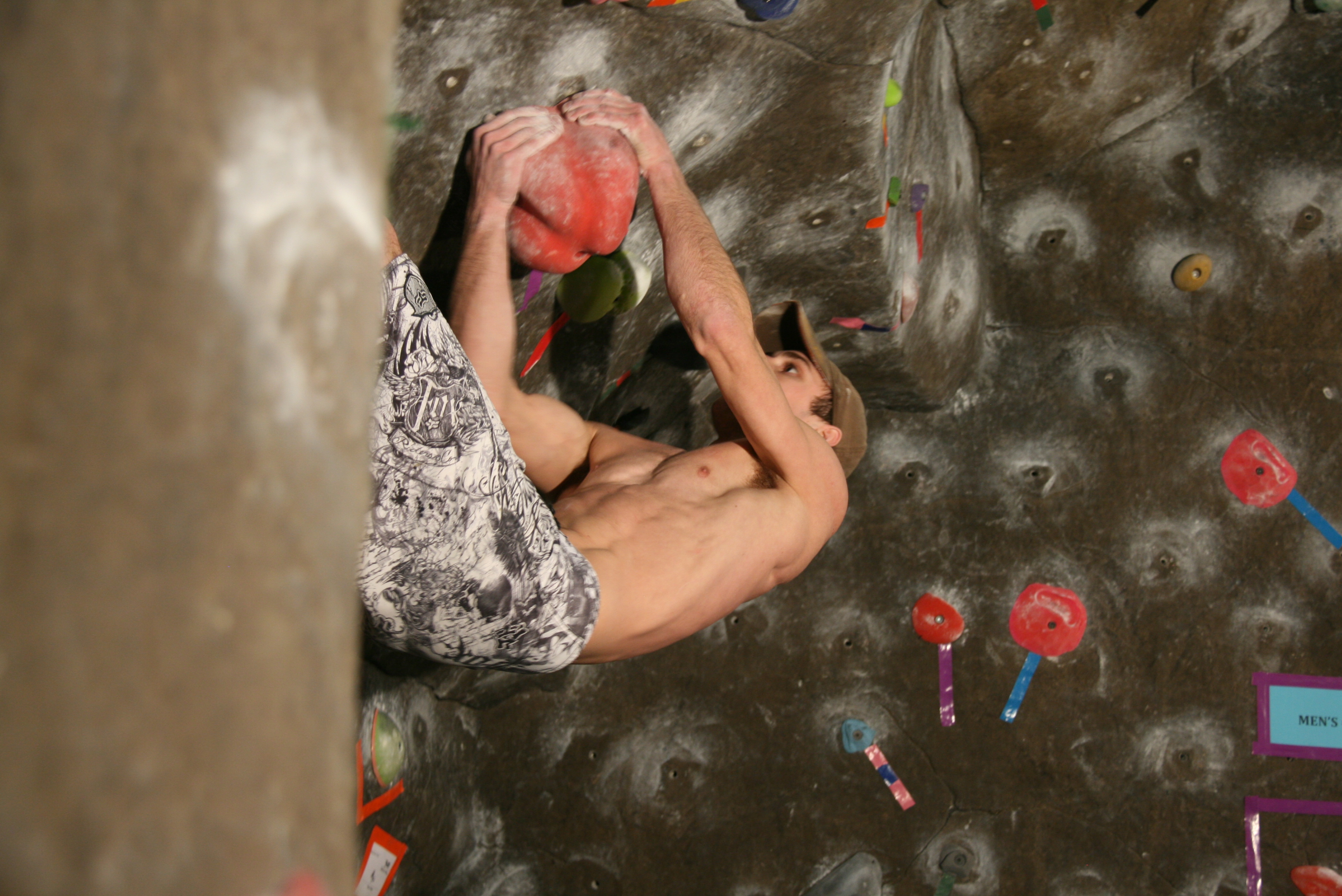
Climb on

I have been climbing lately. During my undergrad, and even grad, when I had the time, I would go over to the University of Idaho climbing gym and boulder or, if I could find a partner, rope up and try a route. I always felt sort of like I was pretending; goofing off and trying not to injure myself in the process. I climbed outdoors a few times in Post Falls with a group of people, the culmination of which was watching them lead-climb a 5.10-something, which seemed impossibly difficult at the time.

Fast-forward several years, to the beginning of this summer. I hadn’t even put on my climbing shoes since 2007, never having had a reason to. I went down to Post Falls with some friends, expecting to be terrible, but, to my surprise, found that I wasn’t. The extra 10 pounds I’d lost seemed to have made up for my sabbatical from working out. I remembered, in a rush, the brief feeling of exhilaration I would get when I nailed one of the bouldering routes in the gym, or when I topped out on anything. I have to do this more, I thought. I really like it.

Those who have never experienced this may wonder what there is to like about inching up a sheer rock wall. Especially when you have to drive to get there, hike in, set up your semi-expensive gear, and then endure cold, heat, scrapes, bruises, falling rocks, a crick in the neck and fantastically dirty hands from belaying, potentially pulled tendons — heck, potentially, even death, particularly if your partner isn’t paying attention.

But it’s all part of the experience; the drive out in anticipation, music blaring; the hike in, with the sun flickering in the tree tops, the ritual of set-up, the gritty details that remind you that this isn’t some plastic undertaking, this is life and death you’re talking about. Probably not death, though. Not if you’re careful and have someone you can trust. And that’s part of the ritual. And then the climb; the gaze up at the cold, hard, unmoving wall, the reach back into the chalk bag for comfort, the first move. The second move. And so on. Everything is escalated if you’re lead climbing. You have to stop, let go with one hand long enough to set the draw, pull the rope up, clip the rope. And with every tentative moment, you have to talk yourself into continuing, have to determine how much you trust your belayer, your savvy, the rope, the equipment. It’s amazing how much of it is talking yourself into it, relaxing into something rather than fighting it, finding the right body position, the right balance. Perhaps this becomes more fluid the more you climb, and even now, when I’m trying a familiar and relatively easy route, I am much calmer than I was initially. I must have improved somewhat, because last weekend, I lead-climbed a 5.10-something at Post Falls. It was an easy 5.10, but still.

To improve, I’ve found the following work well: practice, deciding not to freak out, experienced friends who goad you into trying something for your own good, and inexperienced friends whom you have to be responsible for. Overall, a desire to be capable of doing stuff you’ve never done.

None of this may sound particularly appealing, but it’s a good metaphor for life. Maybe that’s why I like it. More than the strain of my forearms or the lichen chips in my eyes or the smell of feet, I like the feeling that on a good day, improvement, camaraderie and challenge are all possible. Realism and idealism high-five when you finally touch those anchor chains.