What is localization?

One of the most frequent questions I get when I’m meeting people in my own neck of the woods is, “So, what do you do here in town? Do you work for Coldwater Creek?”
Image“No,” I say, although I am often in the presence of one or more people who do — as photographers, web designers, copy writers, and so on. “I’m the managing editor of a magazine.”

Sandpoint magazine?”

“No, it’s called MultiLingual. It’s about translation and that sort of thing. It’s international; we’re in 87 countries. We just happen to be based here.”

“Cool. So, um, you translate?”

“No, no. It’s all in English. It’s like a trade publication for the localization industry.” At this point, I feel as if I’m reading from a script, and the much-repeated words flow off my tongue. “Localization is when you take a product or service and adapt it for another market. So, often it involves translation, but it doesn’t always, like when you localize a website for the UK or Australia.”

Usually, at this point, the other person nods.

“The idea,” I add “Is to make the product look and feel like it was produced locally, whether it’s sold in China or Argentina.”

Exactly the kind of thing you do not see in those hilarious photo snapshots of badly-translated English-language product documentation or marketing materials. Good localization is so invisible, it’s no wonder people have never heard of it. It’s only when it’s bad (or non-existent) that it’s noticeable. And believe me, people do notice it. You know they notice it, because you notice it. If some Japanese company decided to try to sell perfectly shaped golfball-sized lychee fruits in beautiful packaging at Walmart for $9 each, you’d notice even if the translation was impeccable. You’d notice because it was expensive and you have no idea what this scaly, prickly, weird thing is. And hence, it’s not what you want to buy at Walmart. This is why localization professionals chortle to each other about the popcorn mogul that wanted to sell “family-sized” trans-fat-heavy microwave popcorn in Japan. Or the guy who dreamed about bringing bulk goods to the downtown London crowd. Or the violent video game producer that wanted to market in China. Sometimes, localization involves a whole lot more than translation. Sometimes, it involves re-thinking and re-tooling the product entirely. The earlier this is done, the better. And this is why large companies such as Microsoft have entire divisions devoted to preparing software for localization, even if they do not do the actual localization in-house — and they usually don’t. Microsoft outsources translation and at least some localization to Moravia, one of the biggest language service providers in the world, which you’ve likely never even heard of if you’re not in the localization industry. If Moravia’s quality is anything like their staff and sense of loyalty, it’s got to be good, so I was glad to see that Microsoft recently recognized them for their service.

By the way, if you want to know more about localization, (of websites, in business, or how localization technology works) there are some great Getting Started guides available for free download here. If you want a directory of localization companies and services, you can download the one just out for 2012 here. And if you want continuing in-depth information about the industry, you should, of course, subscribe to MultiLingual and consider attending Localization World.

A short history of our magazine and the economic downturn

The economic downturn has hurt many a publication, and ours was no exception. Our advertisers had to cut costs, and some cut us.

Our boss laid out the situation for us, telling us that in order not to lose anyone, we could choose to lessen our individual hours. We were paid hourly, and we had signed in and out, some of us working from 8 a.m. to 2 p.m., some working from noon until 5 p.m. Our hours varied depending on whether we had a conference call with someone overseas, or how much was in our inbox. There wasn’t a whole lot of micromanagement, which meant that, if we pushed ourselves, we could get a solid few hours in, unbroken by more than the bare necessities in terms of meetings, reports and so on, and then go home. For my own work — largely editing, often texts from authors whose first language was not English — I usually found it counterproductive to work eight hours a day. If you’re focusing on something that is highly detail-oriented, especially when the subject matter is technical and nuanced, short spans of time are better. On average, full-time American workers waste large portions of their workday, which may be a direct result of longer hours.

So, even if it meant that most of us were going to be working about half-time, we agreed that everyone collectively cutting back was the best policy. Quite a few of us had side projects, both paid and unpaid — graphic design, teaching yoga, building websites, running a community radio station, working for the organic market, setting routes at the climbing gym, decanting the local wine, establishing a wilderness area. It was perhaps fitting that a magazine based on localization in worldwide business helped fuel all of us wanting to keep our own locale healthy. We depended on our magazine jobs (and each other) for a baseline stream of income. If we wanted to, we could sign out and do our own things from our work stations until something came back to roost our inbox — and many of us did.

Now, the advertisers are beginning to come back in greater numbers, and our most recent reader survey suggests that our audience is satisfied. This, combined with the fact that I feel more rich than I perhaps have complete cause to, makes me think that this type of set-up is, at least for a small business composed of competent, professional people, a good idea. Internally, we have very limited turnover in spite of the scarcity of hours, so I’m not the only one who seems to appreciate getting paid partially in freedom (and partially in job satisfaction). Life, after all, holds much more than the sum of your paycheck.

Getting by on beauty

I’ve been doing my taxes, studying returns from the last few years and sorting through my bank account statements to make sure everything is in order. Not for the first time, I’m vaguely surprised by how little I make, considering how good I think my life is. But I can appreciate getting paid partially in freedom.

I mean, it helps that I live in a place that is naturally beautiful and that offers relatively inexpensive recreation, where you can get organic produce off alleyway trees and walk just about everywhere. It helps that, personality-wise, I am almost anal in how careful I am with my money. It helps that (because of this) my only debt is my mortgage. And I’m not going to lie — getting to travel for work to places I actually want to go helps too. It provides decadence to what would otherwise be a more austere lifestyle.

But austere only in a certain way — in exchange for a smallish paycheck from editing an eight-issue-a-year magazine, I can write, I can explore the wilderness that surrounds me, or I can leave work early on Friday for a mini-roadtrip somewhere. Or I can take a freelance job and be gone for a week. Or I can cut out if the snow is looking tempting in the winter or the rock is looking tempting in the summer. And I do these things. Even with a part-time job, it’s amazing how little time I have left for things like laundry.

I don’t think this freedom would have been possible if I hadn’t made a habit of doing something I’ll call “respecting the cushion.” You know how driver safety manuals advise you to keep a three-second cushion between you and other drivers (or more depending on conditions) so that you won’t crash into them before you can stop? The same basic principle applies to your bank account. You’re going to suddenly need the plumbing fixed, or suddenly need to visit the emergency room, or suddenly need to replace your alternator. If you’ve got no cushion, you’ll crash in the everyday traffic of life. It’s basic economic sense, but Americans still don’t seem to get it sometimes: You need to keep a certain amount of money on hand for emergencies. You need to make sure you have insurance to cover what you wouldn’t be able to cover out-of-pocket. For most working people, this is not impossible — I make less than $20,000 a year (and again, I have a mortgage and other house-related bills, including property taxes), so I’m not coming at you with advice that’s only fit for the rich.

Respecting the cushion means that about 95% of the time, in matters of non-necessity, even if you want it, you do not pay full price for something. You consider your need for it. You consider the quality of it. You consider the alternatives. If you can’t afford it, you don’t buy it — for yourself or anyone else. This may sound strict or even callous, but I’ve relaxed my standards considerably since my undergrad days, when I lived on $125 per month for rent and $20 per month for food. Let’s just say that if my friends and I went out to eat, I would have ketchup. At home, I ate a lot of potatoes, some flavored with nothing more than pickle juice. You could get a 20-pound bag of potatoes for a few bucks then.

Clearly, this is not exactly a healthy lifestyle beyond the college years (even if it’s still more than what 50% of the world population lives on) and is in many ways socially unacceptable. Most of the time, you can be a cheapskate more gracefully than that.

If you don’t make a whole lot and are trying to correct years of bad spending habits or a grotesque school loan that didn’t pan out like you’d hoped, this is going to be tough. If you’re unemployed, clearly, it’s impossible. But I still think that if I can save money every year, it’s within reach for most working Americans. I know too many people, “fiscal conservatives” and otherwise, who spend their money before the month is out and then complain that it’s the fault of government handouts to lazy people — taxes need to be paid, and if you’re too shortsighted to budget according to your own reality, then consider yourself lazy as well, and part of the culture of debt.

Fiji, live

I had initially embarked upon my recent trip to Fiji somewhat cautiously, because four and a half years ago, I spent a day in Fiji with my little brother, who was 18 and had never seen a third-world country. We exited the airport on an eight-hour layover between New Zealand and Los Angeles, and decided to try to go to the public beach, which we were informed was far away, since most beaches are kept by private resorts. Backpackers that we were, we attempted to get there on sheer determination and more specifically one of the public buses that stops outside Nadi airport. As we rode, my brother and I surveyed the terrain through glassless windows, and I got the unpleasant feeling that perhaps most of Fiji had been turned into foreign resorts, leaving the native people the stifling interiors and a swarming invasion of tourists. We got lost, and eventually turned around, never having seen more than the roadside.

So this time around, I was pleasantly surprised by the relationship Royal Davui has with its staff, and the relationship Fijian natives have with the tourists in general — enough that I remarked on it in detail in my Ocean Home article that just went live.

Pretending to be famous

When I got on the plane to go to Fiji, I was greeted by three other women: Marguarite, Elina, and Jennie. They had each reposed themselves in their row of seats in the second-story bubble of our not-so-private jet. I had a row of seats as well — three whole seats in what amounted to economy-plus. It was a bit more crowded ahead of us, and Marguarite said she’d arranged with the airline for us to get these rows as upgrades as long as they were available, but that if everything else sold out, we’d have to share. We decided to sit in the middle of our rows to discourage anyone else from joining us.

This made it difficult to talk to the others, but somehow we managed to swap stories a bit anyway. Jennie sat across from me, and I leaned over and chatted with her, a precursor for many other talks we would have bouncing along mountain roads and relaxing at the resort together. Once we were in the air, my food was slow in coming, so she shared her vegetarian meal with me.

When we landed in Fiji, I waited with Elina as the other two collected their checked luggage. In a matter of a few minutes, I discovered that in her earlier life, she had escaped from the USSR, thanks to her job as a translator. When she got to the US, she decided she wanted to go into journalism because “I couldn’t believe that you got paid to tell the truth.” Eventually, she wound up as a correspondent and producer at CNN. And now, she said, she was taking it comparatively easy, doing travel and lifestyle writing. She said she’d just been spending some time with her daughter, who had her own career.

“Really?” I demanded “You don’t look old enough for that.”

Her daughter was 15, and in the movie industry, said Elina. “She’s an actress. She was filming a movie.”

Which movie, I asked. “The Hunger Games,” said Elina.

I was surprised. “Do I know her? What’s her name?”

“Isabelle Furhman. She starred in The Orphan.”

“I never saw that.”

By this time, the others had gathered their suitcases, and we exited the airport, to be met by fresh flowers and (eventually) a small private plane.

Over the next few days, the four of us were regaled by Christopher, Royal Davui‘s owner-manager (or owner’s son, depending on how you looked at it), who managed to make us forget that we were even working, a difficult task for anybody entertaining a seasoned coterie of travel writers. We went adventuring together and ate delicious food, over long, drawn out evenings — New Zealand lamb, fresh fish from the lagoon, taro made with coconut cream, and fruit plucked from trees hanging within reaching distance.

I wondered at times, as I have wondered before in similar situations, if the fact that we all seemed to get along was because we were actually dazzling people, or because we were being paid to get along. Maybe we were dazzling only insomuch as we were acting like professionals. But that seemed unlikely. The setting, even for a coterie of seasoned travel writers, was too vital, too saturated with color, for this to be drawn from the well of professionalism. The ocean gave us views the like of which we had never seen before, and the island itself was a living thing, lush and fragrant with wild-growing flowers, its breath present in the breeze sighing against the pearl-hued sands, and we were ready to be seduced.

In any case, the four of us women aroused curiosity from the two of the other guests, a honeymooning couple from what appeared to be the back woods of Australia. This was not lessened by the addition of David, freshly arrived from Tasmania, to our parade of soirees. One night over dinner, Christopher told us in a hushed voice that this couple had approached him and asked about us: “I know they’re meant to be famous, but who exactly are they?”

“What’d you say?” we asked Christopher.

“I told them I was sorry, but that I really couldn’t talk about it.”

Then he told us his bright idea: he intended to insinuate to this couple, once we’d left, that we were the writers from a television show cum movie franchise about four cosmopolitan city-dwelling women who have outrageous adventures in exotic locales, and that we were researching our next film. That seemed like a titillating explanation, although I thought that at least one of us was probably better-known than that in real life.

“David’s the producer,” Marguarite added.

“Perfect,” I said “because the producer doesn’t really do anything.”

David keeps teasing me by asking impertinent homeschooling and/or Idaho-related questions, like if I know who Farrah Fawcett is, or Michael Jackson. Even more impertinently, I’m not sure he believes me when I tell him I do. And I’m not sure what to make of his conspiratorial wink, and assurance that he knows my innocence is all just a front for the deadly female-James-Bond persona I’m hiding.

Marguarite seems to be well-acquainted with him, and before he arrived told us he had the craziest stories ever from his years of traveling the world. I doubted that, but now that I’ve heard him talking, I only suspect that some of the details might be re-organized to better suit the occasion. In any case, he is entertaining, a good quality in a dinner companion. He self-deprecatingly tells us of other dinners, like the one where he informed a pair of neurosurgeons that he was an astronaut, fully expecting them to get the joke from his 60-ish frame. They expressed interest instead, so he went on to make the thing more and more fantastical so that the joke would be quite obvious, until he realized it was hopeless, and that they were never going to forgive him if he confessed. So he tapped his wife (“A Saint,” remarked Marguarite) on the shoulder, and told her that he needed to leave the dinner immediately.

So, am I to understand that…

Given the premise that having someone else pay for your contraception or chosen method of family planning makes you a prostitute

To avoid having one party in any relationship reduced to prostitution, it is necessary for them to equally divide the cost of contraception, perhaps calculating it out per encounter and leaving the money on the bedside table. Remember, the more careful you are with the coin-counting, the less likely that you will actually be a whore or a john.

If you chose the rhythm method, you should make sure this applies to any calendar you use to calculate when you are ovulating. If you use a free calendar from a non-profit, assume the non-profit is paying for you to have sex/ not have sex. Obviously, you don’t want to do this, so you need to buy your own calendar — or most accurately, half of a calendar. Hence, housewives, you need to have your own personal source of income separate from your husband’s. Remember, if he pays for it, or even if you pay for it out of an account you’ve both contributed to at different times, you’re a prostitute, given the above premise.

In the woods

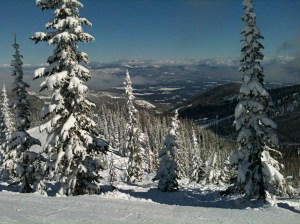
Last Saturday, I decided to take advantage of the week’s fifty-odd inches of new snowfall and hit up Schweitzer with my snowboard. I texted a few friends on the way, but they were waking up late. I chuckled and surveyed the conditions. Foggy at the summit, and windy. Ice-whipping-sideways-and-stinging-my-face windy. I guessed it would be calmer on the back of the mountain, and took the lift up, crossed the ridge on foot, and boarded down towards the t-bar. I slid to a stop short of it and looked to my right. I spotted fresh powder, and, yes, it looked protected from the wind. It was steep and wooded, but I could go sideways. So I did, cutting through trees and fog gingerly, looking ahead for some less-steep spot where I could relax a bit more. There was nobody around, which was surprising for a ski resort on Saturday after a decent snowfall.

I paused in a narrow clear spot to look uphill, and saw exactly what I did not want to see: cracks atop a steep grade twenty feet above me, ending in a sheet of ice where my board dug in. It looked like there had been slides here, and more waiting to happen. I knew that the ski patrol kept tabs on slopes like this, but I also knew that a guy on ski patrol had gotten buried in an avalanche on just such a slope only a few weeks ago. Up to his neck. And here I was, alone and relatively inexperienced. My adrenaline skyrocketed, making my hands numb, and on its wave I traversed at a speed and straightness usually reserved for the cat track, until I had gotten away, whereupon I caught myself in the deep snow and fell over silently in a nearly-flat spot. I lay there for awhile, cooling off under the two coats I’d donned after reading the day’s wind report. Then I had to take off my board and half-wade-half-crawl to the next ridge. After doing this a couple of times over the next half-hour, and still hearing and seeing nobody, I started to wonder if I had somehow dropped out of bounds inadvertently. But I decided that was improbable, and kept going. Sure enough, I hit a run eventually, and made my way down to the main lift on the back side of the mountain, which had a line that took fifteen minutes to get through. So much for my suspicion that nobody was out today.

Although it is a prize to find untouched powder on the mountain, I wasn’t sure if I liked trying to board alone in a spot like that, since it felt more like terror combined with work than fun. I tried finding a less challenging spot in the trees, but the snow was starting to get heavy, and heavy, knee-deep snow is hard to turn in. I found a few decent lines under a lift, tried the groomers and then headed home.

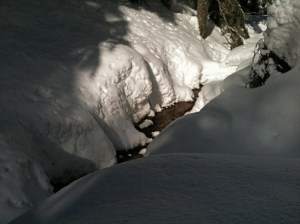
Yesterday morning, I checked the mountain’s weather report again, which claimed sun and powder. So I decided to go up for a couple of hours before work. Most of the fresh tracks were in the trees, but from my first run, a steep slope that I sank slowly down on a pillow of light snow, to my last, a straight shot over some untouched lines adjacent to the bunny hill, I stayed close to the runs; well within shouting distance. With one exception. I accidentally found a gully on the back of the mountain that was a thin line of wilderness in an otherwise heavily-traveled area. There was a tiny stream at the bottom. It was beautiful, and the sun, which had been hiding, came out just in time to create a charming tableau complete with snow dust falling through the sun-lit trees.

After taking a couple of photos with my iPhone, I tried to backtrack on foot. In several feet of powder. Each time I took a step, I sank to above my knee, punching down through the light new stuff through a thin layer of ice to the heavy older stuff. My foot, encased in its stiff snowboarding boot, would stick in the hole. So I had to crawl, still sinking, leaning on my snowboard, using it like a makeshift ice axe on the steeper slopes, pushing it up these little picturesque hills and through cedars. It was such hard work that every ten to twenty feet I would collapse and eat some snow — intricate, fluffy ice crystals that curled away from my hot breath like polyester from a flame. Or else I would roll over and try to stay positive by admiring the view. It was ridiculous not to be able to walk like an adult; it was ridiculous that such short distances were so daunting, especially when I’d been flying across acres of downhill terrain such a short time ago. The trek was probably less than a quarter mile all told, but it took over an hour to make it back up to a spot where I could put my snowboard on and surf out. On the bus ride down from the mountain shortly thereafter, I realized I was freezing, probably from eating the snow, and so tired that I was practically nodding off anyway. So I went home, took a super-hot shower, and went to bed, to sleep until I felt human enough to go to work. Fortunately, my work is flexible like that.

Glendale Raptors defeat Old Puget Sound Beach in spring season start (and other stories)

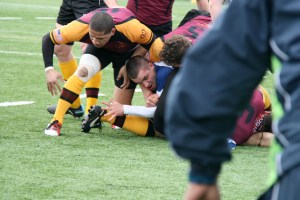
Glendale won 35-21 after a close game this past Saturday between two of the nation’s leading rugby teams. Despite winning the last season, the Colorado-based Raptors had suspected that they would have their work cut out for them in playing the Washington-based opposition on its own turf, and, indeed, they were tied at the beginning of the second half.

When I say “its own turf,” I don’t mean that completely literally. There aren’t many rugby stadiums in the United States. In fact, there’s just one, and it’s Glendale’s. Glendale, by the way, is set to become one of a few US professional rugby teams in 2013, boasts current US team members on its roster, and is currently ranked #1 in the nation among Division 1 club teams. But that’s not really why I care about Glendale. I care about Glendale because my brother Sam Botkin plays for them. This weekend, I was watching him play at the semi-pro level for the first time, alongside players who had been on national teams all over the world.

He was — no surprise — ferocious. Within minutes of the game starting, in fact, his face was covered in blood. His lip got mangled in a tussle for the ball; ground up into hamburger. He checked to make sure his teeth were still intact, and kept playing, until the ref made him go wipe off his face.

“I hope you didn’t have any modeling contracts,” one of his teammates joked, looking at the blackened, swollen mass.

“Actually…” Sam trailed off. He’d submitted some photos to an agency, which had gotten him a couple of interviews. No actual modeling jobs yet, but it was a start. I thought, in any case, now his lower lip will match his upper lip. Back when he was three, he’d been chasing eight-year-old me around the yard (not the other way around) and I jumped up on the deck to avoid him. He attempted to follow suit, and crashed into the edge face-first, splitting his lip. That one has had an excess of testosterone since he was an infant.

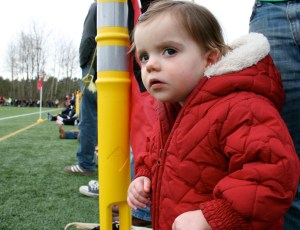
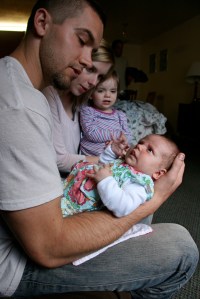
Which is probably why he was back in the game fairly quickly. By this point, my sister, brother-in-law and two nieces had shown up. Chloe, who is 20 months old, positioned herself on the sidelines where she could follow Sam’s every move. Chloe loves her uncle, and she also really likes rugby. To the point that she’ll climb up on Sam’s lap, find his iPhone, and ask “uh’bee?” bouncing and nodding until he pulls up a video and hands it to her. She will watch the uniformed men tearing up and down the field, and at the end, will often ask “more?” Her first live match held her interest enough that if you asked her where her uncle was, in the melee of white and blue stripes swirling across the green, she would point. Accurately. At least until the junk food appeared.

Meanwhile, the rest of my family was looking cold and somewhat hungry.

After Glendale emerged victorious, we celebrated by heading back to our hotel in the University District, towing Sam with us, bloodstains and all. While Sam was in the shower, we — my brother-in-law, boyfriend, friend and I — realized that we had 15 minutes before happy hour ended at a local brewery, and decided to run the several blocks, texting Sam on the way to let him know where we were going. We ordered with three minutes to spare, getting Sam an oatmeal stout. Sam arrived shortly thereafter, in a double-breasted jacket, looking about as suave as one can with dried blood plastered over one’s lip. He drank his beverage out of the left side of his mouth, pronouncing it tasty enough to be worth the sting.

Afterwards, we ate dinner together, cooked in our hotel’s kitchenette, and Sam held his newest niece.

Then we did something that I do not remember ever having done before: we went to a bar with my parents. The Raptors were congregating at a spot a few miles away, and Sam wanted to join them. Apparently, most of them were leaving as we arrived, which meant the volume settled to a dull roar and allowed us to talk. One of Sam’s teammates introduced himself — as Butters. I asked if this was a reference to South Park, wondering what this African-American from New Orleans had in common with the sweet, naive blond kid from the cartoon. “Naw,” he said “I’m slippery. Tough to tackle.” He sat down with us, shared a pitcher, and told us how much he loved rugby. “I would be a different person if it wasn’t for this sport,” he said “I’ve met a lot of good people. I’ve traveled.” He put his mug down and proposed that we play a drinking game. We played one round, and my mom lost.

The next day, we said goodbye to Sam, and drove back to Idaho.

In the waters of Royal Davui

I look for adventure that will make my blood surge, although the ocean has probably provided me with more terror than all other terrain combined. I have always wanted to go diving, and now, here in a pristine Fijian paradise, I have the chance. So I start in the resort’s pool, and dive off-jetty within the hour, sinking in my heavy equipment to watch the clouds of multicolored, flashing sea life — fish of a dozen varieties. When they disappear, and it’s just this murky, light-strewn three-dimensional world, I tell myself not to care that I feel seawater in my nose and can taste it in my mouth, try to slow my breathing and study the coral. I tell myself that this is fun. We are not that deep, and it’s mostly the fact that worst-case scenarios are running through my head. I had neglected to ask the dive instructor what happens if I start coughing so hard I lose the regulator, inhale water, and, unable to breathe, am rushed to the surface. Will my lungs explode at the top? I shut this thought out.

The last full day on the island, I go out on a fishing boat to try to catch my own lunch, but it is rather slow going. On a whim, I climb to the bow and dangle my legs over, close enough to the racing surface that when the boat lurches into the valley of a wave, my toes break into the sea. I lean over, grasping the rail, watching for the crests that will topple the craft down again so that I can bury my feet in the waves and feel the salt spray lick my skin — skin that I have covered these four days, though less than perfectly. But momentarily I do not care and I am lost in the sway of the ocean. I look back at my fishing companions. One of them has just lost a fish because his line crossed my unattended one. So I climb back, over the two-inch wide metal strip between the hold and the bow, and watch the lines with them. But I can’t help leaning over the side, and then dangling both feet over again, holding on with my right arm. I peer down into the water, closer than on the bow, but more obscured by the foam coming off the boat, and I see shapes through the water. Flat gray, and slightly smaller than me, though it’s hard to tell with the way the light shifts into the depths. Perhaps rocks, or coral. But they move with the boat. I point with my left hand. “Sharks!” I say. The water may smell of blood from our catch of a mackerel and what the guide says is some kind of sharp-toothed garfish, but I leave my toes in the water. They’ll just be reef sharks. My companions laugh at me. “Those are dolphins,” they say. I stare, entranced, as the creatures leap, arc, racing the boat, three of them, until they swim away. Too late, I realize I could have let go and fallen into their midst, perhaps touched one. I might have given my Fijian fishing guide a heart attack, but then again, probably not.

When I get back from fishing, I am so delighted I do not even want to stop for lunch. I don my Under Armour tights and a Nike long-sleeved running shirt to stave off sunburn and traipse down for a Hobie Cat lesson. Gus, the 18-year-old Fiji Youth Hobie Cat racing champion, whom the owner of the resort picked up off the docks of Suva as a loitering youngster and taught to sail, is waiting. He looks at me and goes to the Marine Center for a pair of harnesses. Gus shows me how to hook into the side of the catamaran, and we’re off, one hull up, leaning back into the harness and bracing against the side of the trampoline with our feet, so that when both hulls are down, we’re parallel with the surf. I have the jib, although I don’t do anything with it other than hold the rope for balance so hard I begin to get blisters. I arch backwards and drag my fingers in the water as we fly past, as the boat wavers up and down, so we’re almost vertical at times. Gus chuckles as he tips it up, until he goes too far, and we’re so far upright I lose my balance and plummet to the ocean, and the boat tips over, sail flat. Gus tells me to climb up on the hull with him and help him right everything. Only we aren’t heavy enough, so I have to climb his knees and lean on his chest so we form a counterweight.

When all is righted, Gus tells me to take the rudder and the mainsail, and we go slowly back as he shows me how to catch the wind and steer. Every time we begin to tip too much and I let the sail slack to bring us down, he chuckles again. He asks me where I’m from, and I tell him that back there, it’s snowing.

We sail for nearly three hours, sliding around under the boom, and I’m thankful for my Under Armour, especially when I discover red burns up to my ankles. We tip the boat again, and then I’m hungry for lunch, which consists of beer-battered fish and chips made from the Mackerel caught earlier — the best fish and chips I’m sure I’ve ever had.

When I arrive back in Los Angeles, I fill a Fiji water bottle from the drinking fountain and wait for my next flight. I try not to be picky when it comes to drinking water, but I can’t help being horrified at how bad it tastes. And, not for the last time, I miss the waters of Fiji.

For my Valentine

Sometimes, in these last few years, I couldn’t help but feel that the mistakes I’d made would haunt me forever, at least in projected marks upon my forehead. For better or worse, as cliché as it may be, the bad times make you who you are as much or more than the good times. But had I never known abject failure, I would have no tolerance for abject failure in another human being.

Shortly after I was born, my father wrote me a note telling me that if he could make for me a world devoid of pain and heartbreak, much as he might wish for such a world looking at me in my tiny, frail state, he would not do it. And for this I am grateful. My father has done his best to protect me from harm all the days of my life, but to create a world devoid of pain is to create a flat space where there should be texture, topography, valleys of shadow and mountains so close to the sun that its heat burns you. Sorrow is the world’s common denominator, its oldest call to maturity, its first precursor to forgiveness. To shut out pain is to shut out living.

And if in the midst of this, in the midst of the bare-faced, nuanced imperfection of your being, someone can tell you whole-heartedly that you are worthy of pursuit, that you are worthy of being treated well, it can give you hope, not just for yourself, but for the race of men. Though you may have countless examples of non-romantic excellence, sometimes it takes romantic excellence to convince you that romantic excellence exists in a form to fit your particularities. Even if you don’t end up marrying the guy. Because it’s real. You know it’s real. You’ve been there. You won’t settle for anything less again.

The first night I met Louis, we were sitting around a fire in our mutual friend Em’s back yard, and Em brought up the story of how he’d carried a girl home from a wedding because she was too drunk to get there on her own initiative. This girl’s fiance was absent, so Louis took responsibility for her. After Louis trudged back, and she threw up on his shoes, he deposited her in her own bed, and she, anxious from the toxins coursing through her small frame, asked that he sleep on the floor next to her in case something bad happened. Louis said he couldn’t do that out of respect for her fiance, but that he would leave her door open and sleep in the hallway if she liked. So it was that our mutual friend Em, the other girl’s housemate, got up in the middle of the night and found Louis curled up in the doorway, “like a big mastiff.”

This odd little story warmed my heart, and I thought, I think I like this dude. Despite the less-than-ideal situation, he didn’t try to pawn her off on someone else. He just took care of her.

We started dating a few weeks later, and I was completely myself with him. We disagreed about some things. I half-expected him to be uncomfortable with this. But he wasn’t. We still disagree, but he reassures me: “If anyone is rude to you for what you believe, I will always have your back.” And then he grins, because I think he likes this idea.

This is one reason I respect him — because he is man enough to consider what I have to say and not be threatened by it. And believe me, he should be this secure in his manhood. This is someone who has personally hunted, and caught, terrorists — a man who will care for and protect his friends without expecting anything in return, who will protect the weak even if he personally disagrees with them. This is a man who does what he says, who tells the truth, who would never use his greater physical strength to impose his will or his wrath upon me, even by insinuation. This is a man who is respected by his peers and has been fair with his enemies.

But he is not perfect. Thanks be to God. And in his imperfection, he understands mine.