In search of the best pizza in Rome

Louis has family in Rome, and he asks me to go visit them for him. They’re his second cousins or something along those lines, and there are three brothers who own a pizzaria not far from the Spanish steps, he tells me. Also, as a bonus, it’s supposed to be the best pizza in Rome, although my source may be biased. “Go early,” he tells me “it can get crowded.”

I take the metro to Spagna and head down Via Condotti. Valentino, Prada, Cartier, Louis Vuitton, Hermes and Chanel line the street, displaying impossibly high heels and beaded dresses and delicious leather handbags. Behind me, the sun is setting. At the end of the street, there’s a huge sign for Fendi, and a triangular mess of small streets, and I duck into the Via Leoncino and find myself face to face with the pizzaria.

There’s a man at the door who I find out later is called Antonio, and I remember that I should have been practicing my Italian on the way over to try to explain the point of my visit. I get as far as “yo sono…” and then ask if he speaks English. Not very well, he says, and thinks I want something to eat when I try to tell him who I am. I shake my head.

“La familia DiConti,” I say, “In America. You know? I am the girlfriend of Luigi DiConti.”

He is intrigued, but still very confused, so he takes me back to the pizza oven and finds someone who speaks slightly more English than he does. It is enough to get the point across. I find a photo on the wall of Marc, Louis’ father, from when all the family but Louis came to visit the Italian cousins, and point. Antonio asks me, in Italian, which one of the brothers pictured is my boyfriend. I shake my head. He says, oh, he was the one in Iraq. I nod. “Si, si,” I say. Is he still in Iraq, or did he come back? Asks Antonio. I gesture cheerfully to indicate that in fact, he has come back.

At this point, two other older men, the other two brothers who own the pizzaria, come out and kiss me on both cheeks. They welcome me in Italian, and I sit down, and order in (bad) Italian. That much I can do. My pizza comes, along with my sparkling water, and a few locals come in and sit down. I can hear Antonio explaining to one well-dressed couple who I am. The man speaks English, and he tells me, grandly, that this is the best place for Roman pizza in all of Rome. It’s the best pizza I’ve had in Rome, anyway. It is nothing like American pizza, and the crust is so thin in spots that it crumbles like a cracker. The olives, salty and plump, still have the pits in them.

I finish the entire pizza, and I ask the waiter for the bill. He goes off, and Antonio comes back. “No, no,” he says, waving his hand at me. He turns and asks the couple to translate for him.

“No, no,” the woman repeats, waving her hand.

“It’s only one pizza,” the man finishes for Antonio.

The other two brothers come out again and kiss me goodbye, along with Antonio. They say to give their regards to Luigi and Marco. I nod. The well-dressed man repeats this for me in English case I haven’t understood.

And then I head back towards the metro, with a full stomach, smiling.

The papal blessing that was not

There’s a whole passel of people, Catholic and non, going to Rome with Emily and Thomas to see them get the papal blessing on their newly-minted marriage. I have the same flight from Cork they do, as does Mary, so we all share a cab to the airport. Em manages to convince Aer Lingus to give them an extra seat for her wedding dress.

ImageEm and Thomas have been planning this for months. They had to apply, get tickets, and the day of, they have to get up at five in the morning, put on their wedding garb, wait in line for front-row seats, run to claim them, and sit in the sun for about six hours, only one of which is taken up with the papal address. They had been planning to get sandwiches to take with them, but room service is not available at five in the morning in Italy. So the day of the blessing, they sit, in the front row, hungry, and getting more sunburned by the minute, as the Pope gives a short address, which is then translated into French, English, Spanish, Portuguese and Polish. Then it is time for him to bless sacred objects and Catholic people, and Em and Thomas wait for him to come and pray over them in their native language, as they have heard he has done in the past. But apparently he gives the ticket-buying crowd a quick wave over his shoulder and that’s it. He does some other blessings and gets on his Popemobile and goes to wave at the larger crowd below. Which is exciting for the crowd below, but bitterly disappointing for Emily and Thomas.

Sunday night in Cork

I’m staying in Emily and Thomas’ house after their wedding, with Mary, one of Emily’s bridesmaids. Fortunately for everyone concerned, they are not there; they’re in downtown Cork staying a hotel, on something they have dubbed a “mini-moon.” Sunday nights in Cork, they say, there’s a band that plays down at Counihan’s, and they tell Mary and me that they’ll meet us down there. Mary convinces Isaiah, the photographer from Em’s wedding, to pay for a $50 cab from where he’s staying because it’s our last night in Ireland. We meet Isaiah out front, where we’re lectured by a very drunk Irish gentleman that we need to have a good time and not tell everyone inside “Hey, I’m a Yank.”

“Um,” I mumble “We never say that.”

Mary and Isaiah are nodding and smiling, because they’re having trouble understanding him. His accent is so thick and his slang so profuse, you could make stew out of it. We shake his hand several times and then go in.

The band is playing probably the best traditional Irish music I’ve ever heard in person. There’s a South American flair to it, and it makes me want to get up and dance. But nobody else is dancing, so I sit at my table and clap vigorously instead. Emily and Thomas show up and join us, and we drink Guinness and Beamish. Mary drinks something a bit lighter in color. Soon enough, I feel the need to find the ladies’ room. As I go in, I catch a glimpse of a blonde girl in the mirror as she stands at the sink washing her hands. She looks like someone I know. For the next minute, I’m trying to remember who. Maybe she looks like someone famous. And then I remember: she looks almost exactly like a girl I’ve seen in yoga class a few times in my town of 10,000 people. I bolt out of the stall to get a better look at her, trying not to seem creepy. And sure enough, it looks like her identical twin.

“Are you from Sandpoint?” I blurt out.

“How’d you know that?” she asks, obviously startled.

“I’m in your yoga class,” I say, still trying not to be creepy. “Hot yoga. The one Noelle teaches.”

She doesn’t know who I am, but it doesn’t matter. “I’m Katie,” she introduces herself.

“I’m Katie, too,” I say, and I laugh.

So we go downstairs, and of course we take a picture together and tell our mutual friends about it. And we go back to drinking our Irish stout.

The whole purpose of my visit

One of the most surreal things about traveling is finding people displaced into a new context, as, in this case, happened shortly after I arrived at Barabrow and people started trickling in for the wedding of Thomas and Emma, which was my whole reason for being there in the first place. Most of these people I had never met, although I knew them by reputation or sight or last name. So I spent the evening sitting outside, in my down jacket, talking to people who live about an hour away from my hometown, as they ate and drank and laughed together.

The next morning, I asked Thomas, the soon-to-be groom, who was calmly partaking of his full Irish breakfast in the center of a small crowd of guests, whether it was normal for an Irish wedding celebration to extend to either side of the wedding so extensively. He said sort of. Emily, meanwhile, was upstairs getting ready. A few hours later, she emerged. Naturally, it had started to rain.

The rest of us from Barnabrow, including most of the bridesmaids and the flower girl, walked down to a waiting bus, which apparently could not make it up the driveway, and which apparently had been booked by Thomas to ease the to-and-fro. We the rode the half-hour to Cork, where the wedding would take place.

The bus driver stopped and told us to walk down an alley, and we would find Saints Peter and Paul’s Church, a neo-Gothic structure built in 1786.

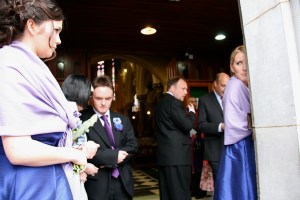
I’m not sure if I was technically supposed to, since I was at one point reprimanded by someone for holding a camera, but I took some photos during the course of the Latin mass and marriage ceremony (both were sort of mixed and I wasn’t completely sure which was which all the time). Emily’s parents, excellent Catholics and highly traditional, were doing it, so I figured it was probably alright.

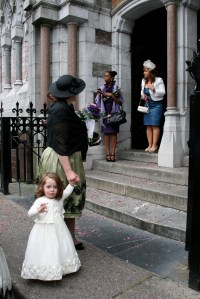
Once we were out of the church again, I felt more comfortable taking photos of everything. We assembled around the exit and grabbed handfuls of dried rose petals to throw at the happy couple when they had finished with a few photographs or whatever it was they were doing.


Then we gathered ourselves up to take the bus back to Barabrow, where the reception would take place. There was some champagne, and then we settled in for a four-course meal. I think there were about nine bottles of wine at our table. The place was lit almost entirely by candles, which was lovely, but apparently not altogether safe. A table nearby almost set the place on fire twice, once when someone tried to lean a camera bag against a flame, and another time when a napkin went alight. Both times, the offending objects were drowned in someone’s water glass. After dinner, we danced to traditional Irish music, forming lines and switching partners as we were instructed. At around 12:30, I was so tired I went and took a nap, setting my alarm for 2. I got up and went to the after-party, two doors down from my room, where Thomas and Emily were singing and drinking Irish whiskey with a small group that had not gone to bed yet. They left around 3, and we kept singing, our arms around each other, swaying back and forth in time with the acoustic guitar.

Beyond Dublin

“You’re checked through all the way to Dublin,” said the uniform-clad woman in the Spokane airport, at half-past four in the morning, handing me a trio of tickets. And one, two, three, four, five, the phrase “all the way to Dublin” was lodged melodically in my head for the next 20 hours, until, in fact, I was sitting on a bus staring out the window onto the River Liffey, taking in the pedestrians on the quays and the harp-bowed bridges, my sleep deprivation buzzing in the background and tinging the experience with a level of the surreal. That looks just like the quay I sat on back when I was out that one time with all those Australians and Finns, I thought to myself, a split second before realizing that it probably was, since that one time had been on a ramble back from Temple Bar. The vodka out of teacups night, we had called it, because we had started it back at the hostel kitchen using the only glasses available to us. Part of the curse of traveling so much, especially if you stay somewhere with people of different nationalities, is that the places start to blur together, and occasionally you have trouble remembering where certain events were anchored. I had actually spent the night in the Dublin airport once, and I still, somehow, was picturing the Buenos Aires airport when I tried to remember its layout.

In spite of the vast differences in the climates I’ve been to, there’s a certain way the air hits me when I emerge into a strange place, fresh off the plane, and it jolts me awake and gives me enough energy that I can then find my way to my destination, even if it’s complex and takes hours. In this case, I found my bus to Cork, got dropped off in Cork, discovered a taxi to Barnabrow would be about $70, wandered around, asked an old fellow on the street how I would get a bus to Midelton, found that, waited an hour, got on the bus, told the bus driver where I was going, got his advice on how to get there from Midelton, got out at Midelton, asked a group of kids on the street where I would get a taxi from there, walked down an ally and found a taxi company, commandeered a ride to Barnabrow for $20, and arrived at my destination approximately 26 hours after having been handed the tickets in the Spokane airport.

I think it’s partially the memory of how much worse I used to be at this, but every time I’m getting ready to go on a trip this detailed, I start to worry a bit if it will actually be any fun. But in so doing, I underestimate myself. On the plane, there was an interesting neurological documentary about how habits are regulated by your subconscious, allowing your cerebral cortex to focus on other things. I usually travel in such a way that I have minimal extraneous stuff to worry about. I have a tiny suitcase, I wear my really important stuff under my clothes, and I carry water and Olympic-training-grade power bars with me.

But mostly, I think, I’ve suspended myself in different cultures and places so many times that the unfamiliar is easier to deal with, and rarely does something seem completely unfamiliar. Which, on the one hand, is nice, and on the other means that sometimes place and culture jump around in my head, and world itself becomes my backyard.

Areté after Ares

There is no honor

In resting upon your laurels or your thorns

In letting past glory or failure answer for the day

There is no honor

In claiming gain as worth, or debt as sin

In having either steal your self-possession

There is no honor

In giving any slight, annoyance, hindrance, tardiness or lack

Inordinate weight.

Rather, your honor lies in this:

That you protect yourself and fellow man,

However depleted you may be

However little you agree

However little you have slept

That you make do with whatever tool lies at your right hand,

That you take the sword and turn it to a plowshare

And learn the thought behind the action —

To live by honor, when none but honor orders.

To catch a thief, crowdsourced

On May 29 or 30 of last year, my Burton snowboarding jacket got taken out of my car, which was parked (unlocked) in front of my house. It was a distinctive coat, with a purple argyle pattern that had endeared it to me when I discovered it on clearance in Seattle back in 2007. It was on the kid’s rack, and was the only size XL available, which meant that it was (for a Burton snowboarding jacket) affordable.

So when it disappeared, I wondered, given how small Sandpoint is, if I would see it again. Maybe on the ski hill, or maybe around town somewhere. And I kept my eyes peeled for it. Because I really liked it, and because I couldn’t really afford to replace it with a new coat. Instead, my friend Melissa gave me one she had, which was incredibly nice of her.

But it wasn’t my sweet purple argyle coat, which I had taken all over the world with me. So I watched, and I waited.

And then, on Saturday night, as I relaxed downtown in a trendy little wine bar listening to some music, in strolled what looked like my coat, worn by a thin, just-out-of-adolescence-blondish girl with sharp features. I sat bolt upright and stared. Louis looked at me with concern. “What’s wrong?” he asked.

I told him, and asked him to go ask her where she’d got it. So he did. “That’s a nice coat,” he said “Where did you get it?”

I overheard her tell him that some friend of hers had given it to her. Which really didn’t resolve anything. “What should I do?” I whispered, feeling my hands go numb with the strain. “I want to say something to her.”

I got up, went over, trying to look polite, and said I’d had a coat just like that stolen. She showed me on her smart phone that she’d just been texting her friend (unnamed) to ask where her friend had gotten it. Slightly weird, since Louis had been so nice, but OK. An older lady in this group stepped in at this point and asked if the coat I’d had had been distinctively marked in some way.

“Well,” I said “I’m guessing that coat is a size extra-large, which you wouldn’t know by looking at it. But it’s a kid’s coat. It’s a Burton.”

The girl took the coat off and looked at the size. It said: Burton, XL. “Weird,” said the girl, as if she’d never realized that.

At this point, the older woman, who was between 40 and 50, sleek, dark-haired and shorter than the college-age(ish) girl, started to get irritated and said I was accusing the girl, who was her stepdaughter, of stealing. “I’m not saying that,” I said “Maybe her friend stole it. But that’s a very unusual coat. I bought it in Seattle years ago. I’ve never seen anyone else wearing one, have you?”

“Actually, I have,” said the woman “In fact, I bought two in Seattle. I gave one to my cousin, and one to —” she said the girl’s name, pointing. It sounded like Darshna.

“Um,” I said “She just said her friend gave her the coat.” By this point, I was starting to suspect the girl had stolen it or was otherwise known to shoplift; why else would the stepmother insist on something that was so obviously untrue? I doubted this woman’s cousin was the type to be wearing a children’s snowboarding jacket, either.

But the woman insisted that thinking the jacket had once belonged to me was “illogical.”

“No, you’re being illogical,” I retorted, getting mad. “Your stories don’t match up.”

“But they would if you just let me explain!” the woman protested. So I listened. The woman proceed to tell me that in fact, she’d given the jacket to her stepdaughter’s friend.

“And then the friend gave her the jacket?” I finished.

“Yes,” the woman mumbled.

I’m not sure how the stepdaughter hadn’t known that, and had seen fit to preemptively text her friend to ask where she’d gotten it. But, you know, these things happen.

The father, a tall man with a gray goatee, leaned on Louis and slurred in his ear: “Come on, man.” Louis looked up at him and said “Come on, what?”

The older woman went to get the bartender because I was ruining their nice evening out. The bartender ushered us away, but was quite understanding after we’d told him the details of the conversation. He said he’d try to get these people’s contact information. I said Ok, and went out the back door to get some fresh air, and then returned to sit back down. I didn’t know what else to do. I wasn’t going to call the cops and disturb the whole place. I knew our server; I knew the band; and I didn’t think I had any real proof other than their ridiculous lack of cohesiveness and entitled-yuppie attitude. Louis got the details the girl had provided the bartender. She’d said her name was Kim and had scrawled a Wisconsin number that went to a Kim’s voicemail. We left. I didn’t think her name was Kim, but what was I going to do?

Later, I left a message on Kim’s answering machine saying I’d met a girl who had claimed the name and number as her own in Sandpoint, Idaho, and that if I didn’t hear from her I would assume this was not the case. So far, I haven’t heard back from her.

I remembered that I still had the liner from that jacket, and wished I’d asked if the girl had the liner to hers. She hadn’t been wearing it, anyway. I dug around and found some of the tags to the coat in my warranty files. I found an e-mail from June 2 about missing the coat. I then called the police, explained the situation, and asked if they could get these people’s contact information from the wine bar’s records. I was certain the bartender would remember them. The police said they’d file a report and see what they could do, but that “they didn’t have a lot of information to go on.” I said thanks, gave them Kim’s number just in case, and hung up.

So, now I’m looking for any other information and would like help in the endeavor. It’s a long shot. And I know, it’s just a coat. But these people’s attitudes really chaffed me.

Polarizing on purpose

Here’s the thing about having something like your own book label. It means you’ve got to get people’s attention one way or another if you ever hope to sell anything. Let me just say from a quick survey of hits on various blogs and websites I write for that the easiest way to get attention in this ADD society is to be controversial; polarizing, even. So out-there that people might want to read you out of sheer rage or shock.

Lately I’ve been wondering if people do this on purpose. There’s a lot of theory you can read on successfully marketing yourself, which is what you need to do if you want to get repeat blog traffic, devoted readers, happy editors, and so on and so forth. And basically it boils down to being able to grab, and hold, attention. Even if you’re willing to be nothing more than the Jackass of your particular niche, they will come in droves to laugh at you and cheer you on — and will pay to do so. All the more so if you vehemently delight in your antics. All the more so if you can do it with a straight face.

Maybe I’m misreading people’s motives, but I can’t help suspect that some of the more notorious religious figures and writers of the modern age are imperfect on purpose. By which I mean that they say things that on the surface are ridiculous or bizarre, insinuate that you’re in error if you disagree, and then, when you point out the obvious fallacy, smoothly walk out the back door of metaphor and hyperbole.

By then, maybe, you’re so mad you start obsessing. You talk about it to anyone who will listen. They don’t get it; they check it out and then you argue about it. Or vice versa. Maybe you had friends who liked this figure or writer to begin with, and you only got involved when you became alarmed at some of the things they were echoing. Or maybe you got involved because you thought the echoes were hilarious, or just very, very true; so true nobody had dared to voice them until now because of their potential unpopularity.

Take, for example, something like Douglas Wilson’s recent suggestion that churches should be filling “the sanctuary with loud sounds of battle,” preaching on battle, and the minister should look in some way as if he were “robed for battle.” Taken at face value, this is ridiculous. Nobody would seriously suggest that a preacher or priest strap on the latest fashion in Kevlar before addressing the congregation. Neither would anybody suggest that worship services should incorporate the sounds of bombs, screams and dismemberment. So what exactly is the point of this rhetoric and what is it supposed to mean?

The goal of this particular blog post is to mock “effeminate” worship services, which is more or less in vogue in certain evangelical circles at the moment. But obviously, jumping on a bandwagon isn’t going to get you any headlines, so you’ve got to take it a step further. You’ve got to ask yourself: what is the epitome of masculinity? And answer: Well, war and battle and blood and gore and the warrior spirit. Hence, that’s what Christianity should look like, because Christianity is supposed to be masculine.

Christianity = masculine. War = masculine. Hence, Christianity = war. This equation will no doubt offend people, so I can insinuate that if this offends you, you’re either gay or a feminist, or possibly both.

Of course, this is a religion started by the “Prince of Peace,” a man whose only association with ready-made weaponry of any kind was to tell his follower to put it away. That anyone should say it is best celebrated by lauding battle has more to do with right-wing American culture than actual Christian tradition. But no matter; this is not a serious suggestion. It’s merely a flick against the ear of a bored public.

I only know this because I attended Wilson’s sister church in Moscow as recently as Easter, and there was no battle garb and no gunpowder. The two pastors wore floor-length black robes, and neither looked muscular or warrior-like in them — which was fine, because I did not expect them to. There was a choir that included both genders, in which some of the women were tastefully showing their knees. The fathers in the congregation got up and tended to their babies about as often as the mothers did. It was not particularly masculine, unless by “masculine” you mean kind overall, musically traditional, harmonious or slightly atonal. And that, again, is just fine, because you can’t force something that is concretely unconcerned with how masculine it appears into the mold of trench warfare or military-style hierarchy without it getting really weird.

In general, it seems that rarely are polarizing figures (or congregations) that controversial when you get them one-on-one, in private. After all, I have yet to meet anyone I absolutely hated after a real conversation. Have you?

Stop Abortion Now

There was this sign I used to hold as a kid when we went to pro-life rallies, which typically consisted of long lines of families standing on the sidewalk. It said, like all the other signs said, “Stop Abortion Now.” Once, when I was nine, some guy jumped out of a van with a television camera and asked why I was holding the sign. I looked at the ground, embarrassed. “Well,” I said tentatively “Because I think God would want us to stand up for the little babies.”

I still think that in an ideal world, there would be no abortion whatsoever. None. Oddly enough, I think you could get just about everybody to agree on this. Even if you don’t believe that humanity begins at conception, as (apparently) St. Augustine did not, even if you don’t think the Bible equates abortion with homicide, as conservative Jews do not, and even if you’re neutral about the moral implications of accidental pregnancy, it’s still not a choice that you want to ever have to make. Maybe you make it to save your own life. Maybe you make it because you’re 17 and your parents are going to disown you. Maybe you make it because you can’t afford to feed another person. Maybe you make it because you have no idea who the father is. None of these are particularly wonderful realities to be faced with, and probably, you’re fully aware that if you could change the reality, then you wouldn’t have to make this decision.

Back when I was nine, I wanted people to outlaw abortion. I had Stop Abortion Now club in my room a couple of times, where I talked about writing strongly-worded letters and opinion pieces on the subject. I composed my will on a sheet of legal paper and declared that half my bank account should go to the Right To Life in the event of my untimely demise. I mean, I was only nine (or so) years from having had the possibility of that being done to me, and that was kind of appalling, especially as a kid who had not been planned. I thought making it illegal would take care of it.

This last week, a full 21 years later, I got curious and started doing actual research as to whether this was true. Apparently, it’s not. Statistically, making it illegal doesn’t decrease the rate of abortion. In many countries where it’s prohibited or highly restricted, in fact, the abortion rates are quite a bit higher than the United States. Consider this extensive compilation of abortion rates by country, for example.

This really shouldn’t come as a surprise. People do things that are illegal all the time; that’s why an entire stadium will smell like pot at a concert. That’s why there are speeding tickets and jails and cops and lawyers and judges.

If you seriously want to stop abortion, you have to change the baseline realities that lead to abortion. So, let’s consider the places that have the lowest instances of abortion. First on the list: the Netherlands. Yes, that’s right. Pretty much the most liberal country on the planet has the lowest rate of abortion on the planet. Ironic, isn’t it?

Well, not really. For one thing, the Netherlands is also one of the most egalitarian countries on the planet, especially when it comes to gender roles. This is true even though many Dutch women are still stay-at-home mothers and the Dutch are still very family-oriented. But when, as a woman, you know your voice counts, you also know that your “no” supersedes his “yes,” and hence, you can refuse him if you want — even if he’s an authority figure.

Contraception is also widely available in the Netherlands, and people expect you to use it — you’re basically considered an idiot if you have unprotected sex unless you’re trying to have a child. This goes for many Western European countries where abortion rates are low, and this doesn’t necessarily make these countries less monogamous or more likely to engage in sex earlier. French women, for example, are actually more monogamous than American women, as it turns out.

The baseline reality that often leads to abortion is a disconnect between theoretical belief and what actually happens. Take the highly Catholic country of Peru, where abortion is outlawed in most cases — it has an exponentially higher abortion rate than Western Europe or even America. Consider the abortion rate of the predominantly Catholic country Chile, where not only is abortion illegal, but divorce is as well. Heck, take America. Apparently, 65% of abortions are performed on those claiming to be Christians — and American Evangelical Christians are hugely opposed to premarital sex, at least in theory. Which is probably why they aren’t using contraception. Because, you know, it’s less bad if it’s not premeditated.

At least until you realize you’re pregnant, and that there’s no way you can be pregnant without ruining your life and what everybody thinks of you. And then what do you do?

Faced with these kinds of statistics, you often get people saying that what we really need is to just start making an example of unwed mothers, who obviously didn’t take sex seriously enough, and return to the good old days when Family Values really counted for something. Only I have yet to find an era where this actually worked. Punishing unwed mothers resulted in systematic infanticide in Victorian England, for example. In the colonies and in early American history, single mothers were punished more harshly than the men who sired their children, though this somehow did not stop men from siring illegitimate children, sometimes with slaves. In the 1940s and 1950s, single mothers could be forced into places like the Magdalene Laundries — or merely kept out of sight and coerced into relinquishing their children — and their offspring were sometimes subjected to cruelty or sexual abuse, as in the case of the Duplessis Orphans. Even the combination of making abortion illegal and the widespread practice of something like female genital mutilation, which makes sex painful for women, does not prevent abortion, as evidenced by Kenya, where about 300,000 illegal abortions are performed every year — a per-woman rate about four times higher than the per-woman rate in the Netherlands.

In Kenya, interestingly enough, “Men are the decision makers in society, and this trickles down even to sexual issues. Men are the ones to decide how and when to have sex,” says Jean Kaggi, Chairwoman of the Protecting Life Movement of Kenya. Which brings us back to the egalitarian thing. Places with high abortion rates tend to be more hierarchical, which means, overall, that men make the decision to have sex and women are the ones punished for it, especially in the case of illegal and dangerous abortions. In fact, the countries with the highest rates of abortion seem to have a perfect storm of hierarchical gender roles, limited access to contraception, and poor sex education. Sometimes this occurs where abortion is highly restricted, as in Latin America, or it may occur where it is barely restricted at all, as in Eastern Europe — but in general, a reputable team of researchers has recently found that “Restrictive abortion laws are not associated with lower abortion rates.” They even go so far as to suggest that the opposite may be true.

So how does one stop abortion, then? It will not be accomplished by politicians placing legal sanctions on it. It will not be accomplished by religious institutions placing moral sanctions on it, at least not combined with sanctions on gender equality and contraception. Based on the evidence, and on basic logic, it will best be accomplished by allowing people to take full responsibility for their sexuality and fertility.

By this, I do not mean that the official line should be “don’t have sex, ever, unless you, as a married person, fully intend to procreate or are willing to accept that procreation may be a result of your action.” First of all, not everyone believes non-procreational sex is wrong, and this tends to balance out the logic that abstinence (and the luck to not get raped) is the only fail-proof method of birth control. Not everyone — in fact, the vast majority of Americans — is actually willing to wait for marriage to have sex.

And even if you do wait, like I did, there’s no guarantee that the person you marry is going to be around in the long term. This means that even if you did everything “right” and have the self-control of a high-wire artist, you could still end up as a single mother facing a less than ideal future if you haven’t been using some form of birth control. Which, personally, I used. But I know too many divorced and separated women who are, or have been, single mothers through no real fault of their own to be smug about this.

What this type of responsibility requires is honesty with yourself: what you intend to do, what you’re willing to do, what you will not do. It requires that you be willing, and able, to discuss these things with your partner if and when you have one. It requires that you, as a sexual creature, be educated in contraceptive use, the inherent risks of sex, how (and why) procreation works, and how to respond when you’re faced with a situation you’re not comfortable with. This type of responsibility does not hide in female “weakness” (I’m a girl, so it’s a guy’s job to take care of me and to make the hard decisions) or male “weakness” (I’m a guy, so it’s the girl’s job to say no and make sure she doesn’t tempt me). It doesn’t hide behind the beliefs of a larger body of people. It doesn’t lie or coerce; usually, people can tell when you’re making something seem worse or better than it is — at least when they start doing their own research. This is exactly the type of education and responsibility that is prevalent in places like the Netherlands where abortion is most rare.

It also requires that you, male or female, have access to and be willing to use contraception (correctly) if you’re not ready to have a kid but you are willing to get jiggy with it. There are a whole slew of options, and more on the horizon.

This is not an idealistic approach so much as a pragmatic approach. However, I do think that, paradoxically, if you are willing to take responsibility for your own sexuality, and its potential consequences on yourself and other people, you may actually wait longer to have sex. You may not wait until marriage, depending on your belief system. But you’ll wait until you’re sure.

And if now that you’ve gone through all this (and possibly done your own research through credible sources to verify it), you’re thinking: it doesn’t matter if it actually decreases abortion, we should still make it illegal in order for punishment to occur, then I don’t think you should consider yourself pro-life. If you think the horrors of back-ally abortion-related maternal death are a more appropriate way to deal with abortion rates than education and birth control, in spite of what statistics actually tell us, then don’t call yourself pro-life. Just come out and own your point of view. You want the rest of the world to be punished if they don’t think just like you do, believe what you believe, and keep it in their pants unless you say it’s OK. And you really don’t care how many abortions are done, as long as you don’t have to see them and you can condemn those who have them.

Easter in the graveyard

ImageMy sister’s in-laws have this tradition of getting a bunch of people together and eating Easter breakfast as a picnic in the graveyard. The result is this sunny spread of bacon, sausage and sweet rolls against the backdrop of weathered gravestones, right around the time of year when you could actually first have a picnic outside and not freeze to death. There are so many layers of meaning and old tradition in this new tradition — the first sunrise Easter service was supposed to have been held in a graveyard, after all — that it’s almost weird it isn’t more widely practiced.

ImageIImage‘ve always liked graveyards, which is maybe a little macabre, but it’s like this perfectly-preserved piece of history, these monuments to people I’ve never met and know nothing about. Always, walking around and reading ancient tombstones, I’m struck by how many were so young. Three years old, two years old. Sometimes there’s a whole row of small, flat markers, likely from one family, likely too expensive to inscript individually. So I take my almost-two-year-old niece by the hand and watch her trace her fingers over the lichen, watch her observe the birds and help her jump over the stones. How lucky she is to have been born in an age of vaccinations, of reproductive safeguard against her mother’s O-negative blood, of antibiotics and plentiful food and good shelter. Of love, because she is loved, widely and generously, by all the people of this gathering, and they watch her to make sure she does not trip headfirst into one of these gravestones.

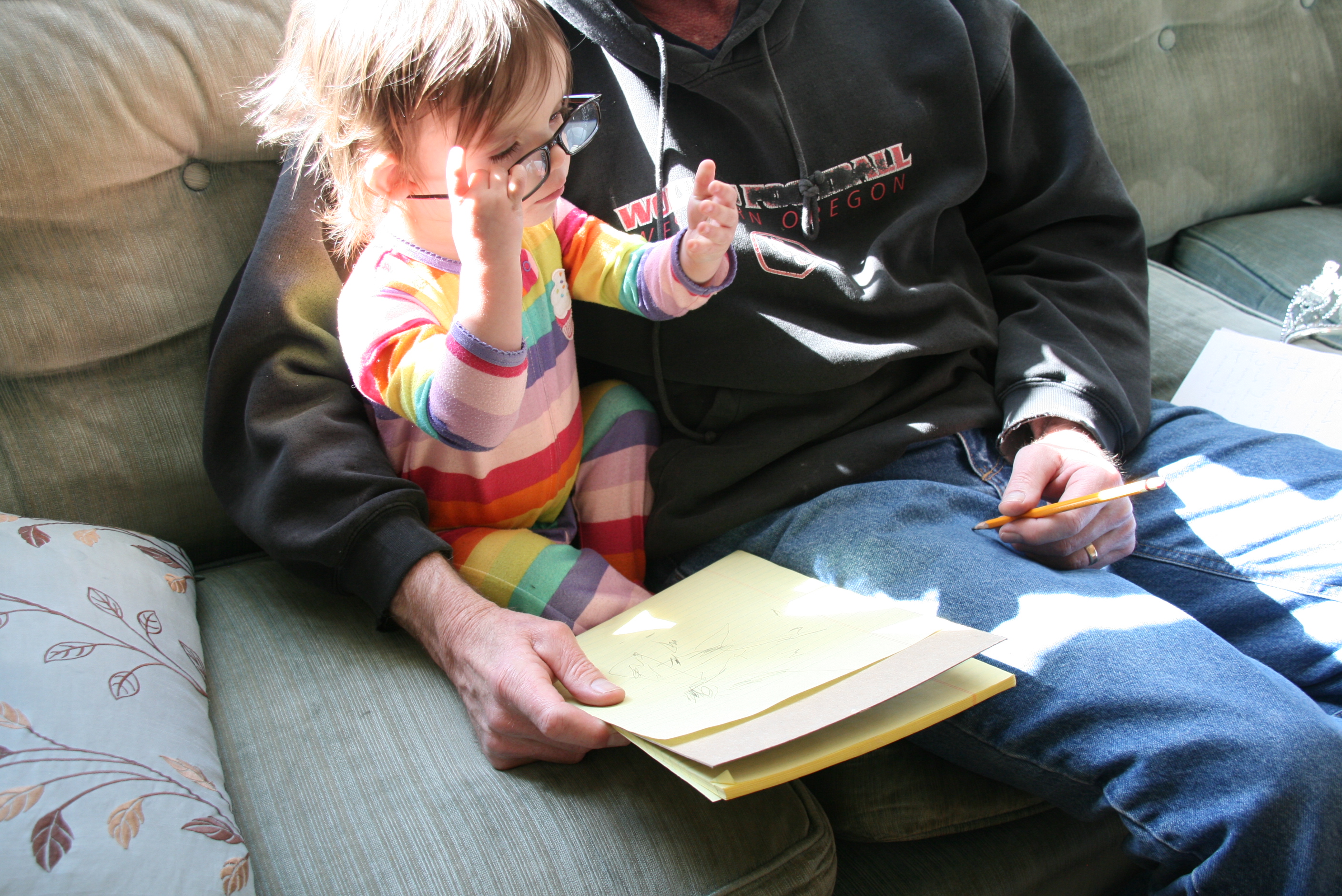
Here, I am reminded to be glad for many things. Mine is an imperfect life in an imperfect world, but there is much to love and to rejoice over. Not least of this is the curiosity and discovery of these elfin children who can take a pair of reading glasses and find new understanding of vision; who never fail to make spring fitting again, even in the graveyard.