Dear Prudence,

I have seen you struggle from afar for a long time. I know you are sad, with the kind of sadness that eats into your psyche and erodes it, that the rust of what was falls away from you in fine, brittle pieces. I know what it is, that sadness.

So because of this, I wanted to offer you a thought for this new year.

Your soul is yours to safeguard. It does not belong to anyone else on this earth. Take it back from him, take it back from what you have heard for so long — that a woman is not fit for shepherding souls, or for learning the great mysteries behind her own skin.

Nobody can take your power from you. You and you alone can stand bare before the mirror and stare hard enough to see the beauty and the real flaws — hard enough to see the real flaws, soft enough that you know you can rise above them, work with them, overcome them. You and you alone can come to the place where you no longer see his words, their words, when you look at yourself in the mirror. When the sight of you doesn’t remind you of all the ways he said you failed, but instead reminds you of what is, apart from him, after him.

Be kind to yourself. It is not easy. You have heard it so often, so loudly, for so long: you are less than. Less than, always, no matter what you did. His glances outward, his emotional distance, his physical absence all screamed it even when he didn’t say it. He wanted you to take responsibility for his failings, to bear their burden, because he was not strong enough. He was weaker than you, much, much, weaker than you.

You are re-learning now that you are lovely, that you are intelligent on many levels, that you work hard and that this dark time will pass. You are re-learning that it is not failure to ask for help, that people are willing to help, that people love you even when you do fail. Your values were strong, though perhaps misplaced. Do not discount how tenacious and passionate you were to live by them. They speak to your strength, not just to what might have been, if only you had known.

Live your life, as it was, as it is. Be here, where it counts, and always hold your well-learned mistrust with an open hand, where someone can snatch it away from you easily.

Happy Christmas holidays

Christmas for our family lasts a few days. Christmas eve, Christmas day, Christmas II, wherein we often end up getting things for ourselves on sale, and then Isaiah’s birthday. His claim is that we celebrate his birthday every year together because he’s the youngest, but the date is serendipitous.

This year, my nieces were old enough to count down the days to Christmas, and young enough that everything they did struck everyone else as adorable. Chloe was dying to open the pink-sparkle-encrusted gift I’d said was for her, and opened it to find a kid-friendly book on anatomy. She was appropriately intrigued.

The adults were happy because they had filled each other’s stockings with chocolate and small bottles of alcohol. I’d been saving a stash of scotch from Edinburgh, from a little side-street store I wandered into with five kegs tapped for sampling. I tasted five and liked two best, the 12-year-old Deanston smooth and balanced, the 9-year-old Ledaig smoky-wild, selecting bottles sized for hand-luggage transport and stockings. I took to the streets of Edinburgh again with a heavy bag and blood warmed by five thimble-sized drams.

I’m trying not to think too hard about that Scotch now. It was so delicious, and I did not save any for myself.

ImageImageImageImage ImageImageImage

An expat in any country

One reason I love other cultures is the possibility that they will be more familiar than the one I’m currently living in.

I grew up in a microculture, one with its own way of dressing and thinking, its own news services, textbooks, cultural heroes, way of speaking English. Since the moment I set foot in the wider world at 18, and was able, for the first time, to drive somewhere without asking permission, to listen to mainstream music and movies without feeling guilty about it, to participate in a culture that I’d only ever seen from a relative distance, I felt out of place; curious, but like some foreign person posing as a native.

Perhaps this is why I immediately wanted to travel somewhere else. At 19, I went to China and experienced rather severe culture shock; at 20, I decided to go live in France for a semester despite only having taken the language for a few months. The great thing about living abroad was that everyone assumed you were starting with zero linguistic and cultural knowledge, and they patted you on the back for learning quickly, for mimicking what they were doing so adeptly. And sure, it was hard, but it was all pretty straightforward. After all, people were perfectly willing to explain the minute details of everything, down to the way your tongue was supposed to be shaped when you pronounced tu. They didn’t pressure you to make small talk, except on quotidian topics such as how many brothers you had or what you were studying.

And people did things the way I liked. They sat at the table for dinner, they didn’t plaster on the makeup, they didn’t go the mall for fun. They walked the cobbled streets and ordered little pastries and bought inexpensive yet delicious cheese and wine. It was very easy to feel at home doing that. And if you didn’t feel at home, that was normal. Nobody was going to hold it against you if you didn’t get the reference to the cartoons and the comics of their childhood.

Over the years, I traveled all over the world, suspending myself, still that foreign person posing as a native. I always tried to learn phrases in the language of the place, enough that I could get by. When I could, I kept my mouth shut, dressed to fit in. I sat quietly on benches, journaling as I had journaled all throughout my childhood. It was magical, this suspension, this ability to find home (or homelessness) anywhere and everywhere. It was magical, being able to quantify cultures and languages and gain some amount of control over them, tuck them into my repertoire, make them familiar, bring their familiarity back into the ever-changing oddness of mainstream American culture. I went to grad school and studied linguistics, and then continued to travel two and three times a year for work to Asia, Europe, wherever, listening to lectures on culture and language and global business. I specialized in cultural and linguistic differences.

Increasingly, the homeschool culture, what I had grown up with, was something I questioned and tried to make sense of. As one woman says of her upbringing in Kathryn Joyce’s article “The Homeschool Apostates,” I felt “like an expat from a subculture that I can never go home to, living in one that is still not fully mine.” And while I have learned the language of this foreign place, watched 80s movies and sampled Top 40 for a decade, it’s still never quite my own. When I meet people who understand both the homeschooling culture and the process of living outside it, it’s like I’m meeting someone from my own country.

Not long ago, I became instant friends with a Korean-American who was biking cross-country to raise funds for MS. We talked about our upbringing, our grades in school, our family, the microcultures we experienced and were still part of to some extent. I went to the East Coast and visited him. We talked some more. I started wondering if companies that wanted to bridge the gap between American and Asian corporate culture should start hiring formerly homeschooled people as project managers. Many American homeschoolers would instantly get patriarchy, hierarchy, community, politeness, tight family dynamics, perfectionism, conformity. They could suspend themselves, see the differences, keep their mouths shut when they didn’t know something — or at least, they could if they had regularly experienced being lower in the hierarchy. If they were the oldest female children of large families, they would likely also have a knack for organizing the people and tasks in their care.

I put together a survey that attempted to test this theory, comparing choices and attitudes for both groups. It seemed that my hunch was accurate, but I didn’t get enough responses for it to be statistically significant. Whatever the case, my Korean-American friend’s mother was happy to list my positive attributes (in Korean) upon meeting me: I was skinny, but I ate plenty of what they offered me; I was pale, and I attempted to politely address them in their native language. And I was apparently a hard, fast worker.

It remains to be seen concretely if the oldest female children of large, traditional American families make good cross-cultural businesswomen. But the idea is ironic. Many of these females have been told their place is at home, only at home, and that they are rebelling against their true nature if they desire anything else. The way these natures are molded, however, certainly can contribute to other careers. Once they have stepped outside the boundary of the home, it’s a short step to take on the rest of the world. When nothing is quite as scary or as antagonistic as you’ve believed growing up, you start getting curious about all kinds of things.
Psychopaths, testosterone, leadership, patriarchy

A few days ago, Doug Wilson pontificated that Doug Phillips, having fallen from grace and besmirched the name of patriarchy, had been led astray by his own “testosterone,” which men in leadership are apparently prone to do if they don’t watch themselves: “A man with lots of testosterone is in a position to start a dynamic ministry that speaks to thousands, that fills conference halls, and that rivets people to their seats. Taking a hypothetical, that very same man is also in a much better position to succumb to the blandishments of a stripper with a stage name of Foxy Bubbles, and all in the settled conviction that his sin will not find him out. How could his sin find him out? He rivets people to their seats.”

Predictably, there was some fall-out from that particular blog post, and Wilson (not for the first and probably not for the last time) started complaining that people misunderstood him, possibly due to their wrongheaded ideologies. Though he still thinks Foxy Bubbles might be involved: “what my objectors may have been picking up on, in between the lines, is my conviction that such a scenario could have been the case. I really do think any number of things might have happened, and don’t take sides based on the current politicization of sex.”

So let’s take a step back and ask a more basic question: could Doug Phillip’s sin have stemmed from an excess of testosterone? Does testosterone spur men to simultaneously fill conference halls with penitents and hire insistent strippers for “inappropriately romantic and affectionate” after-parties? Wilson explains that he doesn’t have the facts, so he’s just offering one possible scenario.

The thing of it is, that doesn’t sound like that’s what happened if you’re paying attention even a little bit. Peter Braderick, Phillip’s close friend, mentee and former right-hand man, put it this way publicly on his Facebook page: “When those who champion ‘women and children first’ hide behind smooth words … When the strong take advantage of the weak, and then turn them out like so much garbage… When the strong seize the lifeboats and leave the weak drowning in the icy water… it leaves no choice for men of God other than to rise up and oppose them when they discover the truth.” Braderick also says that he attempted “to confront a man who has been like a father to me for a third of my life and plead with him to truthfully confess, and to genuinely take responsibility for longstanding betrayal of everything we had fought together for…. Instead of being received as the ‘wounds of a friend’ (Proverbs 27:6), I was formally disowned and declared to be a ‘destroyer’ to my face.” This appears to be consistent with what other men who were close to Phillips — much closer than Wilson ever was — are saying about the Phillips situation. The portrait that’s emerging, then, isn’t of some testosterone-rich, quickly-repentant horny toad getting carried away in the heat of the moment, spurred by the wiles of some expert exotic dancer. It’s looking more like Phillips behaved like a psychopath over a long period of time. In other words, Phillips behaved as if he had no real conscience and manipulated the situation to get away with it.

Psychopaths are not all that rare, and their numbers in leadership positions are statistically about three times that of the general population, according to one study. As one writer notes, “it’s a fact that psychopaths have a clear advantage in fields such as law, business, and politics. They have higher IQs on average than the general population. They take risks and aren’t fazed by failures. They know how to charm and manipulate. They’re ruthless. It could even be argued that the criteria used by corporations to find effective managers actually select specifically for psychopathic traits: characteristics such as charisma, self-centeredness, confidence, and dominance are highly correlated with the psychopathic personality, yet also highly sought after in potential leaders.”

What a coincidence! Charisma, confidence and dominance also come in handy when you’re leading a for-profit movement supporting patriarchy. This isn’t a big surprise — I wrote something two years ago outlining how male sociopaths can blend into patriarchal movements in particular, noting that “the sociopath will probably admit to anything he’s caught red-handed at. He may be extremely eloquent at expressing his regret and will pad his Christian image with confessions of sin. But watch to see if he actually apologizes to his victims and, if so, how he treats them an hour later, or a year later.” In re-reading this, I’m reminded that as far as anyone knows, Doug Phillips has not apologized to the woman in question, or mentioned her in any way.

But let’s go back to Wilson’s comments on testosterone and leadership. It’s true, of course, that testosterone plays a factor in aggression and risk-taking. But in and of itself, high testosterone doesn’t do much for leadership. You need a favorable ratio of testosterone to cortisol, a stress hormone secreted for a “fight or flight” response. Studies have found that high testosterone and low cortisol produce confident, calm leaders, regardless of gender. And here’s where it gets interesting: taking up space and puffing your chest out for even as little as 60 seconds can actually boost your testosterone and lower your cortisol, according to researchers. If you strike a powerful pose, you feel more powerful on an endocrine level. Taking up more space raises testosterone, while taking up less decreases while simultaneously raising your cortisol. Reading this, I immediately thought of Doug Phillip’s (and his fellow patriarchs’) penchant for posing for the camera with his legs about four feet apart. And of the demure poses often struck by the young ladies next to them. If you’re going for maximum gender disparity, this just seems like good policy.

Here’s another interesting twist: a 2011 study showed that psychopathy scores were also associated with an increased ratio of testosterone to cortisol, suggesting “that these highly interconnected hormone systems may work in concert to predispose to psychopathy.” So, an increased ratio of testosterone to cortisol could just mean you’re a good leader, capable of keeping a level head when Rome is burning. Or it could be an indication that you’re a psychopath, able to keep a level head when Rome (along with its citizens) is burning.

Back to Sandpoint

I arrived home to yellow and red leaves on the trees, and brown, crisp ones on the sidewalk. The air was cold; 40 degrees colder than it had been that morning in Newport Beach. I had been thinking on the airplane, as I tend to do to pass the hours in that buzzing, monotonous in-between, this time about the contrasts between Southern California and a place like Sandpoint. Specifically about why it was so hard for me to visualize myself in So Cal, the miles of concrete and high-end commercialism, plastered veneers and neon signs over more concrete. The traffic, always; the sprawl and the orange-skinned women with stretched faces and coral talons and their dinner salads of iceberg lettuce and American cheese. Although chez Dave, it was a different kind of So Cal, a foodie, meat-eating So Cal in a surprisingly quiet and apparently safe neighborhood, less than an hour from LAX. I imagined, however, that the price tag for such peace would be well beyond my budget.

Of course, networking in North Idaho is next to impossible, or at least it has proven slow since I’ve moved here. However, I couldn’t imagine that I would write the same way, be the same person, if I were to live in So Cal. With so many So Cal-style writers vying for a shrinking amount of printed space — giving their elevator pitches to producers, editors, agents — my selling point, my raison d’être, has to be different. And so my locale keeps me in line. The north — the long stretch of snow and gray punctuated by the fleeting, perfect summer — is melancholy and savage where the south indulges. I hold my essence, my grittiness and my innocence, my crooked teeth, the curiosity in my gaze, close to my heart because without those things I cannot peer into the essence of another thing, another person, with the same abandon. Or at least so I tell myself. And I stay in North Idaho, sometimes venturing outward to other continents and finding that the people there are like the people here, crooked, gritty, innocent.

Remembering Fiji

My last stop in California was Newport Beach to visit David, a writer I’d met in Fiji and asked for advice every so often since then, and his wife Jan. Their house was quiet and soothing, often open to the sunlight and the air, full of art and books. David turned out to be a phenomenal cook, making lamb caramelized and then slow-cooked; delicate vegetables, hearty potatoes. He kept chickens in the garden and there were fresh eggs for breakfast.

In the guest shower, there was also a fragrant small bottle of shampoo left over from Royal Davui, flowery and exotic without being cloying. I used it, assuming that it was there as a mark of exceedingly astute hospitality. Then I mentioned it to David. “That surprises even me,” he said “but I like bringing those bottles home.”

Newport Beach, the Beach itself, is probably best on a hot weekday in October when the weather is still warm enough to swim, but not so warm that everyone does. So after breakfast I went out and played in the surf, and when the water hit my hair it would release the rich overtones of the shampoo I’d used, mingled with sea salt, mingled with the sleepy, cheerful adrenaline I feel in the calmer parts of the ocean. It was enough to transport me back for a brief moment, as smells and sensations do, with a sharp flash of nostalgia.

The next morning, an odd thing happened. Everyone who had been in Fiji with me, minus Elina, showed up to breakfast. Chris, in town from Australia on business; Jennie, having just moved from San Francisco; Marguarite, dressed to kill on a Saturday morning. And of course David and I. We talked, multiple conversations at once cross-hatched over the table; press trips, gossip, stories. “You should move,” they said “get out of Sandpoint.”

“Well,” I said “I do like Newport Beach.”

On that note, we all trooped outside for a group photo.

IMG_5187

SLO wine tasting

Ever since we were on a press trip in Fiji together, I’ve kept in touch with David Lansing, because he’s always full of good ideas and interesting stories. In this case, the good idea (and potential interesting story) involved him virtually introducing me to his daughter. I was going to be in her neck of the woods, and we had similar interests. We e-mailed, and then texted, and then she sent me her address and I picked her up for drinks. It was like the non-romantic version of online dating, with your own humanoid matchmaker. Paige had suggested we go wine tasting at the local vineyards, which seemed perfect given that she knew the way and had a serious member discount.

At this point, I should probably relate a hilarious tale of some mischief we inadvertently got into, but we really just talked and sipped on wine. A few different kinds, but nothing crazy. She talked about how she’d just moved back from Tasmania and how she’d recently gotten engaged. I told a brief story about working in the vineyards of France, folding it between some Chardonnay and Pinot Gris. The Shiraz, our last pour, was my favorite. Paige pronounced it meaty, to the point that it made her crave tri-tip. So we ate tri-tip for dinner, and then we had more drinks at a place with an outdoor fire. The fire was intriguing, being that it emerged from a bed of small square-cut glass pieces that sparkled but apparently did not get all that hot (Paige tested it). The wait staff was composed entirely of hipster males in their 20s, and our own waiter, his vest jaunty and his smile appropriately ironic, was followed around by what we assumed was his manager. The manager found it necessary to stare pointedly — almost broodingly — at our waiter from about a foot away, no matter what he was doing. The waiter served well anyway, judging from the price of our bill.

The rest of the time in SLO was a blur of driving and beaches and a few more hidden spots. It was California, after all.

Raymond saves the day

It is rare but not unheard of for timber framers to make mistakes. As it turned out, for Collin Beggs’ massive Oregon barn project, mistakes were made. In the thousands of cuts needed for this project, a few were off, which was not discovered until the crew was laying out the timbers for the raising, 500 miles from Collin’s shop. So Collin had to try to find some last-minute beams — not the kind of thing one can just buy at Home Depot, mind you. He was worried and busy for several hours, until, magically, out of the sunset a Harley-Davidson appeared, ridden by a man named Raymond. Raymond was a neighbor, a carpenter-machinist-hobbyist, who lived just down the road from the site of the raising, and he wanted to see this big barn everyone had been raving about.

As it turned out, Raymond had wood and his own private sawmill. Collin purchased four timbers from him, cut to strict specifications, and the next day the crew got to work carving the joinery into them.

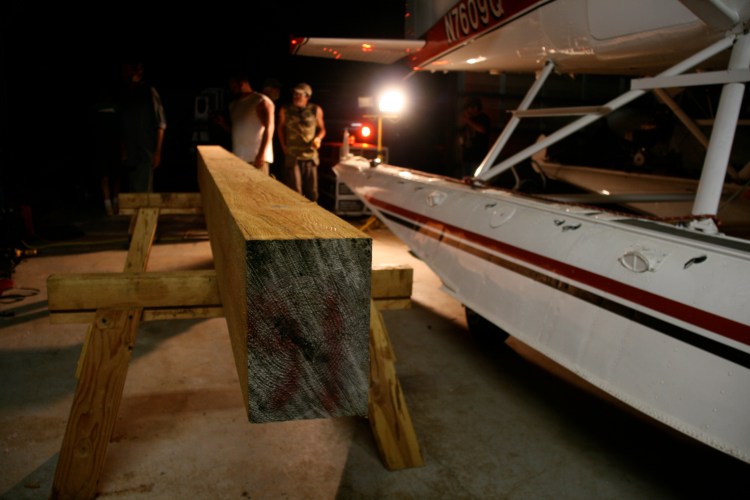
A few days later, the crew found another miscut timber, eight inches by twelve inches by sixteen feet. They contacted Raymond. Raymond happened to be at home, and as the crew finished dinner, Raymond bounced up the driveway with a large block of wood sticking out the back of his pickup truck. It was still wet from milling.

The time was five minutes until 8 p.m., and by 9:19 the timber had been set up next to a floater plane in the hanger and re-done by the crew, nonwithstanding the frequent breaker blow-outs due to the overage of power tools and floodlights.

IMG_3956

Testing Lake Pend Oreille

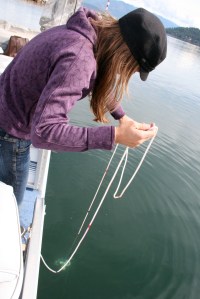
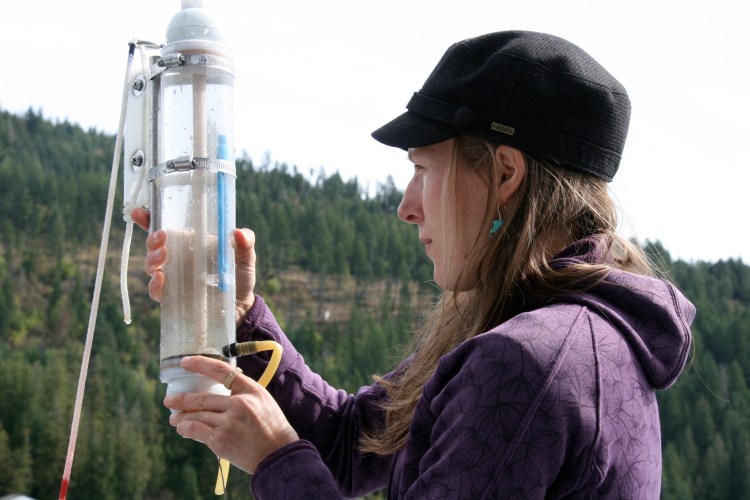
IMG_4443  Kelsey asked if I wanted to be her water-testing buddy today for Lake Pend Oreille Waterkeeper, and I said sure. So we took a boat out to Bottle Bay, where she tested the murkiness of the water and took samples from the depth at which her line disappeared (6.4 meters today, averaged out over multiple dips for maximum accuracy). She took enough to test nitrogen, phosphorus, oxygen, and more, and refrigerated the samples until they could be sent to the lab. During the summer, she and volunteers do this each month from multiple sites around the lake. This way, they can collect data and track water quality levels over time, and alert the authorities if something goes wrong. Like if city beach gets polluted with chemical waste or something.

IMG_4436

IMG_4427

Lake Pend Oreille

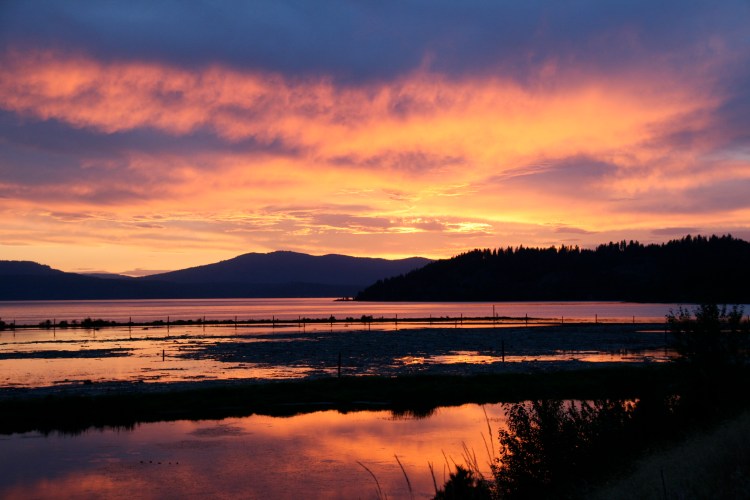
There are two spots I particularly love on lake Pend Oreille. One is just past the Montana border as you drive west on Highway 200, and the lake opens before your eyes, stretching past marshes and open expanses to the mountains.

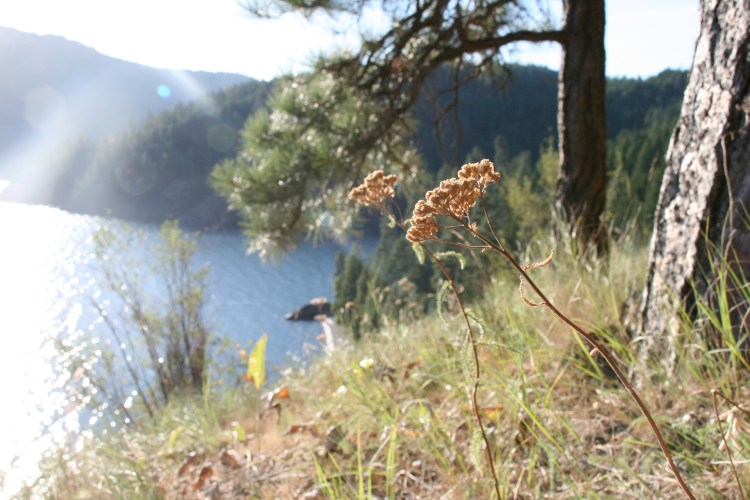
The second is Mineral Point, where the water is clear and the beaches rocky. On a windy day, the waves are big enough to scare you, just a little, if you jump from the cliffs and attempt to swim to shore without hitting any unseen jagged edges. There is a trail above the water, and somehow the feel of the place is like the feel of I hike I once took near St. Tropez in the south of France. The air smells less spiced, less exotic with olive trees and hot-weather plants, but there are pines, sharp with resin, and sweet-wafting grasses, and the gentle crash of the waves on the beach below.

IMG_3333

IMG_3345