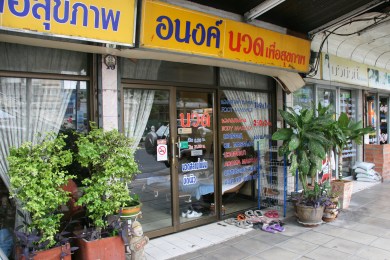
A real Thai massage in Bangkok

I land in Bangkok just after midnight, and by the time I get to my hotel it’s after 2. I figure this is great news for getting my sleep on track: to recoup from my 28 hours of travel and the impending jetlag, I plan to sleep, eat, and relax until I don’t want to anymore. So I pass out until 11 the next day.

ImageI’ve booked what is supposedly a two-star hotel, and I’m unsure what I should think of the result. The room itself seems clean-ish, although I can’t be positive due to the dinginess of the furniture. It is located on a one-way street tucked away in a maze of small local shops — most displaying long bolts of cloth, so I assume they are tailors. I wander around and inspect the hotel’s pool. That, at least, looks just like the photos online: long and clean and devoid of people.

The restaurant is also devoid of people when I have coconut curry seafood for lunch, sitting on a balcony with the breeze blowing in from the street. The food is delicious, but so spicy that it burns the roof of my mouth. I search in vain through my Thai phrasebook for next time, but “not too spicy, please,” is not to be found.

Image

And then I set out for my main goal for the day: the massage. I ask about one at reception, but there’s a slight problem. Of the two women on duty, one is a non-local who speaks very little Thai, and the other is a local who speaks no English. After ten minutes of confusion, I’m taken outside, pointed in one direction, and told to walk that way. So I do. Halfway down the street, I remember that I have no map and no address for the hotel. Also, I do not speak Thai. I figure that’s fine; I’ll just keep track of where I’m going. I walk in a straight line until I get to a busy street displaying various spa and salon signs. Then I wander until I find a door with the word “massage” on it, and the prices: 150 baht ($5) for 1 something, 250 ($8) for 2 something. I assume those are the prices per hour, and indeed they are when I walk in and ask. I peek around, and there are five local people sprawled across six low padded tables, getting prodded, stretched and slapped by four Thai women and one Thai man. The other clients are all lying in loose-fitting, modest clothing with their eyes closed as their limbs are manipulated. I look down at my summer dress and feel a moment of panic. However, my masseuse calmly hands me a pair of thin cotton pants and a shirt, and shows me to the bathroom.

This outfit is so enormous and shapeless that once I put it on I can’t help giggling at myself. The drawstring waistband wraps around my waist twice. I parade out in this ensemble, lie down and immediately wonder if I’ve made a mistake coming here. Again, I speak no Thai, and the tiny woman attending to me is making me think the locals must be extreme yoga devotees with rhino skin just to ensure the massages don’t dislocate their hips and/or mottle them with bruises. After ten minutes of torture I grimace. She asks in sign language if everything is Ok, and I reply in what I hope is a legible gesture that I’d like it a little softer, please. This actually seems to work. However, the damage has already been done, and later I discover that, indeed, my shins are mottled in blue.

The entire duration of my massage, the Thai masseuses chat with each other as their clients all pretend to be comatose. Twice, my masseuse answers her phone with one hand while she pokes me with the other. Casual massage, I keep thinking. This is how it’s so inexpensive. No frills at all, at least by Western standards.

When my hour is up, I leave, trying to figure out if I feel better or worse. I walk back to the hotel with no problems. Mission accomplished, I guess.

Ice climbing Copper Creek Falls

This week, the temperatures dropped to below zero, freezing moving water and making ice climbing possible. I’d never been before, for a few different reasons — with the chill factor being topmost. But a few friends were heading out to Copper Creek Falls, only a few miles from where my parents live, and the elements had conspired to make things as pleasant as possible. The mercury was rising, the sun was out, and the set-up had minimal danger and effort involved. Plus there was going to be a fire.

Image

I am not normally a morning person, but I got up at 6:30 and found that I felt bizarrely excited to be making the trek north in the searingly bright sunlight. Perhaps it was the familiarity of the drive, of the scenery, the feel of homeward-boundness. I met up with my friends and we carpooled to the Canadian border, or just short of it. We hiked in to a small, shady enclave of rock and cascading ice formations. They set up a top rope and then it was my turn. I had heard horror stories of the “screamy pukies,” wherein ice climbers’ hands get so cold that re-thawing them induces extreme pain to the point of vomiting. So I stuffed hand warmers into a special slot in my mittens and cinched them up to make sure they didn’t fall off.

As it turned out, I had over-dressed for the climb itself, and my two hats kept sliding down into my eyes underneath my helmet. My two coats felt a bit unwieldy, though not as unwieldy as the sharp metal weighing off me in every direction. I was trying to climb the ice as I would a rock face, roughly speaking, with some rather delicate footwork, using the features that were already in the ice. However, ice climbing tends to lend itself to “thuggery,” according to my male climbing partners. In other words, bashing holds wherever you want them. But, you know, then you break all the best features.

Image

Now, the waterfall was not completely frozen. Under the layers of ice, it gurgled and flashed by, visible and audible. To be climbing a roaring, vertical stream of water in any form felt immeasurably odd. Parts of the ice dripped. By the time I had made it the 200 feet to the top, I was pretty well worked. So I sat by the fire in the sun, watching the top layer of the ice I stood on become slick with relative warmth. As the sun began to pierce the canyon we were in, we finished and packed up.

ImageImageImage Image

Ken Ham and Bill Nye, revisited

Watching the Ken Ham-Bill Nye debate on evolution and creation last night took me back to when I was 14. I got familiar with both men’s work that year. My largely-homeschooled youth group was going through a video series put out by Ken Ham’s Answers in Genesis, featuring him doing a lot of talking about why the earth could only be 6,000 years old. After each video, we took a quiz to test our knowledge of it. I remember that I was a little uneasy about replying to the query on what you said to someone who believed in evolution. The proper response was “were you there?” which seemed both belligerent and stupid, but I nodded along, and did better than everyone else at regurgitating what had just been presented. I even had a friendly little rivalry going with an 18-year-old male over who got the most answers right. It was posted, in a list, and I wanted to be at the top of the list.

At the same time, my two-year-old brother was obsessed with watching Bill Nye on PBS, the one channel we got. “Biw Nye, da science guy. Biw! Biw! Biw!” he would sing. It stuck in my head to the point that the echo reverberated when I heard the two were debating: “Biw! Biw! Biw!”

Last night, Ken Ham’s debating points were odd in that they were entirely familiar, and yet it was all hitting me in ways that such words had never hit me before. I can remember saying things he said — specifically the line about how if your neurons are just in arbitrary flux, the result of a billion years of randomness, how can you trust them to mean anything? I remember smugly writing a clever little axiom in a letter to someone: God defines and defies logic. And I remember thinking: there are lots of scientists who believe in God, and all this talk about evolution is just because the rest of them would rather not face the inconvenient truth that they can’t just do whatever they want with impunity.

Something that Ken Ham brought up that Bill Nye didn’t address, likely because it seemed so patently absurd to him, was the claim that all logic comes back to the Christian worldview (despite the fact that by all appearances, formal logic was invented by Greek pagans); that in order to be able to think, you need the assumption that God has designed your brain and the world to compute in an orderly fashion. Sort of a take-off from Descartes: “I think, therefore God is.” That’s all quite interesting from a philosophical perspective, but unfortunately, Ken seemed to have a rather dim grasp of logic. Let’s break some of his arguments down.

  • Premise A: My religion has a story about the origins of the earth
  • Premise B: Evolution is a story about the origins of the earth
  • Conclusion: Evolution is a religion

The logical fallacy becomes more obvious in a simpler example:

  • Premise A: The dishes on this shelf are black
  • Premise B: My cat is black
  • Conclusion: My cat is a dish

Or let’s try this slightly more complex one:

  • Premise A: Mainstream scientists do not find young-earth creationism to be scientifically valid
  • Premise B: There are scientists who believe in young-earth creationism
  • Conclusion: Young-earth creationism is scientifically valid

Here’s the thing: a scientist can believe anything he or she wants. That doesn’t make it scientifically valid. To do that, you need to be able to test the belief using scientific methods — or, if you can’t, to accept that, by definition, it has nothing to do with science. The argument above is not logically valid — just like the following one is not; the conclusion does not follow from the two premises:

  • Premise A: Most kids think the sky is blue
  • Premise B: Some kids believe in a sky where blue does not exist
  • Conclusion: Blue not existing is a valid viewpoint

Something else that struck me was the lengths Ken Ham went to in order to try to explain that what the Bible said should only be taken in the most literal way possible. The whole thing with the Ark seemed particularly weird to me, so today, I decided to calculate just how much space was on the Ark.

Now, I’m not a mathematician, and the sum total of my math knowledge comes from my years of homeschooling. So feel free to check all these calculations out for yourself. I present them because I think that as a 14-year-old, I would have appreciated them, and probably gotten out my calculator.

So the Ark would have, by Ken Ham’s estimation, carried 16,000 animals for a year (two each of 8,000 “kinds,” some now extinct, which he claims is the number of animals God originally created — not including insects et cetera — that would have needed to go on the Ark). Using the Biblical account of the Ark’s size, we translate 300 cubits long into 450 feet long, 50 cubits wide into 75 feet wide, and 30 cubits high into 45 feet high. That give us 1,518,750 cubed feet, though that’s assuming that the boat is square in nature rather than measured at its widest points and rounded off elsewhere, as most boats are. Divided by 16,008 (16,000 animals and 8 humans), that’s 95 cubed feet per being, averaged out. To give you some idea of how small that is, 4 feet by 4 feet by 6 feet is 96 cubic feet. So you’d have a stall (or space) that size for every man, woman and animal — and their food — for a year, if we are going by Ken Ham’s math plus the Bible’s math. Even if all animals were vegetarians and could all somehow eat something with a long shelf life such as hay (again, according to Ken Ham) there’s no way you can fit an average animal and a year’s worth of e.g. hay into a 4 by 4 by 6 foot space. A mid-sized animal such as goat eats around a ton of hay per year. Using modern baling techniques, which pack the hay very tightly together, a ton makes up about 30 to 50 bales. A standard bale of hay is two feet by two feet by four feet, which makes 16 cubic feet. You can fit less than six bales of hay into a 95-foot-cubic space, even when you leave out the animal. And this is, of course, assuming that drinking water wouldn’t need any storage space; that the ocean was somehow unsalted and therefore available to all.

So six bales per animal is not nearly enough to last a year. One elephant eats 300 to 600 pounds of food per day. Even calculating from the conservative end of things, two elephants consume 219,000 pounds of food per year. That’s 109 tons, which given the above calculations requires 52,560 cubic feet of storage. Add two rhinos, two hippos and so on, and you’re quickly running out of storage space. Especially when you factor in the dinosaurs, which Ken Ham believes were on the Ark. Even in an infant state, I can’t imagine dinos slack on the eating.

Basically, the Ark would only work if the animals (and humans) were all in some sort of suspended, non-eating state. Which makes sense, because 8 people really can’t keep up with mucking out 16,000 stalls every day. And I just don’t buy the proposition that there were sophisticated systems available to bronze-age boats for taking care of most of this excrement (and feeding, and watering) automatically.

Eight people, 16,000 animals. All of them, despite teeth and digestive systems designed (or adapted) to various kinds of food, eating vegetation gathered by eight people using bronze-age farming techniques, producing dung, and maybe copulating and multiplying. All of them getting along, none of them getting sick, in spite of the fact that all the world’s germ “kinds” would have needed to be on board as well. All of them sailing around the world in a wooden ship that somehow manages to defy the laws of wooden-ship engineering and stay rigid in the turbulence of a sudden worldwide flood. To assume all of this, at a minimum, you can’t have ever worked with real animals, done primitive farming or worked at wooden ship building. Or you have to assume that none of the natural laws in place today applied then.

And that’s kind of the key to Ken Ham’s whole line of reasoning. Despite what he says to the contrary, he wants us to assume that none of the natural laws of engineering, geology, zoology, astrology and so on apply backwards into history. To apply these laws, in his view, means you’re making up your own religion, because everything, to him, is religion. If any question exists, it can only be answered by the Bible — or at the very least, in accordance with the Bible’s text taken the most literal way possible. If something doesn’t fit with this, it’s perceived as miraculous; unknowable, or else some convoluted justification is presented as fact. And thus any further inquiry is silenced.


Alone Yet Not Alone in an Oscar yank

I took a blissful little break today and played in the new snow atop Schweitzer, coming in to work in the evening because my work is awesome like that, and because my e-mail dings around the clock anyway due to the multinational nature of my job. Apparently by doing so, I had missed 24 hours of internet gossip, which in that field is basically a lifetime.

The subject: the rescinding of Alone Yet Not Alone‘s Oscar nomination for best original song. The suspect: Bruce Broughton, a former Academy governor and current executive committee member in its music branch. The charge: that Bruce violated Oscar rules by e-mailing voters. The response from the American public: varied, as usual.

Alone Yet Not Alone‘s Facebook page is awash with comments blaming Satan, “Godless Hollywood,” and the nebulous destroyers of traditional family. However, my favorite comment is probably “It would have been very nice to see something with good morals win,” from one Brian Merrick.

Brian, I agree with you. I’m all for good morals in Oscar wins. As such, I cannot support someone who breaks the voting rules to get ahead, even if he justifies it as “the simplest grassroots campaign.” The thing is, the composer has produced great work before, the kind that really gives you chills. But the other thing is, there is no way this particular song could have been nominated based on its musical merits alone. It’s just not that good. It sounds like most songs you’d hear flipping to the Christian radio station — long in the inspirational lyrics department, and short on musical genius. I say this as someone whose musical diet up to age 18 consisted of Christian contemporary, hymns, classical, and country. Mash all that together into an all-too-familiar package, and you’ve got what is supposed to be one of the year’s five most original songs.

So from here, the story will diverge. Many Christians will no doubt overlook the fact that Bruce broke the rules, and claim that somehow, disqualifying the nomination is a slap in the face of all good moralists. Meanwhile, the rest of America cringes and reminds themselves: this is why we think conservative Christians are hypocrites who’d rather assume the rules don’t apply to them (and then claim persecution when they’re caught) than produce true artistry.

Localization, Thailand and the global market

Sometimes I stop and think for awhile about my job, and about the long chain of assumptions that lead out into its final goal, which nine times out of ten is that people will purchase (or remain loyal to) a product that did not originate in their own culture. Localization is primarily about making the foreign seem local; by adaptation and translation, and yes, sometimes that means hiring actual local people. I like focusing on that part of it, on the part that says the local people are always the experts, and they get to tell these enormous multinational corporations what to do on some small level. I like that my field is replete with those who understand the power of cultural nuance, of linguistic nuance. There’s something that can feel very magical, very special, about a group of people who care that much about cultural identity and the way it’s expressed. The whole point may be to sell services to those large multinational corporations, who in turn want to sell something to the masses, but it feels more noble than that. It feels like we actually care about everyone in the world.

Sometimes, of course, we really do. I’ve been very proud of the efforts our industry has gone to in providing free services to those who need it most. At times, I think this is the great big missing piece, something that really could change the world for the better if it’s used correctly. Offering knowledge, bridging cultural differences, locales, language, mitigating cultural slights — this can mean peace rather than war, alliance rather than xenophobia. It’s all very P.C. and feel-good, while at the same time it’s excellent for capitalism. Localization is staunchly bipartisan, and often apolitical. We don’t take sides — we interpret.

And yet we do need to pay attention to politics, because politics affect global business and signal shifts within nations and regions. In the case of Thailand, the site of Localization World’s upcoming February conference, the politics are a little complicated and have recently been a source of contention. The New York Times reports that “the most important political decisions in this country of 65 million people have been made from abroad, by a former prime minister who has been in self-imposed exile since 2008 to escape corruption charges,” who rules by proxy using various officials, including his sister, whom he nominated for prime minister in 2011. Many Thais find this situation to be illegitimate, and have taken to the streets in protest in recent weeks, attempting to “shut down” Bangkok’s government. According to most reports on the ground, the protests are peaceful and even fun, as can be see in this video. They are limited to certain areas of Bangkok, and have already waned a bit.

Of course, this isn’t the most stable climate for conducting certain kinds of business deals. But I think that for our business, it’s an important kind of reality to face. Our future lies in markets such as this — the emerging markets, the ones attempting to move in positive directions, the ones that have traditionally been considered less than rock-solid. Thailand is a serious market contender, and is starting to take the place in the global market that China took previously, and that Japan took prior to that. Keeping an eye on its current reality potentially means a step up for anyone seriously considering global industry.

So, from a business perspective, I’m actually very excited to be going to Bangkok in a few short weeks. On a more personal level, there’s nothing quite like feeling the pulse of a place that is trying to better itself through peaceful means.

HPV for the uninitiated: an update

Exactly a year ago, I was dealing with the frightening reality that I had “precancerous” lesions due to HPV. I wrote about my conclusions here, explaining that despite the fact that the doctors recommended I get an LEEP procedure to snip things into normalcy (I was diagnosed with CIN II, basically two steps removed from cancer), I preferred to wait and see, improving my nutrition, trying not to stress out, and generally giving my immune system as much support as I could give it. Because HPV is a virus, its lesions could be cured by my own body, at least in theory.

So I did it. I cut out gluten and more or less went organic, grass-fed paleo. I ate a lot of kale. After my not-yet-boyfriend left bone broth on my doorstep, I made bone broth and drank it like tea. I ate grass-fed beef and wild salmon. In the summer, I picked myself blueberries. I ate local grass-fed yogurt for the live probiotics, which have been linked to HPV suppression. I slept — I made sure I slept eight hours a night, even if it meant I slept in. I got a panel of blood tests to make sure everything was in balance — my vitamin D was low, so I started taking that. I still drank some and had treats, but my sugar and alcohol intake were naturally curtailed due to the fact that I was avoiding gluten. The stress of eating that specifically sometimes tended to give me pause, but I hoped that it would more than balance out.

And then it was time to face the music. I’d had a lingering cough for three months, which didn’t seem like a good sign in terms of the efficacy of my immune system. I had a nagging fear that I’d made the wrong choice and would go in to find that I had cancer. With this happy thought, I visited my gynecologist. I half-expected her to give me a lecture about not following her surgical recommendations and basically falling off the face of the earth for a year, but she didn’t. She was polite, upbeat, gave me the world’s fastest pap smear, and then I was out of there.

I was thinking that what would probably happen would be that I would get a call that I needed to come in for a colposcopy, just like last year. In a last-ditch attempt to send my lesions into regression, I supplemented for a week with folic acid, vitamin C (which my well-beloved pomegranates contain), CoQ10, indole-3-carbinol (which kale contains), green tea extract, and coriolus versicolor mushrooms, which have all been linked to regression of dysplasia in clinical trials. The mushrooms made me feel nauseated and a bit out of it, so I stopped taking them.

And then today, I got the call. You’re clear, she said. No HPV, she said. And just like that, this nagging weight at the back of my mind is lifted. I have conquered this on my own terms, and my body remains whole and intact.

Alone Yet Not Alone in a sea of dominionism

Apparently, I am one of the few people in America who had heard of Alone Yet Not Alone before today, when the internet exploded with a collective “WTF?” over the movie’s Oscar nomination.

I’d heard of it because I am loosely connected to the independent Christian movie scene, or more specifically, the quiverfull, dominion-mandate Christian movie scene. The movie was supposed to premiere in 2012 at the San Antonio Independent Christian Film Festival, which shut down recently with the closing of Vision Forum ministries and the resignation of Doug Phillips. This same Doug Phillips has two children who appear in Alone Yet Not Alone. He himself was originally cast in the movie, but either his role or its credit was cut after the scandal of his resignation. Tracy Leininger Craven, the author of the book the movie is based on, has written a series of books that still appear in the Vision Forum catalogue, adhering to the Vision Forum ideal that women are called to serve God by serving men. “Each heroine’s story points to… the way [God] can use ordinary people to accomplish great things when they are faithfully walking in their calling as wife, mother, or daughter,” the catalogue explains. The cast and crew have similar ideals — the full cast list of the movie reads like a partial who’s who of dominion-mandate Christian entrepreneurs.

If you’ve never heard of either “quiverfull” or the “dominion mandate,” allow me to briefly explain: quiverfull is the ideology that families should have as many children “as God gives them,” using no contraception of any kind. This is usually coupled with homeschooling the children (and often stopping formal education at age 18 or younger, particularly for females) and “training them up in the way they should go.” The longterm goal of quiverfull families is to essentially win the “culture wars” by having exponentially-increasing descendants who adhere to a specific set of beliefs. In essence, “take dominion” of the world for Christ and reconstruct it, with the goal to revive some form of Old Testament law, though the details are a bit murky and somewhat debated. My uncle, Geoff Botkin, went a step further and began selling the idea of a “200 year plan,” in concert with Doug Phillips, wherein every Christian patriarch should have a 200-year, multigenerational vision for his family, complete with a spreadsheet. So far, none of my uncle’s adult children have left home, and they contribute to his ministry, so it seems like it’s working pretty well for him.

When I say that this group of people wants a return to Old Testament law, I mean that it even goes so far as to promote the reinstitution of slavery. The founder of Christian Reconstructionism, R.J. Rushdoony, writes that “The [Biblical] Law here is humane and also unsentimental. It recognizes that some people are by nature slaves and will always be so. It both requires that they be dealt with in a godly manner and also that the slave recognizes his position and accepts it with grace.” Other Christian dominionists  — Dan Horn comes to mind — have explained that slavery can be beneficial when it teaches heathens to be good Christians, or when it gives good Christians the tools they need to expand their empire.

The movie Alone Yet Not Alone has been called racist because of its portrayal of Native Americans, but that’s not really accurate. It’s actually reflecting the idea that Christian culture is superior to Native American culture; that other types of culture are hostile to real Christianity, and that real Christianity can and must eventually take over these other cultures.

It is not at all surprising to me that the dominionist crowd has managed to finally finagle an Oscar nomination. Not because the song being nominated is Oscar-worthy — it’s mediocre at best — but because the song’s originators have friends in high places: Bruce Broughton is a former Governor of the Academy and a former head of its music branch, and William Ross is conductor of the Oscar ceremony’s orchestra. It sounds very much like something politically-minded billionaire James Leininger, the father of Tracy Leininger Craven and likely a strong historical supporter of Vision Forum, would try to arrange.

In this case, the dominion-mandate crowd can take dominion using plain old networking. No need to wait for those 156,000 male descendants to get to voting age.

Diary of a snowstorm, part two

Day 7, January 10

The day is off to a bad start when I still haven’t fallen asleep at 1 a.m. because my lungs have decided that it’s a great time to protest how hard I’ve been going. Or maybe it’s the dry air up here. I’m wheezing and coughing to the point I’m worried I’m keeping the entire household awake. Forget about the entire household; I’m keeping myself awake. Around 2, I take four pillows into the condo’s smaller, carpeted bathroom, make a bed by laddering them up on the floor, crank the baseboard heater up and hang a damp towel above it. My boyfriend tries to come in the bathroom and for some odd reason is weirded out by my little arrangement. We have a whisper fight about it, and finally he gives up and finds me a blanket.

My arrangement works pretty well, however, and I stop coughing and sleep on the bathroom floor in my bed of pillows until morning, when I whisper make up with my boyfriend so I can wish him happy birthday without it sounding sarcastic. I cook breakfast for everyone, fried pork medallions and eggs with spinach, and try to rally the out-of-towners by application of black tea and coffee. However, at 8:50, they’re still puttering around, so my boyfriend and I ditch them for first tracks, taking the short groomer to Schweitzer’s village. I have the best first run of my life in the four inches of new snow, and for the next three hours I ride faster and better than I ever have before, with various friends of various levels. Then I’m completely exhausted, which coincides well with the wind picking up and shutting down some of the lifts. I board back to the condo, gobble down some food and pass out — in an actual bed this time.

Everyone trickles back in over the next few hours. We try the hot tub, and at 5 we go down to Sandpoint for my boyfriend’s birthday dinner, small plates and cocktails at La Rosa in front of the fireplace. The out-of-towners love it and keep talking about how good the food is.

Day 8, January 11

I don’t think you can really count this as a snowboarding day, since my sum total of snowboarding consists of riding down to the village for a massage at Marc Vroman’s Solstice Spa. And let me say, there’s nothing quite like the perfect massage after three days of pulverizing nearly every muscle in your body in the cold and the wind. I am trying to take notes at what Kaitlan is doing, but it feels too good to really pay attention. She does tiny things along my shoulder blades that made my scalp tingle with pleasure, and rolls out every aching muscle between her fingers. I think of asking if she can tell by touch where I’m sore, but I am too relaxed to want to talk. Outside, the wind howls.

IMG_5808

I take the shuttle back to the condo feeling very relaxed, and make a flourless chocolate torte for the evening’s party. The lifts are all closed from the wind, but I don’t care at all. I’m totally satisfied with this little staycation and drink tea in the winter quiet. Over the next few hours, everyone heads to the spa two by two to get the kinks worked out, and they return to say the same thing: it’s wonderful, and now all they want is some relaxing and a nap. And some king crab, delivered fresh from Alaska.

The evening’s party is a bit slow getting started; it begins with some attempts at Yahtzee and an examination of a puzzle we might all do. We dig into the prime rib and chat until a vanload of people from town show up. Then things are magically transformed; suddenly we’re dancing on the coffee table, doing feats of strength and drinking champagne in the hot tub, which we chill (the champagne, that is) between rounds in a cauldron of snow.

Day 8, January 12

I’m slow getting started because I have once again spent the night cramped in my own private sauna to cure my coughing. Upon waking to an empty condo, I realize that we are not going to check out by 11 unless I immediately start packing everything and cleaning up the mess we made. My mood is not improved when my boyfriend returns at 11:05, and tells me he’s been tearing it up in the best powder of the entire year. The best powder of the year is a sheet of ice by the time I make it out, but I meet up with three of my girlfriends and we find a good spot buried in some trees. We ride until late afternoon, when the wind and the snow pick up. I eye the falling snow. Maybe, if my legs are not completely fried, I can make it up again tomorrow morning before work.

Diary of a snowstorm, part one

Day 5 on the mountain, January 8

The snow coverage has been relatively awful this year, so I haven’t been up much, despite the fact that I purchased a season pass at Schweitzer. But now there are three inches of fresh powder over a sheet of ice and woodland debris — the first signs of a winter storm that will be with us for several days. I line up at 8:40 and catch the sixth chair. On my second run, I find a nice stash on a steep wooded slope, only to scrape into a fall and slide with alarming speed towards two boulders. I decide my best bet on not breaking anything (including my gear) is to arch my body sideways and slither over them like a rag doll, which I do, and which works. I stand up again and promptly faceplant at the bottom when I try to swoosh between the bare bushes, into an indentation and over a ridge.

I practice dodging things by ducking in and out of bounds under the cord separating the Bunny hill from what otherwise might be a slalom course if those featured miniature Christmas trees as obstacles, riding a thin ridge of untouched snow. I miss the bus out by 60 seconds, so I hitch a ride down. I end up getting the guy’s business card — he’s just moved up from Boise to clean hot tubs and pools, after being cordially invited by the competition because there was “plenty of work for everyone.” After talking for 20 minutes about the jobs around town, he looks at me and realizes, “Oh yeah, I’ve seen you on Facebook.” Then he gets a tad uncomfortable, because he’s obviously just said something that sounds potentially creepy and stalker-ish, but I am sufficiently used to being recognized by people I’ve never met that it doesn’t phase me. That’s just how small our town is.

I am at work before 11 a.m. to try to get the last issue of the magazine wrapped up and sent off. My boyfriend shows up at work to give me a late Christmas present, his third attempt after ordering clothing that, it turned out, looked way cooler online. They’re new snowboarding bindings to replace the ones I got for about $25 back in 2010. I approve of this Christmas present — gear is always a good choice, or at least it will be until I run out of cheap secondhand stuff to replace.

Day 6, January 9

At 8:20, I am stopped by a train on the way to the bus up the mountain. I make use of the minutes by donning my snowpants and wool frantically as the train flashes by and while, no doubt, the other cars’ passengers stare at me through their crusty windshields. I arrive just in time, grabbing my gear and shuffle-running to the bus in my untied boots.

At the top, there are seven inches of new, thick powder. So much beauty, and so much effort. My new bindings are helping me turn, however. I’ve cinched them to the point that my front foot falls asleep, something that was impossible with my old bindings. I get some fresh lines and fall over several times when the heavy snow is more than I can navigate. The trees are my friends — I cut through them, grabbing branches when need be to stay upright.

I get the 10:30 bus back down, tired and ready to work for a bit. I spot my friend Kelsey, Sandpoint’s best female rock climber, also on her way back down for the day’s work. “You had the same idea, I see,” she says jovially. Kelsey has a perpetual smile on her face, at least when it comes to the outdoors, and as the bus heads down the mountain she tells me how much she loves the snow on the trees, how much she loves winter.

At 3:30, I’m heading back up the hill with my boyfriend. A bunch of friends have gotten together and rented a ski-in, ski-out condo for his 40th birthday, something he apparently has wanted to do for several years. He picked a great time to hole up because this is probably the best snowstorm of 2013-2014. We unload massive amounts of food over the next several hours as friends trickle in, but naturally, in my haste I’ve forgotten to pack any toiletries or my PJs. I make do by borrowing.

It’s Still (Not That) Complicated

I was cleaning up today and came across my cousin’s book It’s (Not That) Complicated, in which they lay out their advice to young women waiting around for a husband (spoiler alert: they think you should ask your parents to screen applicants while you patiently do your father’s bidding at home) and flipped open to this passage, which was horrifying enough that I felt slightly sick to my stomach:

“Amazingly, the Bible does speak specifically to our parents’ role in our romantic lives. Deuteronomy 22 is a good place to start. Verses 13-21 lay out a law that God gave the Israelites regarding a young bride whose husband has accused her of not being a virgin on her wedding night. Interestingly, the young bride is not the defendant. Her father is.

The burden of evidence was placed on ‘the father of the young woman and her mother’ to prove that their daughter was a virgin, and the father was required to represent her. If she was proven innocent, the young man had to pay an enormous fine to the father for bringing ‘a bad name upon a virgin of Israel.’ But if the young woman was found guilty, verse 21 continues, ‘Then they shall bring out the young woman to the door of her father’s house, and then men of her city shall stone her to death with stones, because she has done an outrageous thing in Israel by whoring in her father’s house. So shall you purge the evil from your midst.’

Why? Why was it not entirely her own business? Why was she stoned at her father’s door and not her husband’s (or the door of her apartment)? What did her father have to do with something as personal to her as her own purity? Because God had placed the daughter under her father’s care, until the time when the father gave her to another man (as it is said in verse 16, ‘I gave my daughter to this man to marry…’) and her father was responsible for knowing that the purity of the bride he was giving away had been preserved for her husband. She — and the priceless gift of her purity — was not just hers to give. In the event that the young man had been defrauded of what was rightfully his, the responsibility fell on the guardian (father) as well as on her” (page 143).

The passage in question requires the parents of the accused girl to bring out “the cloak,” which refers to a cloth placed on the bridal bed. If it was bloody, that was “proof” that the girl had been a virgin, and if it wasn’t, that was proof that she was a “whore,” and should be bludgeoned to death with heavy rocks. As common as this practice may have been in certain parts of the world at certain times in our history — including some of the current-day Middle East — it is of course widely known at this point that this is about the least scientific way to prove or not prove virginity. At this point, any sane person should be thinking that this passage should be about the farthest thing from something we should aspire to. And yet, according to It’s (Not That) Complicated, we are to draw an important lesson from it: it’s partially the dad’s fault if a daughter doesn’t bleed on her wedding night, and a husband has been “defrauded of what was rightfully his” by the same token. Because obviously, making his bride bleed on their first night together is what every dude should aspire to as his God-given duty, and killing her if that doesn’t happen is the next natural, logical step. And her father should totally approve of this arrangement.

That is one horrible father. So, sorry, and you can call me a feminist for wanting the value of a woman’s life to lie somewhere above the value of a tricky little medical membrane, but you failed to convince me that I should be seeking out that kind of “protection” — either from such a father or such a husband.