I’m not sure if you’ve heard, but girls are emotional. Like so emotional, they’re not supposed to be politicians or CEOs because their hormones might cause them to become irrational and then they’d accidentally kill and/or fire someone.
I actually recited this litany to someone in my early college years, embarrassingly — although it was actually about why females weren’t allowed to be pastors. I recited it in spite of the fact that I was way more even-keeled and responsible than most men I knew. While my male newsroom colleagues were prone to throwing things across the room in frustration over a misplaced modifier or a missed deadline, I stayed in the corner, calmly fixing similar errors, filling the gaps when the cartoonist, photographer or writer didn’t show up. While my male friends spent their money on treats for themselves, I managed mine like an ascetic. While many of my male classmates were out partying and making excuses for their late assignments, I studied and then got a good night’s sleep, beating them at biology, law, statistics, German, Anglo-Saxon, history, pagination, advertising, and, of course, French and ballet. I never pulled an all-nighter; I never broke down crying or froze up over the workload. I never called up my parents asking them for money because I had spent all of mine. Intellectualism, consistency and studiousness were in large part the definition of who I was. That was my personality, and it was also what I had fostered in myself.
Because, as you know, emotional girls might accidentally kill someone. Or they might accidentally date a jerk or something. Just in case, I dated nobody — not really — until Scott. As a teen, I had written in my journal: “I’ve kissed dating goodbye, even though I never made out with it in the first place.” I was committed to the ideals of purity that are often prominent in the homeschooling community, whether or not a family is actively pursuing a specific model of courtship. I was a sanctimonious young woman, determined to remain un-duped by something as shifty as romantic feeling.
In my journals I kept a rather extensive record the time Scott and I dated, and I remember when I was engaged telling two of my male friends, rather smugly: you know, it’s not like I’m under the delusion that he’s perfect. It’s just a matter of what faults you’re willing to live with. I was 26 years old, and the main thing was, nobody else had come along and acted interested. Well, not for awhile — well, not anyone who I found to be any more attractive, and/or who would have been approved by my parents and community. Actually, at 26, I was just beginning to realize that romantically, I could be reasonably popular. But it was a moot point if the person didn’t fit the criteria I’d set out:
- Christian, of the correct persuasion
- Intelligent enough to win a debate with me
- Not too annoying
- Wants kids and a good marriage
- Responsible
- Gets along well with my family and community
- Can beat me in a foot race
- Has decent genetics
This was more than the bare minimum I’d been assured by my pastor: that any two Christians could get married and make it work as long as they followed the Bible. My ex-husband fit all of my own, added, basic requirements. He was tall, had all his hair, went to the gym and claimed he wanted to go more often, read a ton — none of it stuff I was particularly into, but to each his own — went semi-regularly for pastoral counseling, and he had a law degree. He wanted to marry me and he had all the right answers to just about every question I asked him. His pastoral counseling sessions were directing him towards marriage, and when I told his pastor that I wasn’t sure if Scott was God’s will for me — at the time, I wasn’t convinced — the pastor chucked: “I married a woman like that.” Hmm, I thought, maybe I’m wrong. I assumed, as everyone had insinuated, that if we were to become intimate and come together with the goal of marriage and a family, that I would feel myself swimming in the heady bliss that was missing from my previous interactions with him. Girls fall in love if they have sex. Girls fall in love if they’re safe and provided for. Girls don’t fall in love over physical beauty. And keeping your emotions in check until the time is right, until you’re past the point of commitment, until you’re past the point where you’re going to get your heart broken, that’s all quite commendable. That’s what I had absorbed from 26 years in the homeschooling/purity/courtship community. So why not marry him, if you’re 26 and you want to start a family?
Only, in sort order, I found myself in what felt like a very weird and very uncomfortable roommate situation. Pastoral counseling didn’t help; traveling together to exotic locations didn’t help; time didn’t help. No attitude, attire or attribute I attempted seemed to help either. I hadn’t known him as well as I had thought; no amount of interview-style questions can make up for intuition and emotional intelligence about someone. And without intuition, without chemistry, without the wordless connection of two aligning souls, how well do you really know someone you’re going to spend the rest of your life with?
My point here is not that if you’re not stupid in love with your spouse every day of your marriage that you should get divorced, it’s that if you’re not in love and in tune to begin with, it’s probably a serious warning sign. They say something like 90 percent of communication is non-verbal, or at least non-literal. When we first started dating, I described Scott as having shoulders that swaggered and feet that shuffled, and this duality seemed quite weird to me. There were a lot of things like that. It’s just that after a certain point, I made the choice to ignore virtually all but the 7 to 10 percent of his communication that said “I believe with my mouth all the creeds and the prophecies, and in everything you want.”
Here’s why: I had absorbed the idea that you aren’t supposed to “follow your heart” because you’re supposed to do what God says instead. Your heart, your “intuition,” that’s a deceitful, dubious trap making you second-guess important commandments just because you feel like it. Women are the “weaker vessels” in part because they rely so much on their hearts, on the wayward feelings that fluctuate with their passing fancies and hormonal cycle. I would not be weak, and thus, I would not be emotional. I would be rational. All the time. I would be so literal that eventually I would begin to wonder if I was borderline autistic or something.
At this point, as you may have guessed, I have come to the realization that using your emotion and intuition is an extremely useful tool that can help you profoundly connect with people. I know — shocking. Another shocking realization: this may be where many women’s strengths lie, but it is by no means limited to women. Or, more accurately, it’s only limited to women in cultures where it’s supposed to be limited to women. There are plenty of men who are more emotionally insightful than I am. Not just the ones who sit around playing guitar in their skinny jeans, either. In my experience, the stronger a man is, then the deeper his passions and insight run — and the more capable he is, the more fearless and eloquent he is about those passions and insight. The heroes of folklore wept and howled with the best of them; they pouted over women, sang, laughed, and did a whole lot of talking. The puritans, maybe, not so much. But who would you rather be: Achilles or Roger Chillingworth?
The point of being Roger Chillingworth, or at least to pursue the chilling effects of pure logic in courtship or dating, is to supposedly protect the hearts of women. However, the pain of dating a good man and then breaking up with him, wholesomely and cleanly (or even not wholesomely and cleanly), is far less serious to women than marrying a guy you’re not in love with. You can learn things from both situations, but the first tends to yield more positive lessons.
Another shocking realization: contrary to what I was told growing up about how women and men are innately different, several men have developed deep attachments to me or to a female friend more quickly than we did to them, and this is supposedly the norm across American society. If courtship is all about protecting the overly-quick hearts of your offspring, and insulating the fragile youth from those who naturally desire sex for its own sake, then perhaps it should reverse its policies and start requiring that the girls pass muster before they’re allowed to date to the boys.
Especially if the girls are hopelessly attractive. What possible chance does sheltered 18-year-old Jimmy from Arkansas have against the demure hotness of a Calvinist Sophia Loren? And why should it be Jimmy who is vetted by Sophia’s parents, when Jimmy is more likely to get his heart broken when Sophia sort of decides that he’s sort of ho-hum, after Jimmy has already spent six months of his time and money sweating out his chances with her father in nerve-wracking long-distance phone calls?
Weirdly to me, Christian courtship practice assumes by its very nature that females need more protection than males, that being born with one set of genitalia (regardless of personality or personal strength) versus another puts you in a position to wait and see, shielded from making too many tough decisions on your own recognizance, or to go and conquer, goaded into forcefully pursuing something you’re not all that familiar with even if you’re not totally sure it’s (or she’s) what you want or need. Christian courtship seems to be stuck with a specifically Victorian hangover that girls — all girls — are prone to hysterics and bad judgment when they’re faced by an attractive mustache; that men are both cads and infinitely more wise that the women-folk whose honor they’re battling over. But if you honestly believe that about your daughter and the males in her life, you’ve obviously failed her on many levels.
Now, none of this is to say that family and friends can’t be very handy in giving you perspective about a new prospect. But there’s a big difference between giving your perspective and being willing to accept whatever decision your fully-adult daughter or son comes up with, and expecting that what you say and think will be more important that what they say and think — which is essentially what courtship is. If you don’t believe me, ask yourself the question: what would you do if your daughter told you, “Mom and Dad, I honor you and your opinion, but respectfully, I disagree with your assessment, and I’m going to continue to get to know this man”? If your answer is anything short of: “I would continue to love and support her, and would not seek to punish her, implicitly or explicitly, or diminish my affection for her in any way,” then you just proved my point. You believe your opinion about her life is more important than hers.* You believe your daughter should never fully own her own adulthood.
Here’s one reason why that’s a problem: my family and larger community would have, at any point in my adulthood, had a hard time picking out an outfit that would have physically fit me and that I would also have found to be just my own taste — because, as an adult, I had different taste than most of the people around me. If you don’t know enough to pick out clothes for someone, inanimate objects that have handy measurements and come pre-sewn, you’re hardly going to be able to pick out a spouse who will fit them — I mean, unless you’re expecting that spouses are sort of one-size-fits-all, more generic than an off-the-rack dress from Macy’s.
And we know how well that turns out.
*The typical response to this is: it’s not my opinion I’m worried about, it’s God’s. Ok, but does your take on God’s opinion line up 100% with your own parents’ take on God’s opinion? If not, why do you expect your children’s take on God’s opinion to 100% line up with yours? Because you’ve, finally, miraculously, 100% figured it out? Must be nice…

 Until I went on-site to take a few photos of a Collin Beggs design/build project, I had no idea what a timber frame raising looked like. Apparently, at least in this case, it looks like a roof being lowered onto 12 interlocking joints using a crane and a crew of nine men. Some last-minute chisel touch ups were needed. Afterwards, as tradition dictates, the youngest member of the crew christened the structure with a whetting bough (not to be confused with a wedding bow, which is what I first thought they were saying).




















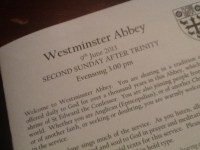 So today I did. Evensong is every day, mostly at 5 p.m., but it’s at 3 p.m. on Sundays. You go up to the North Gate, which is guarded by some old guy in crimson to keep the tourists at bay, and he says “can I help you?” and you reply “I’m here for Evensong,” and he lets you in. If you’re half an hour early, and you go in as the bells are ringing, you’ll get a good seat. Not that it will do you much good if you’re in the mood to document it, because you’re not supposed to take photos, and it seems more cheeky than normal to break the rules during a church service. The Westminster Choir is well worth the wait, and the young boys and mostly-young-men sing as they have done for centuries. Only in English, because they’re Anglican. The Abbey claims that it has echoed with music every day for over a thousand years, and as I sat I couldn’t help but think of all the kings and queens that had been coronated there (and then buried there, some of them). You sit, you stand, you sing, you speak; it’s a fairly interactive bit of authentic historical artifact, particularly as far as tourist attractions go.