On sensory defensiveness and being a mutant

Today at work I made a joke about how my annoyance with a subtle chemical smell, which turned out to be the wafting paint fumes from a graffiti artist in the nearest alley, kind of made me a superhero. For a moment, I indulged in a fantasy where bringing this toxic airborne compound to my boss’ attention somehow saved us all a few brain cells. Although, to be honest, I’m pretty sure that the only thing that happened was that I made myself annoying.

This is not the first time I’ve been difficult at work. After we had fluorescent lights installed, I was so irritated by them that I had them uninstalled above my desk and obscured by brown paper directly across from me. It was either that or wear sunglasses at work, which I actually did for a few days.

Then there was the time I asked everyone to please not play music when I was around. It was distracting, irritating. I couldn’t think; it made me angry. Now, I like music, in the right context. In the right context, I love it. But it really has to be in the right context.

I’ve known for a long time that I’m hypersensitive to just about everything: sunlight, especially flickering sunlight, hurts my eyes and ultimately tends to give me migraines. I don’t like watching TV in a dark room; the contrast is too stark. I’ve hated soda since I was a kid due to the fact that it was too sweet, too fake and the bubbles felt bizarre. The tags in my clothes can make me extremely uncomfortable. I hate having certain kinds of fabric touch my skin, specifically cheap synthetic fleece. It feels like fuzzy plastic to me. Also, wearing thick mascara feels weird on my eyelashes. If there’s a siren next to me, I typically have to put my fingers in my ears. Loud noises can make me want to punch things, so I tend to wear earplugs on airplanes, and have even contemplated taking them to concerts. Not that earplugs help a ton; I can hear pretty well through them. It’s not just loud noises, either. High-frequency noise, like the almost imperceptible buzz from old televisions, put me on edge as well. But touch is probably one of the worst — I am extremely ticklish, to the point that unexpected light touch of just about any kind can be profoundly uncomfortable.

None of these stimulations is like pain, exactly. It doesn’t match with the definition of what I know to be painful. But mentally, it feels similar. It feels like insect bites on some internal skin I have, like fingernails against a blackboard, like a personal insult against me.

Due to all of this, I’ve actually wondered if I have autism, since hypersensitivity to environmental stimuli is often comorbid with it. But nothing else fit; other than the fact that I’m hypersensitive, I’m pretty normal. So it wasn’t that I was autistic. It was like I was autistic. At one point several months ago, my boyfriend was trying to lightly rub my arm or something, and I kept telling him to stop because it tickled. Finally said, in exasperation, “just pretend I’m autistic.” It was the closest explanation I could come up with.

Today, for the first time ever, I started to follow the rabbit trail of Google down the path of “sensory overload.” As it turns out, there are lots of non-autistic people like me with varying degrees of sensitivity to an entire spectrum of stimulation. It appears, however, that not a lot of scholarly research has been done on the topic, for the rather obvious reason that it’s hard to pin down what’s normal and what isn’t when, for example, fully 40% of children are annoyed with the tags in their clothing. Scientifically or not, I fit pretty well into the description of sensory defensiveness, which makes me feel like I’m not actually crazy or deliberately annoying. Sensory defensiveness is supposedly — and again, this isn’t completely scientific — a subset of sensory processing disorder. David Eagleman, who has attempted to study the disorder, says he believes it is due to different wiring in the brain, “where instead of some sense connecting to their color area, it’s connecting to an area involving pain or aversion or nausea.” Makes sense to me.

So what should people with this type of hypersensitivity do, exactly? Well, first of all, I think it’s kind of nice to be able to tell yourself, “this is how I am and it doesn’t make me crazy. It might even be a good thing in some ways.” But we’ll get to that later. Most people with hypersensitivity tend to naturally do things, or avoid things, to help them cope with it. If you don’t like loud noise, you can often avoid it. You can also do specific sensory things that you find calming to balance out sensory overload — which is often exercise, getting somewhere calm and quiet, or applying physical pressure to yourself. I will often rake my fingernails against my scalp, which is somehow very soothing, and has become a lot easier since I cut my hair short. It’s very strange, but firm pressure feels totally different to me than light pressure.

If you’re dealing with a hypersensitive friend, spouse or child, you can do things like let them know that there’s going to be a loud noise coming up, or that you’re behind them and you’re going to touch them. You can even allow them to initiate some of this; they often deal better with sensory input when they feel like they can control it. Above all, listen to what they like and don’t like, and try to be understanding. There are sensory things you can do with your kids that may help, such as skin brushing and joint compression.

And try to see the upside. As a hypersensitive person, I will probably have decent hearing into old age. My risk of skin cancer is lowered due to my avoidance of sunlight. My risk of other types of cancer, and brain damage, is lowered due to the fact that I can’t stand the smell of chemicals. Because I’m hypersensitive to what I consume, and because I relax with certain forms of exercise, I stay fairly healthy by doing exactly what I want. Because I prefer calm environments, I tend to spend time in reflection and study, which has been true throughout my lifetime.

I may not actually be a superhero, but I’m a decent kind of mutant. With any luck, I will pass these genetics on to any children I have, and they will be little health-freak scholars by their very nature.
Reading into fiction

I recently completed a novel, and after a few rounds of edits have just begun sending it out to agents. During the editing process it occurred to me more than once that fiction, while hinging on reality, while gaining power from the truth of what we already know, needs to be both tidier and more sublime than most of what we experience. Thus fiction walks a fine line, appealing to what we know as possible and shaping it into something greater.

For Christmas, I got Mark Helprin’s latest novel. Helprin is sort of the poster boy of both flaunting and flouting reality, and I am always amused, for example, at the collection of beautiful women flitting through his books. Nearly all of them are extremely beautiful; an alarming number are the most beautiful the protagonist has ever seen. And yet it fits, because the protagonists are generous, adoring beauty in all its forms; living high in the clouds with the speed of their own inventions; stealing gold bricks from the bowels of banking institutions; loving horses, pines, lakes, architecture.

In this latest novel, the protagonist, typical of Helprin, has experienced war. The way Helprin describes him in the first few pages brought to mind several themes in my own novel, although mine are scattered and laid out with less straight-faced nobility:

“Whereas many others long before demobilization had abandoned the work of keeping themselves fit for sighting cross-country and living without shelter, Harry had learned, and believed at a level deeper than the reach of any form of eradication, that this was a duty commensurate with the base condition of man; that civilization, luxury, safety, and justice could be swept away in the blink of an eye; and that no matter how apparently certain and sweet were the ways of peace, they were not permanent. Contrary to what someone who had not been through four years of battle might have thought, his conviction and action in this regard did not lead him to brutality but away from it. He would not abandon until the day he died the self-discipline, alacrity, and resolution that would enable him to strength to the limit in defending that which was delicate, transient, and vulnerable, that which and those whom he loved the most.”

As in my own novel, my first reaction is that this is both true and not true, that it captures and does not capture some essential truth about warriors. Warriors are this, but they are more, and they are less. The sweeping postcard beauty of a human soul exists well in fiction, because fiction would not support the exacting tedium of constant equivocation.

Alt Christmas

IMG_9117IMG_9123Our family holidays are special, in every sense of the word. Often, it seems, there’s a whole lot of sitting around and waiting. Case in point, it’s Christmas afternoon and we have yet to crack open the bulging stockings. Two of my brothers are currently wrapping presents in the basement of our sister’s house, using her wrapping paper. She’s out at the in-laws and will return soon, and then our Christmas will begin.

Although it really has begun already. My sister’s family drove IMG_9116north on Sunday, picked me up, and by the time we converged on our parents’ farm, which is crammed with my mother’s art projects, everyone but Daniel IMG_9142was present. It’s a much smaller house than the Moscow set-up, however, so on Christmas Eve we awoke, sat around for awhile, and then turned around and went back south, stopping to see our childhood friend Chelsea on the way, and introduce Bess’ children to her son.

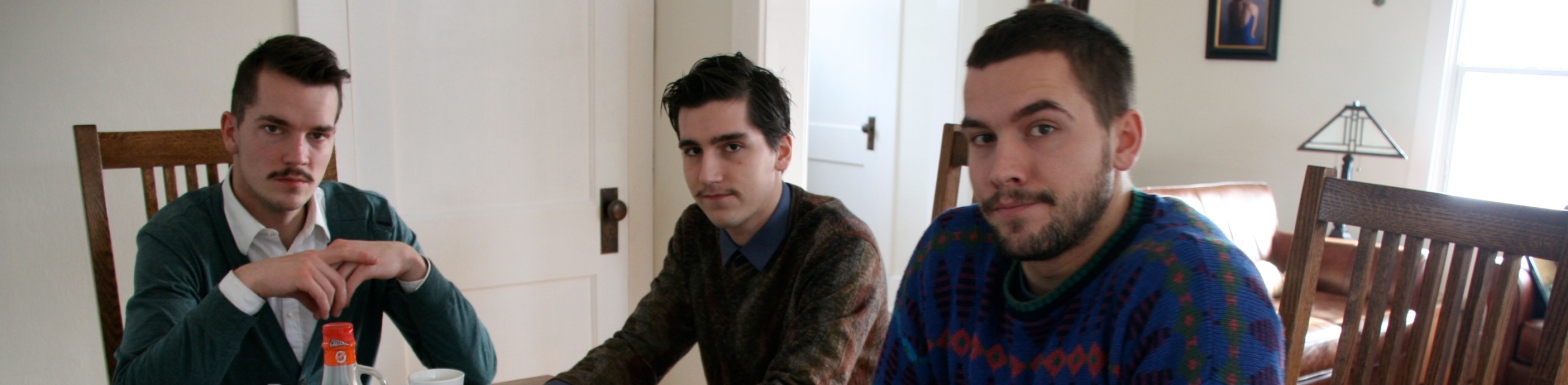
IMG_9147We arrived in Moscow to Christmas lights shining under the snow, the two cozy houses side by side, snug in their winter coverings. We rushed around getting things done and then my sister’s family left to spend the night out at the in-laws. Christmas breakfast for the rest of us was at my parents’ Moscow house at around noon. My IMG_9162brothers had begun their own tradition of wearing facial hair and old man sweaters, and they snatched up the bacon, drank some coffee, cranked the soundtrack of Gladiator and wrestled in the living room.

IMG_9165It has been a good Christmas so far. And I’m still looking forward to giving my nieces their presents.


IMG_9174

The Quaker and the homeschooler

In 2001, at the age of 20, I went to live in France for four months. I had taken one semester of French, and I opted to live with a French woman who spoke no English in the effort to force myself to become proficient. My program was part of the University Study Abroad Consortium, and so there were other students from around the United States. Most of them, honestly, seemed alien and ridiculous. They liked nothing better than to go out and drink beer, a privilege forbidden to many of them back in their own country. They talked about boring subjects like what they were going to be wearing that night. They stuck together and they spoke English, loudly, and then they would whine about the fact that some of the locals appeared to think they were rude.

Part of our orientation involved going to the castle in Pau, the same castle Henri IV of France had been born in. Henri IV was the son of Protestant firebrand Jeanne III de Navarre, and is supposed to have famously declared “Paris vaut bien une messe” when he converted to Catholicism in order to take the French crown. Afterwards, Henri IV provided the French with the Edict of Nantes in an effort to allow for religious freedom. It was in wandering through these halls that I met Meg, a tall girl from New England who was on the rowing team at her school. I had my little black notebook with me, and she wrote her host family’s number in it, and next to it, she drew a picture of the mountains. For hiking, she said. I want to go hiking.

We did go hiking. We hauled ourselves up the Pyrenees with a group of middle-aged French people, we stopped to have pasta and cheese and wine, and then we went down again. Another weekend, we went to a vineyard owned by a guy her host family knew, and for four hours we craned over, cutting clusters of grapes and putting them in buckets. We stopped for cake and new wine, which tasted like juice, and which we gulped thirstily. After our break, we continued in a happy fog, trying to keep up with a blind man who was cutting the grapes by touch.

At some point, we talked about the way we grew up. Meg was a Quaker, which, as far as I could tell, meant she was big on social justice and against anything wasteful. She had gone to Quaker music camp and to an all-girls boarding school, and she was almost reverently polite about making sure she never took the Lord’s name in vain in my presence, although I had never mentioned anything about it. I had been homeschooled until only two years prior to this trip, so she was the most liberal friend I’d ever had up to that point. But we got along well. We had both been raised with a certain simplicity and anti-materialistic worldview, and we would make dinner together rather than go out. At lunch time, we would find the free food together if it was to be found.

Screen shot 2012-12-07 at 6.06.28 PMAt the end of our semester, we took the train up to Paris and went to the Musée d’Orsay, walking along the quays afterwards. She flew back to the US the next day, and I went to spend Christmas in Germany. We kept in touch, though, and in the fall of 2008, we met up for a weekend in Chicago. It was about halfway between where we both lived. We saw the sights, wandered around lost for awhile, and stayed with friends so that neither of us were paying for lodging. “You’re my adventure buddy,” she said as we shared an expensive cocktail in a rotunda overlooking the city.

IMG_8736And, finally, in November, I went East and saw where she was studying to be a psychiatrist, staying in her cozy little apartment in Cambridge. She was on rotation when I arrived, so her fiance Jesse showed me around the neighborhood. He was very proud of the local library, and gave me a special tour of it. “And,” he said “you can print stuff for free here.” Jesse had also been raised a Quaker, and genuinely seemed to have a lot in common with Meg. Or Greta, as she was now called. Meg had been easier for the French to pronounce. Jesse asked what I wanted to see in Boston, and I said, oh, the history stuff, like maybe having to do with religious history. “Ah, yes,” said Jesse “You can see where the Quakers were hanged by the Puritans.”

“Really?” I demanded “The Puritans hung Quakers? But that’s so ironic, given that the Puritans came here because of religious persecution.” Not to mention, who the heck would want to hang seventeenth-century Quakers, who were dedicated to pacifism, the love of Christ, and simplicity?

Jesse nodded. “It’s kind of like the cycle of abuse. You act the way you’ve seen other people act.”

It started to snow, and I hunkered down in the apartment, drinking tea with Greta. I wondered if the reason so many people in New England are liberal has to do with the fact that they live in places where their forefathers were executed for not conforming to Puritan society. I sat on my heels in a straight-backed chair and asked Greta again about being a Quaker. She told me she liked sitting in silence with other people who spoke if they felt moved to. I think you would like it, too, she said. I nodded. I probably would. But I was leaving before Quaker meeting, so I would have to try it some other time.

The War on Christmas: Fight back, for Peace

When someone says something so subversive and offensive as “happy holidays,” they might as well be blowing up your church. It’s straight-up religious persecution.

I mean, I know, I know, the root of “holidays” is “holy days,” so in a way there’s still the acknowledgement of something non-secular there, but it’s too vague. Because Christianity is America’s non-official state religion, in America, during this winter season, we all need to clearly enunciate well-wishes to each other with the actual name of Christ in them. This will prove beyond any shadow of a doubt that we have within us the true spirit of Christmas and Christianity.

If you doubt me, look at the word Christmas. Its roots lie in Old English, and it means “Christ’s Mass.” When we say “Merry Christmas,” we’re all supporting the idea that we will be holding a Mass for Christ in celebration of his birth. That’s the true meaning of Christmas. Or, at least, it’s the true meaning of “Christmas.”

Now, you may not actually be Catholic, but don’t worry. As WASPs, we’ve totally co-oped the word to mean something else. We’ve embraced the pagan traditions of the winter solstice, and we have our Christmas trees. More importantly, we have our presents to put under them. We’ve fully embraced Capitalism as the savior of our nation, because only by spending tons of money on crap we don’t need can we boost the economy. We may go into personal credit card debt in the process, but that’s not a big deal. It’s all part of the plan.

So when someone says to us “happy holidays,” what they really mean is “I’m a stinking hippie who hates this country and everything it stands for, and I may also want to kill you.” Or maybe “I’m a Protestant who’s really picky about etymology.” Or even “I’m a Jew, and I celebrate Hanukkah, just like Jesus did.” Or, God forbid, “I’m an agnostic, but I want to let you know that I care about you despite our differences.”

Screw those guys. Enough is enough. We’re going to fight back. We must save Christmas by doing everything in our power to ensure that they’re miserable unless they use the same words we do. Saturate our airwaves, our Facebook profiles, our blogs (like this one) with messages about how they’re terrible people, those pretentious little sods, for not being just like us. If we torture them enough, surely they’ll recant from their heresy out of sheer exhaustion.

We will win this War on Christmas in the name of the Prince of Peace. Just try to stop us.

This Autumn in New York

The last time I went to New York City, I was two years old. I remember very little of it. The turnstiles in the subway, for some reason, stuck out to me. They were just as I remembered, except they were no longer at head height.

IMG_8902IMG_8873This time, the subway system was not fully functional. As I shuttled around the city of eight million, there were constant reminders that it was still stunted from the effects of Hurricane Sandy. Sandbags, trash piles still waiting to be picked up. Electronic notices about fuel restrictions. Maybe people looked more worried than normal, too; I couldn’t tell. In any case, they seemed relatively grumpy. It was all more dour than I was expecting.

IMG_8870You know how it goes: New York is sort of back there, tucked away in a corner of your mind in case you decide that you’re dying to become a starving artist or a Wall Street executive. However, even staying in a relatively spacious apartment (with four entire rooms) on the Upper West Side, I started to doubt this fantasy. It was a French girl’s apartment, and on her shelf I found a little book, nearly all pictures, describing the differences between Paris and New York. Croissant versus bagel. Demitasse versus venti. Pause versus go go go. I took a break from careening up and down the city to flip through the book, and I realized maybe for the first time that my norm, what I had absorbed from childhood in the rural United States, was in many ways closer to the French way of life than whatever this hyperactive city was offering. I had thought my love of France and Europe in general was due to my ability to adapt, but I’m not sure that’s entirely true. There are pockets in my own country that are less like what I am used to than what I can find on other continents, even given the language difference.

It wasn’t that I couldn’t adapt in New York. It was that I didn’t like adapting in New York. I saw people on the street as obstacles in my path, felt myself dodge around them, felt myself roll my eyes at every musician on the subway. I heard myself start to curse with alarming frequency. And I was tired. So much walking up and down those subway steps, so much waiting.

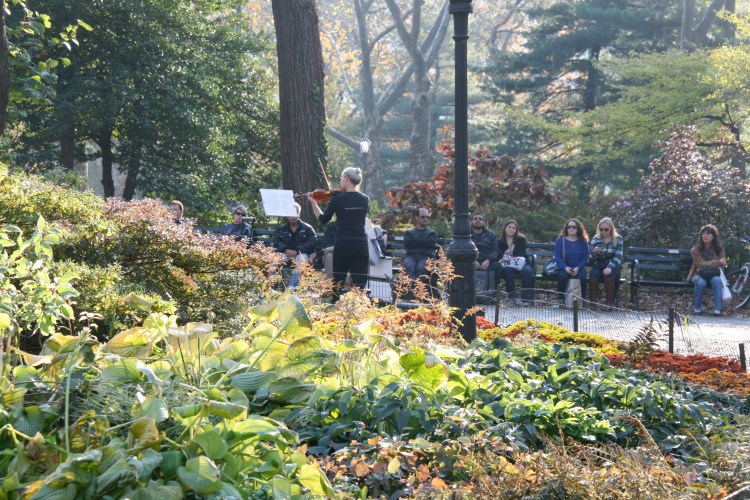
Central Park felt a bit more sane. There were still hordes of people there, but they weren’t scuttling along like so many beetles, all shiny and decked in black. They actually sat down for no reason in Central Park. And there were people bouldering on the rocks, their billowing chalk dust and dreadlocks making me suddenly feel like things might not be so weird here after all. There were children, and people selling music and jokes.

IMG_8770IMG_8789IMG_8824IMG_8850IMG_8797IMG_8865IMG_8917

Adventures in online dating: the power of anti-flirting.

I’ll admit it, I’m bad at flirting. I’ve never been able to do what those girls I grew up with did, with the downcast eyes lifting all starry and shining through carefully-blackened lashes, those girls who insinuated with the sweet high-pitched quaver of their voices that whomever they were talking to was so manly and important. Those girls whose chastely-covered breasts pointed pertly to the object of their attention like soldiers on standby. Those girls with the perfect hair and the inane, adoring smiles. Just thinking about trying to do that to get a guy’s approval made me want to throw up in my mouth a little bit.

I mean, I get why guys would like it. It’s nice to be flattered subtly and even not-so-subtly. It’s just that, personally, I’d rather bang my face into a brick wall than flatter anyone. Unless they deserve it. But then it’s not flattery, is it? It’s just a fact.

What I’m actually good at is anti-flirting. It’s like flirting, but the total opposite. You want to get a guy’s attention so you can let him know you’re not going to fall for whatever he’s pitching. Note that you should not do this unless it’s really called for. There’s no sense being a jerk about it.

So I recently signed up for a free online dating account, because, well, why not? Online dating sites, however, particularly free ones, seem to be a minefield of sad-sacks, morons and liars all looking for some easy action, with the occasional serious prospect thrown in. Actually, I’m not sure about the serious prospect part; I have yet to personally find one of those. However, I did receive this rather astonishing message the other day:

“I was hoping if we hit it off in our messages I could invite you over for a nice seafood dinner. I would catch lobsters myself, with my bare hands, from the nearest waters that inhabit them, which is the tank at the Red Lobster down the street. I would cook them for you in my kitchen…naked if you desire. Then we would indulge in the lobsters, along with any side dishes you would like, and a few glasses of wine from my cellar. Over dinner we could chit chat a bit, you could discover that I am more than just a guy with the physique of a greek god, and I could discover that you are a smart, sweet heavenly blessed beauty just putting on a calloused façade. If you enjoyed my company then perhaps we could do it again if not then you leave with a stomach full of good food when otherwise on a night like that you would throw one of your Lean Cuisines in the microwave and watch Blow.”

I wondered if the writer was attempting to channel Smoove B, and how much of a rip-off this communication was. I checked out his profile, which had about the same tone as this message and was actually quite amusing. Oddly or not, his photos did reveal the body of a Greek god, albeit one who possibly used Elmer’s glue instead of hair gel. His unkempt locks were ferociously pointy. So I wrote him back: “I am intrigued… more by the lobster than by the photos, since I’m wary of any guy who would pose headless, no matter how rocking his abs are. Your profile made me laugh. So is any of it serious, or is it all cobbled together for the personal amusement of some balding fat man?”

After sending this, I put his message into Google and found out that it was floating around the internet in various forms, and was notably found on a body building-related forum for picking up women online. Dang, I thought, I love a man who can use his web browser so effectively that he doesn’t need to do anything but copy and paste.

Soon after, I got another (mostly) stolen message from this dude: “I come up with the most random stuff, comes in handy when writing papers lol. Basically, the more we talk the higher your standards will be raised, and I don’t know if that’s healthy. I have a bad effect, if you get to know me more everybody else will seem bland and boring, and you’ll get ‘the hunger’ that won’t be filled unless you get your fix of me. You have had your opportunity to turn around now without taking the red pill and finding out things you might wish you could’ve been left without. Ignorance can be bliss, and I’m the wake up call, you sure you can handle that?”

This was getting old. Time to shut this yoked-out playa down. “See,” I replied, “the problem is, I know a lot about writing papers. I wrote them, I graded them, and now I edit them for publication. So I’m pretty good at using Google and finding manwhore.org pick-up forums that, however amusing, sort of kill the illusion of creativity. In the biz, we call it plagiarism. I compliment you on your six-pack, though, unless that, too, is plagiarized.”

For the record: if any other women are directed to this page after Googling the above messages, feel free to plagiarize that line about plagiarization. Go, and anti-flirt with my profound blessing.

Thanksgiving weekend

Between the two houses, because my parents bought a place next to my sister, there is a lot of space to sleep and to cook. So we’ve started having holidays there rather than up on the farm, what with its grand total of three bedrooms. Well, fourth of July… that’s different, because you can sleep outside, under the stars, as long as you’re not afraid of cougars.

Thanksgiving this year was a relatively intimate 13 people: 11 adults, a baby and a self-described “big girl” who really liked her grandfather’s hors d’oeuvres invention of pureed smoked salmon with cream cheese and roasted pepper.

At one point I looked over and saw Daniel holding his niece Elaina, who looks a lot like he did when he was a baby, as evidenced rather picturesquely by the adjacent painting of baby Daniel being held by his Dad.

There was also much drinking of coffee and watching of football, particularly the Ducks-Beavers game, for which everyone (even the baby) got decked out in Beaver gear.

A taste of Vermont

I’m going to be in Vermont for an evening and a day, which isn’t much. Joel picks me up and I tell him we should stop by the grocery store for flour so I can make artisan bread. He’s game. Halfway through scouring the unfamiliar shelves, I ask, “hey, you got any meat?”

“What kind of meat?” he says.

“Any kind,” I reply. “I’ve been staying with vegetarians.”

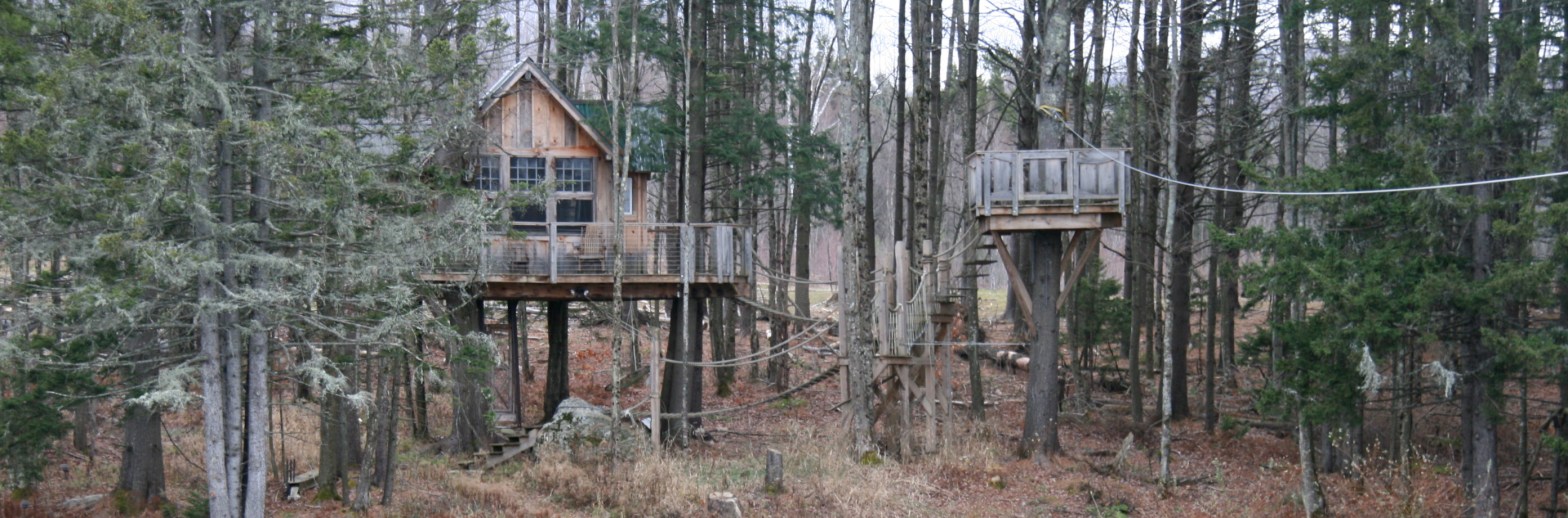
This statement puts Joel in the mood for a big slab of steak, so we track down some Angus tenderloins and local bacon, take it back to Joel’s cabin in the woods, flip on some folk music, and heat up the skillet. Joel realizes that we have nothing to eat with the steak, but I say no problem, and pull two Asian pears from my suitcase, purchased the day before at a Whole Foods in Boston. I tell him I’ll sauté them in the juice from the meat. Joel wraps the steak in bacon and then realizes he has no toothpicks. So he goes to his woodstove and finds a thin spear of hemlock among the kindling, and makes two long toothpicks with his knife.

“Hang on,” I say “Hemlock, like what poisoned Socrates? Is that safe?” I feel vaguely that this must be incorrect, so I Google hemlock and discover that the conifer is entirely different than the poison hemlock plant. So Joel uses his handcrafted toothpicks to hold the bacon in place, sears the steak while I slice the pears thin, and then he pops the meat in the oven, preheated to about 450 degrees or something. I dump the pears in his still-sizzling skillet, turning them so they caramelize a bit but don’t get too soft. Joel takes the steak out while it’s still quite pink. Dinner’s ready in 15 minutes, and it’s delicious. The cut of steak is juicy and tender, flavored through with the bacon, and the pears are just as I’ve imagined them, savory-sweet and delicate.

“I’m pretty sure this is the best meal I’ve eaten at home in the last year,” Joel says. “Maybe ever.”

“It was pretty easy,” I point out. “You should cook more often.”

After dinner, we throw some hemlock on the fire and stay up late reminiscing about our high school days. Or, more accurately, homeschool days, because we were homeschooled within a few miles of each other in Northern Idaho. At one point, during a lull in the conversation, I start picking through the books on Joel’s coffee table to see what he is reading (or, really, if I can find anything I want to read) and suddenly spot my father’s handwriting. “Hey!” I say, and hold up the book.

In 1997, at the age of 19, Joel set out for a cross-country motorcycle trip, and my Dad gave him this, taped so it would not get dog-eared. Joel says he read it on the steps of a brick house in Richmond, Virginia. And then in 2010, he found it in a box of old books. Ironically, we had just started talking again kind of out of the blue after he e-mailed me to ask if I was OK after my divorce. And although the title has nothing to do with that kind of divorce, it all makes me smile as I lean into the heat of the hemlock fire in Vermont. I am far from my hometown, but I feel at home, and very well-fed.