Sousaphones and gravestones

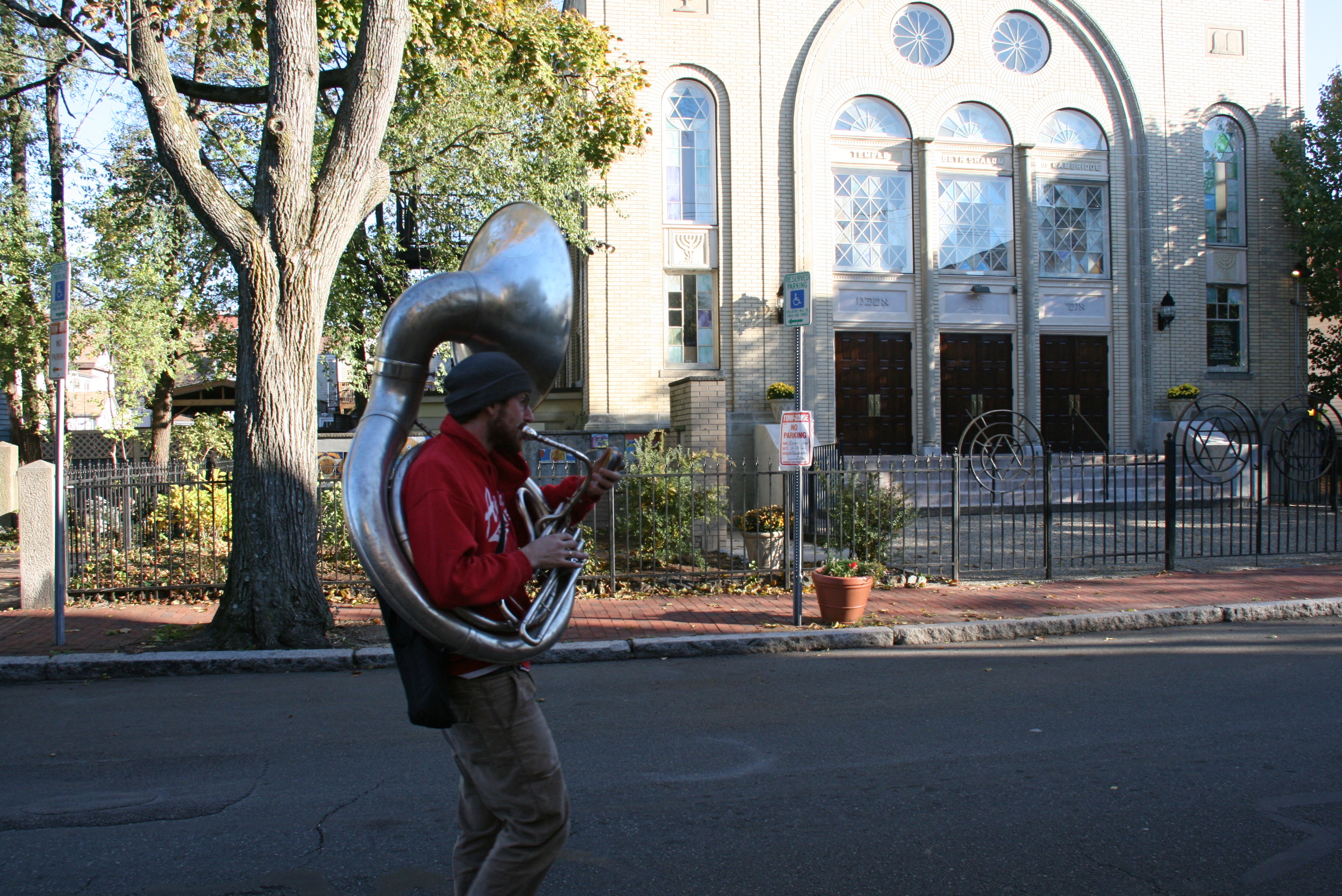
ImageJesse, my friend Greta’s fiance, was leaving the house the same time I was. He was on his way to vote. With a sousaphone. “For the line,” he said. “In case I have to wait a long time.” He also brought along a trombone in case he ran into someone who could play and wanted to jam with him. As we walked, he looked up patriotic melodies on his smartphone and played them. The Battle Hymn of the Republic kept me company most of my way to the subway.

Then I took the red line to Boston Commons and started out on the Freedom Trail, going past the Old South Meeting House, the organizing point for the Boston Tea Party, and pausing to consider Paul Revere’s house. But I spent most of my time in the King’s Chapel Graveyard trying to decipher the names of unknown people long dead and gone. Somehow, it seemed like a fitting way to spend the election day.

ImageImageImageImage

New Jersey inventory

Yong gets a call from his parents asking if he can come help them clean up their dry cleaning business in Jersey City. They still don’t have power, and the water, which was over the countertops, has receded. Their computers are still fried, though; it’s going to take a few weeks to get anyone to pull the customer data from them, and it’s going to cost them up to $1600 just for the data. They need the data before that, and they’re don’t want to pay that much.

Yong’s roommate Patrick and I both say we want to help, so we pile in the car Saturday morning and drive up to Jersey. Yong has written out some Korean phrases for me to say because his parents’ English is limited. I have faithfully transcribed these into a script I can understand using the international phonetic alphabet. I notice that Yong is saying different syllables differently, depending on if he’s using them in context or saying them one by one, and this makes sense when I figure out, by staring at the Korean symbols for a couple of minutes, that Korean uses the same letter for certain voiced and unvoiced consonant pairs, such as [g] and [k], and that their voicing depends on their position in a word. It’s similar to how in American English, the two ts makes two different sounds in the word total. You’ve probably never noticed that, and Yong didn’t notice the Korean thing either until I pointed it out.

However, despite all my linguistic efforts, I am too tired from staying out late at the Ranstead Room to practice these phrases on the way, and sleep instead. Anyway, I freeze as Yong introduces me in English, because it seems weird to deliver a formal speech in Korean in the entryway of a damaged dry cleaning business. They have the door propped open, and cold air circulates over the lingering debris on the floor. I get as far as anyung haseio, and smile in embarrassment. They give me a pen and a notebook, and position me to start writing down the contents of dry cleaning tickets at the beginning of what looks like a small warehouse full of clothes. Location, ticket number, last name, first name, telephone number, number of items, price. I smooth out crumpled tickets, squint my eyes in the gloom, shift from one foot to the other in the cold. Yong’s dad smiles when I finish my row quickly. He tries to make conversation about my experience on the Bike the US for MS tour, where I met Yong and Patrick, but I have to try to correct him to say I didn’t actually take part in the tour. I met them while they were on a rest day in Sandpoint. I don’t think he understands me.

Yong and Patrick are doing inventory of the top tier of clothes, balanced on hanging rods that look dubiously thin. However, the rods have got to be somewhat sturdy if they’re built to hang hundreds of pounds of clothing on them. Because there’s no electricity, we can’t just run the conveyor belt that would bring most of these down for easy viewing. Yong’s brother Albert is on the phone, trying to get information about help from FEMA, small business loans, insurance. They’re not sure if their machines are damaged, but they do know they’ll have to re-clean a good portion of the clothes, and meanwhile, they’re getting no income.

Every so often, people wander in and try to pick up their dry cleaning. They’re told there’s no power and to come back next week.

We break for lunch and then leave for dinner. Yong’s parents treat us to Korean food in a little strip mall, which is spicy and succulent. I look out the window during the drive over, and every few houses, a tree has toppled over, its roots still attached to wet masses of soil. Some are hanging over power lines. On the turnpike, we had passed a line of power trucks with license plates from Oklahoma and Ohio, which did not have to abide by the area’s fuel restrictions. Electronic signs over the turnpike all proclaim that gas is available for odd-numbered license plates only. The lines to the gas stations stretch for a mile or so, and numerous police cars flank the stations in the event of a riot. Yong looks at the smog-free sky. “I don’t think I’ve ever seen it so blue here,” he says.

Then we head back to Albert’s apartment with two new computers, purchased, Albert says, from their dry cleaning network, and installed with the dry cleaning software they had on the old computers. The software is old and clumsy, and even on two computers, it takes everyone until 1 a.m. to input the data from around 2,000 tickets. And that’s about half of the clothes in the store.

Tasting Philadelphia for under $30 per person

Since I’ve gotten here, I’ve eaten a lot and drunk a little. Philadelphia is nice that way because it has about the same gastronomic variety and quality as New York, but it’s cheaper.

On Thursday night, I went out to Marrakesh, probably Philly’s best Moroccan restaurant. You turn down a side street and knock on a wooden door, and they let you in, seat you on low couches, and then, for $25 (before taxes or tip), you get a seven-course meal. First they come by and wash your hands with rose water, pouring the fragrant liquid from a warm kettle in thin streams. With rare exceptions, you then eat the seven courses with your hands, helped along by flatbread. It’s a little on the messy side, so they give you an entire towel as a napkin.

I went with four other people, all of whom had brought their own wine, which was apparently allowed, and the communal set-up helped the conversation along. Maria, a beautiful woman originally from Colombia, regaled us with details from her research on the development (or lack thereof) of infants who were breastfeeding versus those on formula. “The ones on soy formula do the worst,” she said.

Maria had recommended the Latin-Caribbean Mixto with the remark that to get any more authentic, you had to venture into the ghetto. I was starving when we got there the next evening, so we ordered the Plato Mixto as an appetizer — a platter that basically contains a taste of everything: fried plantains, chorizo, shrimp ceviche, empanadas, and various fried meat-pie-things. By the time I was finished, I wished that I hadn’t ordered a main course. And we had split the $24 platter equally between two people. I would have been quite content with a salad (or margarita) afterwards, but I ate part of the main course (the orchid, notably) and then took the rest away for lunch the next day.

By this point, I was considering the fact that I was probably going back to Idaho a size or two larger than I had arrived, unless I toned down the quantity of food I was eating. So the next night, we went to tapas at Tinto. We ordered a plate of Basque cheeses, bites of duck confit, figs wrapped in serrano ham, sauteed wild mushrooms, and the evening’s addition to the menu, an excellent foie gras and pheasant ravioli, for less than $30 per person.

Afterwards, we ducked down this little nondescript alley into a nearly-unmarked door to try to get a seat at The Ranstead Room. It was 7:30, so we figured we had a good shot, but the hostess shook her head at us. We went down the street until she called to invite us back, and we returned to be ushered into what looked like a classy speakeasy. It was tiny, and dimly lit. The cocktails, none of which I had heard of, were all $12. And either they were bad at facilitating turnover, or they were more exclusive than they needed to be, because there was an empty table behind us.

We got the tuxedo 2 with absinth, and a dominicana made with aged rum. Here’s the thing about this place: you’re supposed to order the bartender’s choice, so we did that too, coming away with a variation on a whiskey sour, complete with a silky-smooth eggwhite finish, and a Fancy Free, a boozy drink made with bourbon. The cocktails were not very big, but they were still worth the price. They were that good.

Halloween sightseeing in Philly

It may or may not have been appropriate that the first thing I looked for on my Halloween visit to Philly was Benjamin Franklin’s grave. I wasn’t about to pay the $2 entrance fee into the Christ Church cemetery — there are several things that should never require money, and visiting a church and visiting a cemetery are two of the most prominent — so I observed from between the iron bars that apparently had been inserted into the brick wall for just this purpose. I’m not sure if it was the weather, the date, or the actual sites, but as I wandered, many of them seemed a bit depressing.

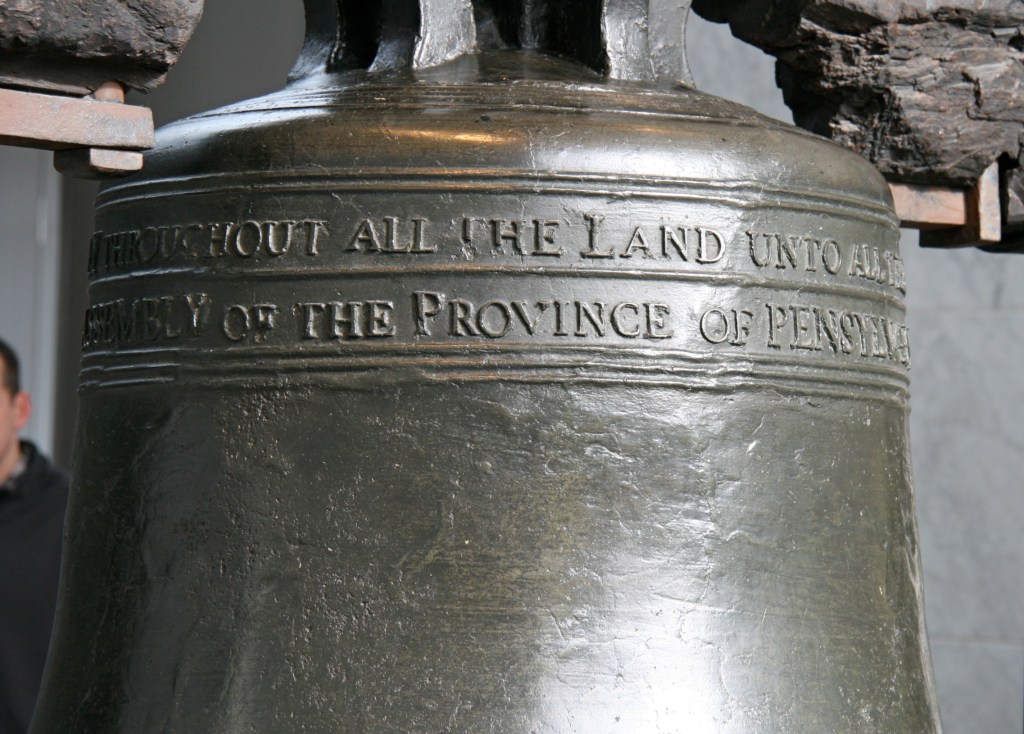
Take the Liberty Bell, for example. Inscribed with the words “Proclaim liberty throughout all the land unto all the inhabitants thereof,” from Leviticus 25:10, the bell cracked the first time it was ever rung in Philadelphia, and had to be recast. Symbolic, perhaps, given that “liberty for all” was certainly not a reality in 1752 when the bell was commissioned, and, for this reason, the bell and its message were metaphorically adopted by the abolitionist movement. 

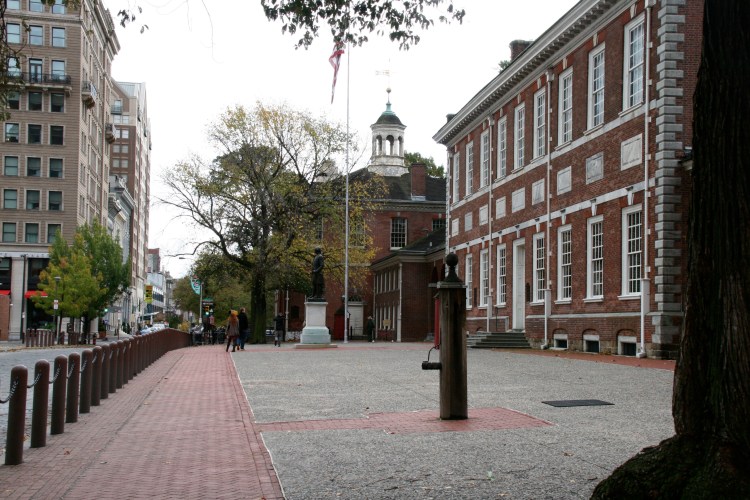
Independence Hall was full of empty chairs and shadows. It was odd, too, to see the drafts of documents, with their crossed-out passages and notes in the margins. The founding fathers abandoned some of the more politically charged damnations against the King of England in the Declaration of Independence, including the remarks regarding his support of slavery

In Philadelphia after the storm

My tense of timing has thrown me into more than one drama in my lifetime. In this case, I had booked what turned out to be one of the first non-delayed flights into Philadelphia months in advance of Hurricane Sandy. Philly was hit much more mildly than some of the surrounding areas, and as the plane’s wheels touched down on the tarmac at 11 p.m. Tuesday, I pressed my nose to the window and saw gentler weather than I had left in Idaho. The storm had moved inland, and it was quietly misting.

The friend who was picking me up filled me in as we rolled my suitcase to his car. There was minimal damage in the city; a few trees and branches down, but it was nothing compared to what had happened over the Delaware river in Jersey, not far away. His parents’ dry cleaning business was destroyed, he said. They found flooding above their counters, and the clothes, as well as the computers keeping track of who the clothes belonged to, were soaking wet. “The computers are totaled,” he said.

“I don’t know,” I said “If you take it to the right person, they should be able to recover the data. Like, someone who works for… the government.” I realized after saying this that I had no provable basis for the statement, any more than I had such a person in my back pocket. But I was still pretty sure it was accurate. Yong brightened up and said he did know a hacker who had “almost” worked for the CIA, and maybe he could help out. Slightly more cheerful, we made our way into the city, parked his car a mile from his house (quite literally) and slept.

The next morning, Yong had to go in to work as a mental health therapist in Camden, New Jersey, which apparently is the most dangerous city in the nation. “Don’t come visit me at work,” he said. I had other plans, and so for about three hours this morning, I wandered around the Old City. I could still see very little evidence of the hurricane, other than the overcast sky, a proliferation of leaves on the ground, and some scattered clean-up crews working behind yellow tape that re-arranged the tour of Independence Hall. There were not a whole lot of tourists, either. I stayed close to a pod of French schoolchildren who posed in front of the Liberty Bell and then sat blankly through the lectures on the signing of the Constitution. They missed the tour of the Congress Hall, however, and thus the prominent (replica) portraits of Louis XVI and Marie Antoinette. “That’s on purpose,” the guide told the group of seven on the noon tour. “The French monarchs were the first to support our nation. So the founders kept their portraits in the committee chambers.”

By the time I was done, I was starving, so I found the nearest cheesesteak food cart. The cook was smoking, but he stabbed his cigarette out as I approached and slapped a mess of onions, meat and cheese onto the grill. I said yes to everything, salt, pepper, and ketchup, and regretted it as I sat on a wooden bench outside Independence Hall and downed the thing. I should have known better than to order anything edible in a tourist district, particularly with extra salt.

Translators without Borders and changing the world

Sometimes I get really discouraged about all the stuff that’s wrong with the human race… the arguing, the senseless violence, the control-freak posturing and the corruption in every direction. Why don’t people see how stupid all of that is? Why don’t they listen more, put themselves in the shoes of their fellow human beings, try to do better?

Well, the thing is, they do. For every act of senseless violence, there is an act of selfless love. You know, the mom who gets up to take care of her crying baby — not because she has to, but because she wants to. The man who stops to change a stranger’s tire. The couple who offers hospitality to a foreigner. Naturally, the larger and more public any of these acts get, the more likely it is that corruption will find them, too; that they will be done for show rather than for mercy. And perhaps it’s impossible to really and truly do anything selfless. As they say, virtue is its own reward, and that great feeling you get when you’ve done something good is a measurable emotional return on investment.

But I’ll take it. And this fills me with hope. I’ve been tracking an organization called Translators without Borders since before its inception — it was a French company before it became a US-based nonprofit. For a long time, it ran in the background, without any contributions other than the time of translators and project managers. Over the years, it donated about $1,000,000 worth of translations to nonprofits such as Doctors Without Borders, and then the Haiti crises happened. Because I’m the managing editor for the industry magazine, I got carbon copied on a whole lot of e-mails that suddenly surged between CEOs of translation service providers, translation tool vendors, web-based translation platforms. And it was like, overnight, almost, the thing blew up. The industry coordinated itself with zero outside donations; it set up a web-based platform where translators around the globe could log on and use what they were good at to help out. This seemed incredible to me. And the momentum continued; using the same (improved) web platform, translators can still log on and find life-changing texts to translate. It’s almost like a dating site for NGOs and translators.

But here’s the thing: this only works with languages for which there are established translators, and for which there is a mode of dissemination in place. You can make health posters, for example, in English or French, but what about the first languages of the diverse people groups of rural Africa or Southeast Asia? As it happens, they often have health materials available, but they’re typically not in minority languages. Given just how understaffed most of these regions are in terms of health care professionals, this means that people may have no way of knowing what to do when they get sick. And this means that up to 90% of childhood deaths in these regions are totally preventable.

Yeah, that’s right. 90%. The most common killer of children in certain regions of Africa is diarrhea. A high percentage of mothers in these areas think you’re actually supposed to withhold liquid when your child has diarrhea. And their babies die with everything they need to survive — water, sugar, salt — in the same room.

Once Translators without Borders figured this out, they started a translator training program in Kenya. Some of the responses from translators can be found here. And, in conjunction, they collaborated on what they call the 80 x 80 project: simplify the 80 most accessed medical articles into easy-to-understand English, and translate them into 80 languages. I hosted a session last Thursday at Localization World where Val Swisher of Content Rules described how her content-creation company has been re-crafting the articles, which are vetted by physicians and then uploaded onto Simple English Wikipedia. Already, translators are transferring these to crucial minority languages. But, of course, this would be pointless unless minority language speakers have some way of accessing the articles. And here’s another interesting thing: most of the developing world has access to mobile phones, so the 80 x 80 project has convinced mobile phone companies to allow individuals in the developing world to log on to Wikipedia free of charge via mobile.

Right now, Translators without Borders has one paid employee, and is funding translator training. Everything else has been done by volunteers. I’m one of them — and I’m not a translator. I’m an editor. So I edit their newsletter, which is something of a work in progress. And if you want to volunteer as well, you probably can — from wherever you are in the world.

In honor of my Grandfather

My Grandfather, John Norman Botkin, died 11 years ago, on September 21, 2001. I was in France — I had moved in with a French woman only two weeks prior after studying French for all of four months, and was dazed from the constant barrage of this largely-unknown language, from the sudden uncertainty of 9/11, and everything else that went with that. I was unable to go back for his funeral. He was buried with military rites.

Over the years it has occurred to me that although I was around him often throughout my childhood, I knew so much less about him than I wanted to. He was born on May 1, 1918, grew up during the Depression “without a penny,” according to my Grandmother, and his father was a street preacher for awhile. I knew he was a soldier — an Army man; he was in the Corps of Engineers in WWII and led troops as a Major in Korea. Perhaps for both of these reasons, he could come off as stern, and he worked hard. He was fastidious about correcting my grammar and word choice growing up, and woe unto you if you said “guy” in his presence. “They are not guys,” Grandfather would say “guy is a derogatory reference to Guy Fawkes.” But he could also be quite jovial. One of my earliest memories of him took place on his porch swing, and as he sang me “Rock a Bye Baby,” his end of the swing fell to the ground. He began to laugh. “Down will come Grandfather, cradle and all,” he said.

He took a lot of pills for his health — heart medications, cholesterol medications — after his heart bypass, which happened when I was still quite young. He was a larger man, and he enjoyed his hamburgers even after the bypass. For my fourteenth birthday, he bought me a subscription to National Review. I was a little in awe of him. He’d gone to Harvard. He’d studied law there, but decided that he could not bring himself to defend guilty men, so he switched schools and emerged a geophysicist instead. He said he never took notes at Harvard because he was working too hard outside of class to support himself. “I didn’t have time to study,” he told me “So I just paid attention.” Years later, when I went to college, I remembered this, and in between taking notes I would just stare intently at the professor and attempt to memorize every word. It seemed to work pretty well, actually. Perhaps we shared an ability to remember large amounts of spoken data, to store it and reassemble it when the time came. He graduated in 1942 with a slew of extracurricular activities on his roster, including debate and writing. That’s his senior picture. The day he graduated, he was drafted into the Army.

He met my Grandmother, Halcyon Heline, during the war, and she started writing him letters. For the longest time, he did not know the extent to which she’d written other soldiers letters. He discovered it one day when we were eating a hamburger together. Grandmother’s brother was in the war — was killed in the war — so she wrote a lot of letters to try to cheer the men up. She was charming and vivacious, the daughter of a natural diplomat, so I’m sure she succeeded. Grandfather chucked at this revelation. “I thought I was the only one,” he said.

“I knew your Grandfather would make a good father,” said Grandmother. “He was a good man.” So on April 10, 1952, at the ripe age of 31, she settled down with him, and they had four children in quick succession — so close together they had to hire a nanny. They often lived where the oil was, spending time in Iowa on numerous visits back to the Heline farm. They eventually moved back to Tulsa, Oklahoma, into the house my Grandfather was born in.

They sent their children to public schools in Tulsa, and this is where things start to get a little bit controversial. According to previous conversations with my Dad, school was a time for putting grasshoppers in the fan and exploding their guts all over the classroom because there was little better to do. According to my uncle Geoff, growing up attending public schools made him into a Marxist — I assume that’s what he means when he says “I was trained to be a compliant, rational Marxist. I was recruited to be a self-conscious supporter of a social order that was Marxist. This required my willing trust in the state as a utopian savior and antagonism to the God of Christendom,” since you could not possibly assert that my Grandparents or any of their friends were Marxists. As far as the wishes of my Grandfather were concerned, the four children were trained to be conservative, God-fearing Christians, although they were apparently not forced to go to church every Sunday. I suppose my uncle might believe that the fact that he learned math from teachers whose salaries were paid by taxes means that he was implicitly inculcated with the idea that taxes should pay for education — while perhaps concurrently assuming that taxation (or public school) is more or less Marxism. Or perhaps that’s a veiled reference to the fact that he grew up reciting the Pledge of Allegiance. Or perhaps, unknown to any of the rest of my family, he really did toy with the idea of Marxism in high school or college. He attended high school in the late 1960s, shortly before his move to Norman, Oklahoma, and personal conversion to Christianity in the early 1970s. I suppose it’s entirely possible that he knew people who talked about Marxism during this timeframe. Whatever the case, it would be a great blow to my Grandfather to have been lumped in with a supposedly-Marxist upbringing, which is what some people seem to assume about him based on my uncle’s assertions.

In the interest of American marriage

I had already been thinking a lot about marriage, and what it does and doesn’t mean legally, so the news, ferried to my unwitting eyes today by the magic of mutual Facebook friends, that my ex-husband got married in an “impromptu” wedding this last weekend sort of fit right into that mix.

The thing is, I’m obviously not a huge fan about how he behaves (or at least did behave) in a marriage, but I still support his right to get married. I support his right, as a man just shy of 41, to marry a girl in her early 20s. I support his right, as a deputy prosecutor, to marry the daughter of the county Sheriff. I don’t have to think it’s a great idea to support that right. I can even cringe at the thought that in this marriage, he may be insinuating himself into a position of greater political power over a town he has already not had a great record with, and still totally support his underlying right to marriage.

I support people’s rights to hypocritically get divorced and remarried as many times as Rush Limbaugh or Newt Gingrich. I support the right of murders, thieves, and those suffering from suicidal tendencies to enter into legal wedlock. I have to, if I believe in personal liberty and the US Constitution. And you know what? All of these people can get married. Convicted pedophiles can get married in the United States. Sociopaths can get married in the United States. Pathological liars can get married in the United States. You can marry your ex-wife’s daughter, your father’s ex-wife, your foster sister, and so on and so on. People of different races and cultures may marry one another. People of different faiths may marry one another. Really, any two consenting adults that are not legally married already can get married, as long as they’re not of the same gender or too closely related — and even that depends on which state you’re talking about.

This is because in the United States, marriage is not a sacrament. It is about as close as you can get to a fundamental right, a contract of sorts between two people, with legal ramifications. The United States is not a Christian nation, and I would argue based on the very first words of the Bill of Rights that it was never intended to be. The Founding Fathers were attempting to shape a nation unlike those that the American immigrants had so recently come out of: ones in which, in the name of Christianity, Puritans, Anabaptists, Catholics, Jews, those suspected of witchcraft and so on were slaughtered for heresy — sometimes in religious wars, sometimes in the public square. In the centuries and decades just previous to the founding of the United States, the drawbacks of forcing citizens into one religious mold would have been quite apparent. Hence, I sincerely doubt it is accidental that these first words run “Congress shall make no law respecting an establishment of religion.” This was meant to be a safeguard against anyone who came to power and wanted to enshrine the tenets of any particular religion (or religious sect) into law, be that Mormonism, Islam, Christianity, or Hinduism; be that Catholic, Baptist, or Neo-Puritan.

But, because of the second clause of the Bill of Rights, people of all of these religious persuasions are free to worship as they please. They are free to perform, or not perform, religious marriage ceremonies that are considered sacramental by their congregants. They are free to limit these ceremonies to non-divorcees, or virgins, or white people. Many churches require pastoral counseling before they will marry you. Some require a statement of faith. They can require that. That’s their right.

And although these two clauses have created a certain amount of tension over the decades — after all, they cover freedom from, and freedom of, religion, which are vastly different in focus — they are both necessary for a nation that adheres to personal liberty. And if that is not the nation you want, then you’re looking in the wrong place.

In the interest of Biblical marriage

Are you disgusted by the thought of two obese bodies colliding during coitus? This is a natural reaction. We should all be disgusted at this sick perversion. God created us all small to begin with, and to exchange our small frames for something that will make us unhealthy, that will encourage others, including the children produced by said coitus, to follow in the footsteps of obesity, is a slap in God’s face. In the Bible, God warns us time and again against gluttony. The man who stored up his harvest in the barn in order to consume it was struck dead — this shows that gluttony was a capital offense in God’s eyes. In fact, the Bible is full of examples condemning gluttony, even to the point of death. Proverbs 23:2 says “And put a knife to thy throat, if thou be a man given to appetite.” The story of Sodom, of course, is the clearest example of this. The Bible states that the entire city was destroyed due to the sin of “pride and fullness of bread.” Biblically, we should really be calling fat people Sodomites.

Science has shown us that the human body simply cannot support an excess of flesh for an extended period of time; being fat is destructive. Someone who is 40% overweight is twice as likely to die prematurely as is a normal-weight person, and overweight people are much more prone to have serious health problems than thin people. Those that blaspheme God’s law by being gluttonous must expect to have the effects show clearly in their bodies. Frighteningly, studies have shown that those born to obese parents are far more likely to be obese as well. Teens who think they are overweight are more likely to try to kill themselves. Hence, children of obese parents are all but doomed to a lifetime of health problems, societal problems such as bullying, and ultimately, sin against God.

Thus, in the interest of public safety and the sanctity of God’s natural order, I call on our legislatures to make fat marriage illegal.

There are those who would protest that preventing fat people from getting married would be an abridgement of their civil rights. This is not so. All fat people may get married, just like anyone else, after they have been cured of their fatness. They may then marry another non-fat person.

Curing fat people has been proven time and again to work. Yes, there are those of them who rebound. Yes, there are those of them who are miserable. Yes, it does seem to fail a lot. But the cure exists. It is possible to refrain from being fat. I have firsthand experience with this, having refrained from being fat my whole life.

This is how refraining from being fat works: if you are prone to fatness, and you see a food item that you really, really lust after, you just don’t put it into your body. Not ever, not even one time. Simple!

I know, some people claim that there are genetic reasons that some people are fat. This might be true. Or it might not. It’s debatable. In either case, however, the previously-mentioned method of refraining from being fat should work to prevent all external manifestations of fatness.

People have asked whether overweight individuals should have the freedom to be fat if they want to be. After all, they are adults, and given our Constitutional right to freedom of religion, they are not supposed to be required to follow Biblical mandates on morality such as the injunction against gluttony. Well, yes, that’s true, but the thing is, they will have to follow Biblical principles if enough people try to take make them. I mean, the Constitution can be changed. It’s all for their own good, and we already have lots of injunctions against things the Bible finds abominable, like murder.

I realize that the Bible never actually objects to fat marriage. However, since it decries gluttony in general, it’s safe to say that minor detail was sort of was left out on accident. Also, keep in mind, in ancient times, fat marriage was all but unheard of. You couldn’t be fat when you were running around the countryside fighting your enemies. Society wouldn’t have allowed for it. Traditional marriage is thin marriage, not fat marriage, and not only in Biblical societies. It’s the case worldwide. After all, as my Korean friend pointed out only this afternoon, “[Koreans] think if you are fat, you can’t get married.”

Koreans really have the right idea here. If you start to doubt it, think once again of those quivering, cellulite-laden bodies, the furniture sagging under their weight, their breath wheezing from compressed windpipes, their bodies wafting stench from whatever is trapped between their fat rolls. The revulsion you feel is noble. It is righteous. Shudder, and make the right decision.

The little girl and the good mans on the roof

My niece is getting to the age where she can tell stories. Sort of. Her first attempt was: “One time, a little girl, a man, and a lady. Summer.” And along with that, she’s sorting out who is a good guy and who is bad guy, which basically at this point seems to correspond to how much she likes them. She whispered to me the other day that a couple of teenage girls who were being loud were “bad ladies.” And on Sunday morning, when I came downstairs and found her proudly eating Fruitloops, she told me that “Papa and Loulis are happy on the roos.”

“They’re happy on the roof?” I asked “Why are they happy?”

Because, she said, “they’re good mans. They’re persons.”

I’m not sure if they are good because they’re happy, or they’re happy because they’re good — or if they’re just happy because they’re persons — but after she got dressed I took her outside so she could investigate. Papa, which is what she calls my Dad (her Dad is Daddy) showed her what they were doing. Because, no doubt, he is a good man; a happy man who is willing to pause to explain roofing to a little girl.

That made her pretty happy too.